
Family Violence and Abuse
Chapter contents
- Background
- Definitions of family violence and abuse
- Family Violence Cross-Examination Ban and Scheme
- Assessing contributions – impact of family violence: June 2025 amendments to the law for married couples relating to family violence
- Assessing current and future needs: June 2025 amendments to the law for married couples relating to family violence
- What about pets? Companion animals and family violence: June 2025 amendments to the law for married couples
- Less adversarial approach: June 2025 amendments to the law for married couples
- Family violence and costs orders
- Family violence resources
Background
A significant number of cases in the family law courts involve allegations of family violence and abuse.
The Explanatory Memorandum for the 2023 Family Law Amendment (Information Sharing) Bill states "Court data shows that family violence was alleged in 80% of matters filed in the Federal Circuit and Family Court of Australia during the 2021-22 financial year, with 66% of matters involving disclosures of four or more risk factors (such as family violence, child abuse, mental health issues or drug, alcohol or substance abuse issues putting a child at risk)".
Definitions of family violence and abuse
The Family Law Act 1975 (Cth) (“the FLA”) and the Family Court Act 1997 (WA) (“the FCA”) definitions of family violence and abuse need to be carefully considered when assessing:
- the appropriateness of compliance with pre-action procedures and whether an exemption is applicable,
- the appropriateness of referral to Family Dispute Resolution (FDR) and which type of FDR is suitable,
- how property should be divided post-separation (impacting the assessment of contributions and current and future needs),
- any spousal maintenance application,
- whether the family violence cross-examination ban applies.
Family violence
Section 9A FCA defines family violence as:
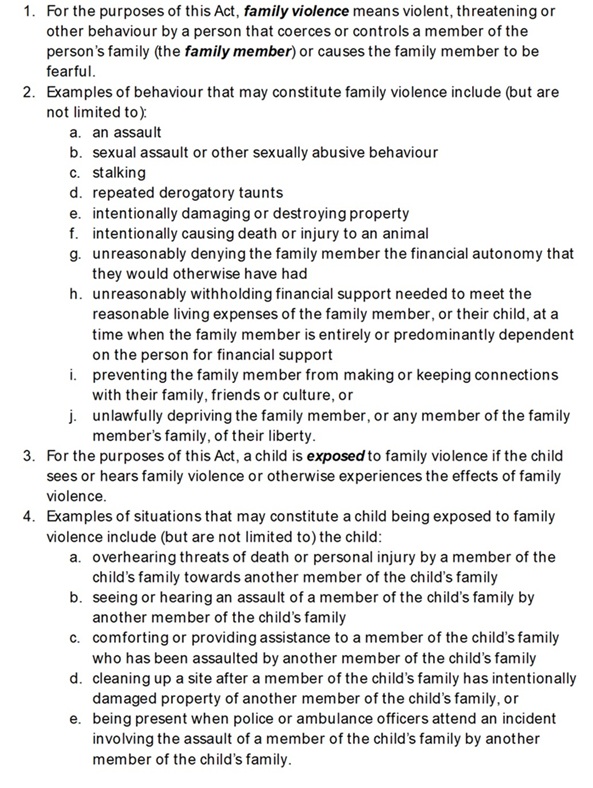
The Family Law Amendment Act 2024 (Cth) has amended and expanded the definition of family violence in s 4AB FLA. See new subsection 2A in bold below:
- For the purposes of this Act, family violence means violent, threatening or other behaviour by a person that coerces or controls a member of the person’s family (the family member), or causes the family member to be fearful
- Examples of behaviour that may constitute family violence include (but are not limited to):
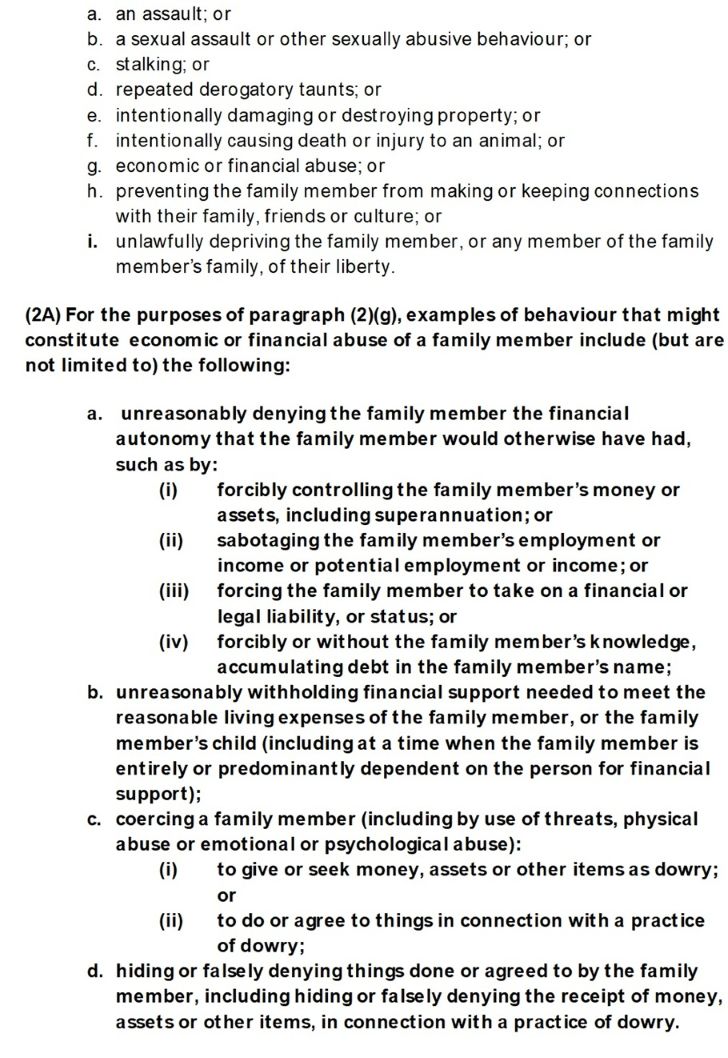
- For the purposes of this Act, a child is exposed to family violence if the child sees or hears family violence or otherwise experiences the effects of family violence.
- Examples of situations that may constitute a child being exposed to family violence include (but are not limited to) the child: (as above in FCA).
The Full Court of the Federal Circuit and Family Court of Australia in Pickford & Pickford [2024] FedCFamC1A 249 considered the s 4AB FLA definition of family violence and the steps required to determine if behaviour amounts to coercive or controlling behaviour:
- An alleged perpetrator’s intention is not a necessary component of coercive or controlling behaviour; rather, the fact-finding process is focussed on the behaviour and its impact (per McClelland DCJ at [15]-[22] and Aldridge and Carew JJ at [45]-[47]).
- Aldridge and Carew JJ (at [47]-[48]) set out the steps required in this process, namely, to identify the behaviour, then its “full context”, any explanation given by the alleged perpetrator and the impact on the alleged victim. The court then makes the factual findings and explains why the behaviour does or does not amount to family violence. McClelland DCJ endorsed this guide (at [36]).
- Aldridge and Carew JJ stated at [50]: “The definition of family violence is necessarily broad and any interpretation that may be perceived to, or actually, create unnecessary hurdles to an alleged victim proving an allegation of family violence should be avoided.”
Schonell J, a single judge in the Federal Circuit and Family Court of Australia in Cadel & Galea [2026] FEDCFAMC1A 142 applied Pickford, finding that the s 4AB FLA definition of family violence was wide enough that self-harm could amount to family violence where such conduct caused fear. This fear could include fear for the self, others or the alleged perpetrator. This could be the case regardless of whether the conduct took place amidst a mental health crisis. See Cadel at [42]-[43].
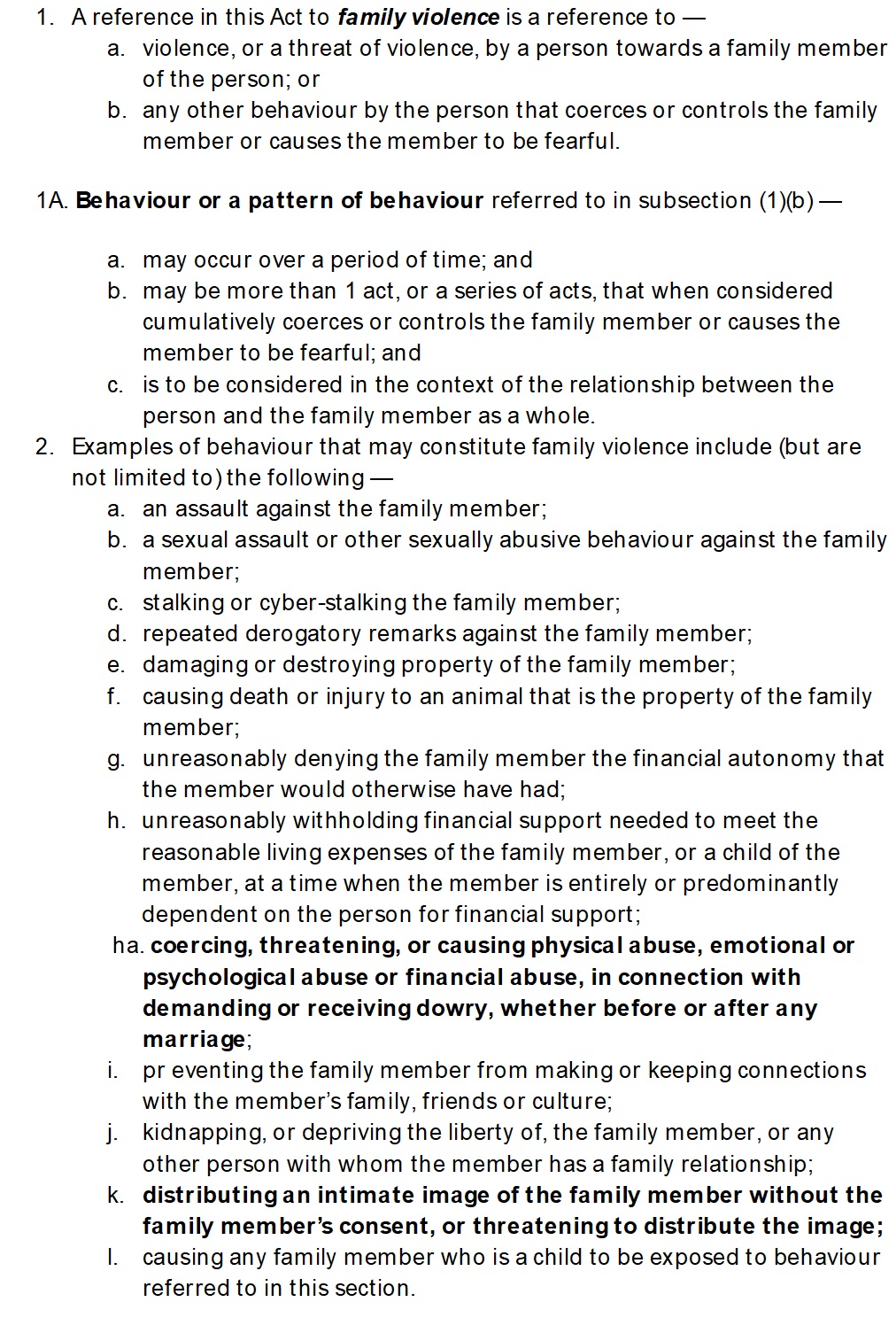
The definition of family violence in the Restraining Orders Act 1997 (WA) (“the ROA”) is very similar to the FLA and FCA definitions and included here for comparison. The examples of behaviour include a number of additional examples not included in the FLA or FCA which have been bolded below.
Section 5A ROA provides:
Definition of family member and relative
For the purposes of the definition of family violence in section 4AB FLA and section 9A FCA (see s 4(1AB)(aa) FLA and section 6 FCA), a person (the first person) is a member of the family of another person (the second person) if:
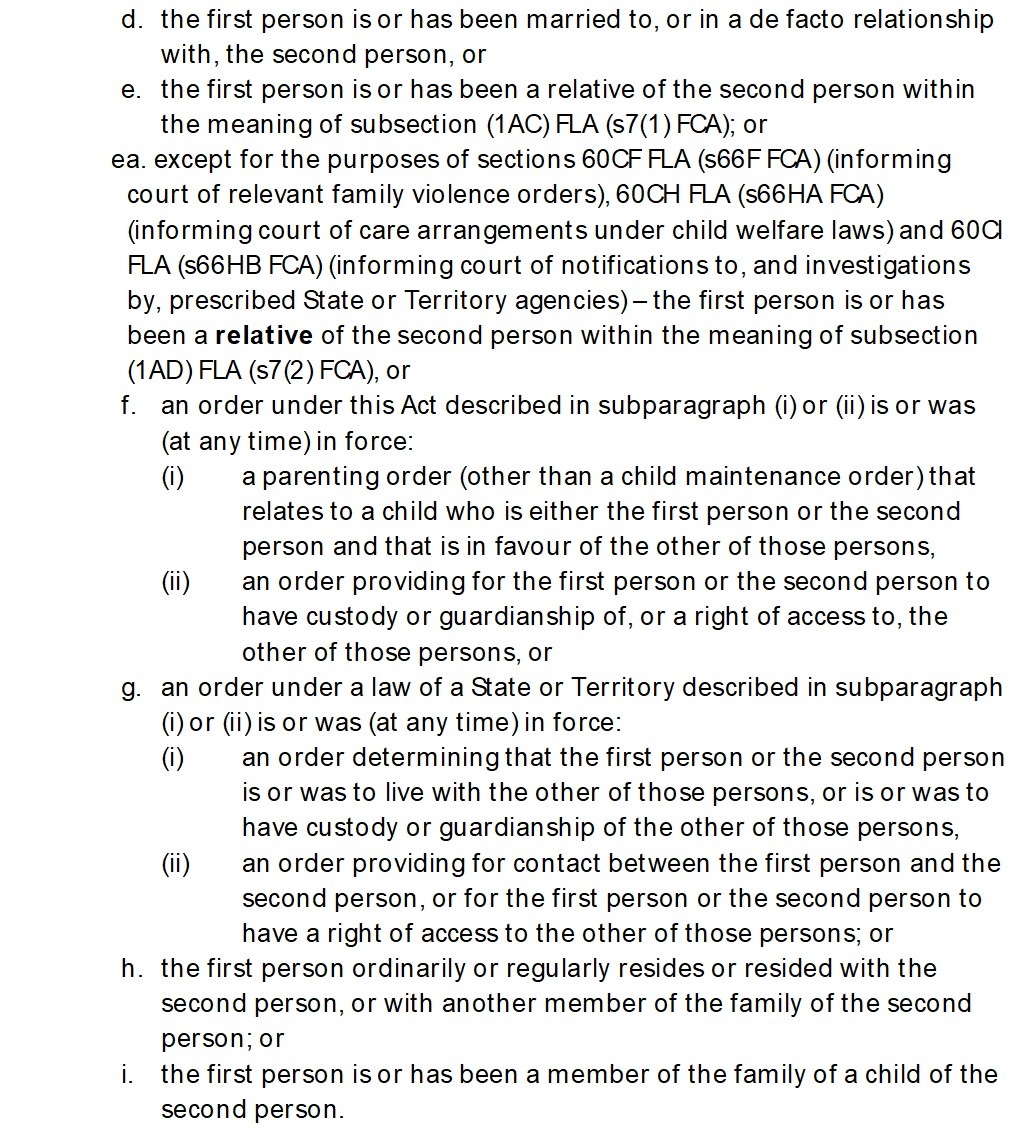
For the purpose of section 4(1AB) FLA (s6(e) FCA) a relative of a person is (see s4(1AC) FLA, s7(1) FCA):
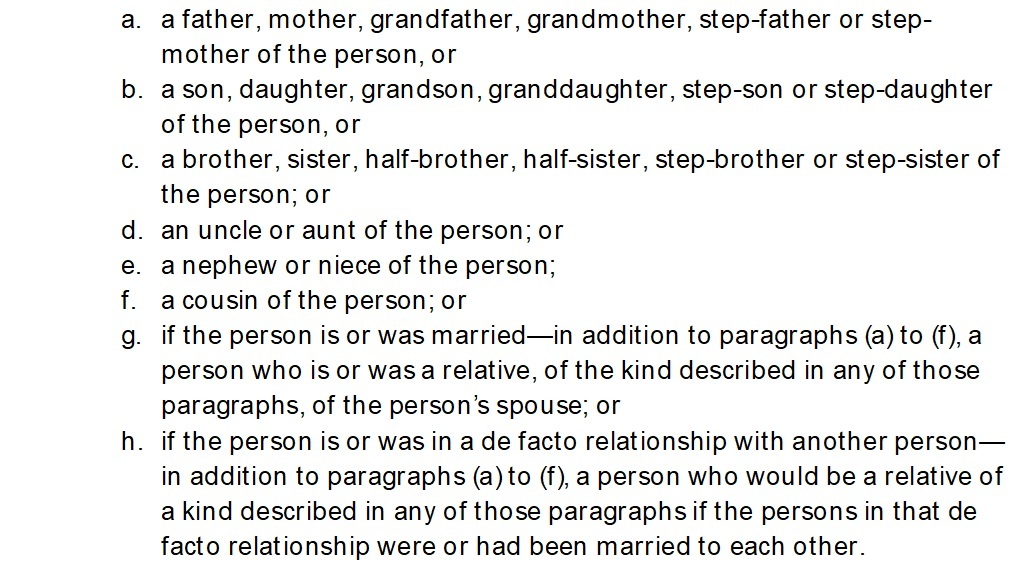
There is a new section 4(1AD) FLA (s 7(2) FCA) which provides:
For the purposes of s 4 (1AB)(ea) FLA (s 6(ea) FCA), if a person is related to an Aboriginal or Torres Strait Islander child in accordance with the child’s Aboriginal or Torres Strait Islander Culture (including but not limited to any kinship systems of that culture), the person is a relative of the child.
Note: this subsection adds to the persons who are relatives of a person within the meaning of subsection (1AC). The difference is that the addition in this subsection does not apply for the purposes of sections 60CF, 60CH or 60CI, which relate to informing courts of certain matters (see paragraph (1AB)(ea)).
Abuse
Section 4(1) FLA and section 5 FCA states abuse, in relation to a child, means:
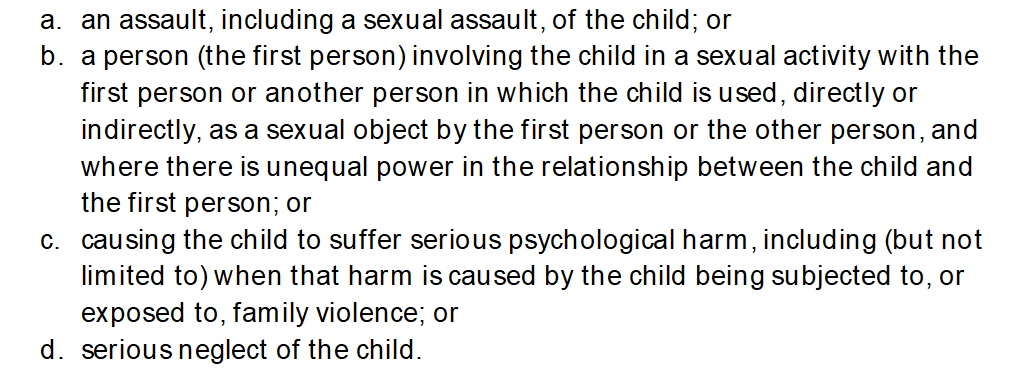
Note: Neglect is not defined in the FLA or FCA. The term was inserted by the Family Law Amendment (Shared Parental Responsibility) Act 2006 (Cth), the Explanatory Memorandum for which states at paragraph 36: “The term ‘neglect’, will have a similar meaning to its use in State and Territory child protection legislation. It is intended to be limited to situations where a lack of reasonable care is likely to cause unnecessary suffering or injury to the health of the child”.
Family Violence Cross-Examination Ban and Scheme
Family violence personal cross examination ban
Personal cross-examination is banned in Family Court of WA proceedings if there is an allegation of family violence between the examining party and the witness and certain criteria are met. Where an allegation of family violence is raised, but the criteria are not met, the court may still decide to impose the ban. The ban has been operating since 10 September 2019 for married couples and 10 September 2021 for de facto couples. The key provisions have been operating at trials since 9 December 2021.
Part XI, Division 3 of the FLA (Part 8, Division 3 FCA) contain the legislative provisions. The protections apply in both parenting and property cases.
The underlying considerations of the legislative provisions and objectives of the ban (as referred to in the Second Reading Speech relating to the amendments to the FLA) include:
- fear of being cross-examined by a perpetrator is often a significant factor in deciding to settle a matter or agreeing to orders that place children and victims at risk of harm,
- it is hoped the ban will assist with the provision of more reliable evidence in court proceedings,
- it is also hoped that it will strengthen the court's ability to protect victims of family violence, and
- it is further hoped that the bill will assist with reducing the trauma to victims of family violence in family law proceedings.
If one of the criteria under section 102NA(1) FLA (s 219AK FCA) applies then section 102NA(2) FLA (s 219AK(2) FCA) mandates:
- the examining party must not cross-examine the witness party personally, AND
- the cross examination must be conducted by a legal practitioner acting on behalf of the examining party.
Note: This section applies where the examining party is the alleged perpetrator, and the witness is the victim and vice versa.
Ban criteria
Pursuant to section 102NA FLA (s 219AK FCA) the ban will automatically apply in any family law proceedings when:
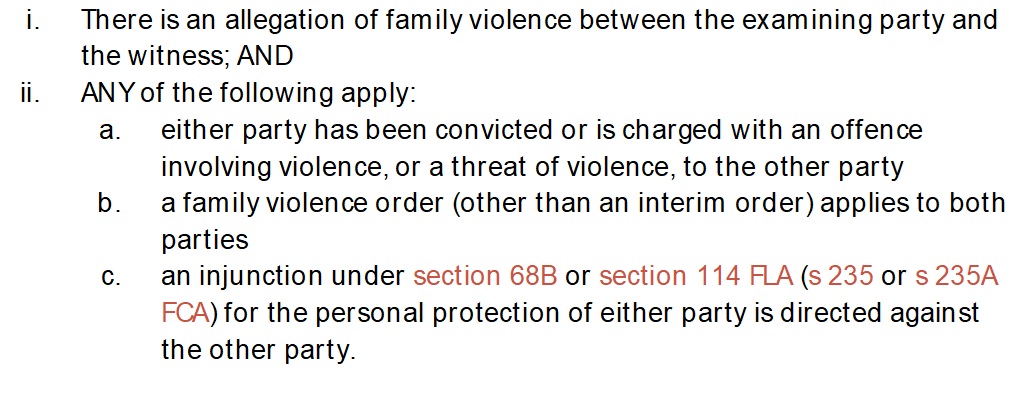
If there is an allegation of family violence between the examining party and the witness but the ban does not automatically apply, the court can make an order that the ban is to apply (s 102NA(1)(iv) FLA or s 219AK(1)(iv)) FCA).
Section 102NA(3) FLA (s 219AK(3) FCA) provides the court may make an order to ban cross-examination:
a. on its own initiative, or
b. on the application of the:
i. witness party
ii. examining party, or
iii. Independent Children’s Lawyer.
If section 102NA FLA (s 219AK FCA) does not apply and a party intends to cross-examine another party personally, and there is an allegation of family violence between the parties and the witness party, the court must ensure that during the cross-examination there are appropriate protections for the party who is the alleged victim of the family violence (s 102NB FLA or s 219AL FCA). For example, the court may allow personal cross-examination, but order that it be conducted by video or audio link, so the parties are not in the same physical location together.
What happens in court
The court will identify whether the mandatory ban applies or may consider whether a ban on cross-examination should be imposed.
If the ban applies, then the court orders made at the hearing will identify:
- that the ban applies
- the implications of the ban,
- the steps that the parties can take in light of the ban, and
- that a copy of the orders will be provided to Legal Aid WA.
The notice will specify if for any reason a party becomes unrepresented prior to or during the trial, the ban remains in place and cross-examination will not occur.
Commonwealth Family Violence Cross Examination of Parties Scheme
Legal Aid WA has been given specific funding from the Australian Government to provide a lawyer to a party when personal cross-examination is banned in their family law proceedings.
Access to the Scheme is not limited by financial circumstances or the details of the case.
A person can apply for a lawyer under the Scheme if the Family Court of WA has made a notice or order banning personal cross-examination in their case.
In addition, the court case must have been:
- given a trial date, or
- placed in a Callover to be given a trial date, or
- placed in a list of cases waiting to go into a Callover.
The Scheme cannot pay for a lawyer for court hearings in other cases that a client may have, only the case where personal cross-examination has been banned.
Conditions apply to legal representation under the Scheme and ongoing representation is not automatic.
The conditions include:
- following their lawyer’s advice, and
- informing their lawyer everything they need to know about their case, and
- providing any documents requested by Legal Aid WA or their lawyer as soon as possible, and
- informing Legal Aid WA if their address or phone number changes while they are receiving legal representation under the Scheme.
The conditions that apply in each individual case are set out in letters sent to the client by Legal Aid WA about their legal assistance under the scheme.
People applying for a lawyer under the Scheme need to complete a Legal Aid WA Application Form.
People can get a Legal Aid WA application form by:
- calling the Legal Aid Infoline on 1300 650 579 or Legal Yarn (for Aboriginal and Torres Strait Islanders on 1800 319 803,
- visiting a Legal Aid WA office,
- speaking to Family Court Services on Level 1 of the Family Court of WA building in Perth, or
- speaking to a Family Advocacy and Support Service (FASS) duty lawyer when the Family Court is sitting in regional locations in WA.
Public resource: Infosheet – Commonwealth Family Violence and Cross-Examination of Parties Scheme explains how people can apply for the scheme and how it operates.
The Cross-Examination Ban and Procedural Fairness
The Full Court held in Suss & Kunkle [2026] FedCFamC1A 127 that where a party fails to engage in the Scheme, this will not result in a breach of procedural fairness (see [27]-[43]). The Full Court noted at [35]:
“The effect of the order pursuant to s 102NA was to prevent the appellant from cross-examining the respondent personally. This meant that he could appear unrepresented at the hearing but required a lawyer if he sought to cross-examine the respondent. The effect of this restriction means that a failure to obtain representation (either privately or in reliance upon the funding scheme) has a greater forensic impact in many cases than merely being unrepresented, but not that a fair trial could not be held if the appellant was unrepresented.”
In considering procedural fairness, the Full Court explained that the focus is on whether the respondent had a reasonable opportunity to be heard, not whether the respondent “made full use of that opportunity” (at [36], citing Sullivan v Department of Transport [1978] FCA 48). This is the relevant inquiry where a s 102NA ban is in place, so denial of an adjournment will be more significant. The relevant factors for consideration are (at [36]):
“(1) whether the litigant had a reasonable opportunity to obtain representation (including sufficient time to access the legal aid scheme that supports the operation of s 102NA);
(2) whether a lack of representation is the result of matters beyond the litigant’s control rather than the consequence of their own delays or forensic choices;
(3) the impact upon the other parties, not only in financial costs but the ongoing stress of litigation if an adjournment is granted; and
(4) the impact upon the litigant’s ability to present their case or challenge the other party’s case, if the adjournment is refused.”
The Full Court stated that a party could not generally rely only on a late application for legal aid or a late choice to terminate instructions just because the “forensic impact of not being represented is greater due to the effects of s 102NA” (at [37]).”
The Full Court held (at [37]):
“It would be an error to treat an order under s 102NA as tantamount to a requirement that a party must be represented for there to be a procedurally fair hearing. Provided that a s 102NA order is made in sufficient time before the hearing to enable the litigant to engage lawyers, or apply to the relevant legal aid agency and for that agency to arrange representation for the litigant, then the restriction imposed by s 102NA will not, on its own, be likely to support an adjournment.”
In relation to the facts of the case, the Full Court held (at [39]):
- The s 102NA order was made well ahead of the hearing;
- The appellant initially chose private representation over representation under the Scheme;
- The appellant’s request for representation under the Scheme came too late for a timely appointment before the hearing;
- There was nothing to indicate this was due to anything other than the fault of the appellant.
And, at [42]:
“The procedural orders in this case allowed the appellant a reasonable opportunity to arrange representation and present his case. The lack of preparation of the appellant’s case was the result of his own choices and delay, not the effect of any denial of procedural fairness. The trial was not procedurally unfair, nor does it appear that there was a realistic possibility of a different outcome.”
Assessing contributions – impact of family violence: June 2025 amendments to the law for married couples relating to family violence
As of June 2025, the FLA was amended by the Family Law Amendment Act 2024 (Cth), and the court is to consider the impact of family violence when assessing contributions. Where relevant, under section 79(4)(ca) FLA the court will consider the effect of family violence to which one party has subjected or exposed the other party, on the ability of a party to make financial or non-financial contributions or contribute to the welfare of the family.
The Explanatory Memorandum to the Family Law Amendment Bill 2024 (Cth) (which became the Family Law Amendment Act 2024 (Cth))) notes the government’s commitment to addressing the economic consequences of family violence for separated families. These amendments and the amendments about assessing current and future needs set out below are aimed at enabling those affected by family violence to achieve a fair property division and to avoid the long-term financial disadvantage that is often experienced by victim-survivors.
If you are representing a client running the argument that family violence impacted their ability to make contributions, you will want to gather evidence supporting this assertion. Evidence might include things like medical records or evidence from their employer showing time off due to family violence or how their performance was impacted (perhaps performance reviews).
In Scheppen & Scheppen [2026] FedCFamC2F 667, Betts J rejected the wife’s application for her personal injuries claim against the husband to be heard as part of the property settlement proceedings in the exercise of accrued jurisdiction, having regard to the recent amendments to the FLA relating to family violence in property settlement cases. The husband opposed her application. The husband had been convicted of a number of violent offences against the wife and was incarcerated. The wife brought property settlement proceedings and had also filed a personal injuries claim against the husband in the District Court seeking damages in relation to various incidents of assault and/or battery, including sexual battery.
The issue for the court was whether the personal injuries claim was sufficiently “associated” with the property settlement proceedings so as to enliven the accrued jurisdiction (at [47]). This was the first decision on this question since the amendments to the FLA.
Betts J accepted the wife’s submissions that the long history of family violence was common to both proceedings and that the court would be obliged to consider the impact on her of the husband’s violence in relation to contributions and current and future needs (at [48]-[49], [93]). These issues arose out of the same facts and involved the same medico-legal evidence as the personal injuries proceedings (at [48]-[49]).
In dismissing the wife’s application, Betts J noted:
- The set of facts did not “wholly coincide”, because the property settlement proceedings involved a much broader inquiry than the husband’s family violence and its impact and because the claim for exemplary damages in the personal injuries claim involved considerations irrelevant to property settlement proceedings (such as deterrence) (at [96]).
- While the Family Court of Australia had on occasions heard personal injuries claims where there were related property settlement proceedings, these cases were distinguishable because they were transferred from the State courts pursuant to a former legislative cross-vesting scheme (and not in exercise of accrued jurisdiction – which has never been done before) (at [51]-[53]).
- The impact of a decision to hear this application could be “potentially far-reaching” and “such impacts were not necessarily intended to be affected” by the FLA amendments (at [103]).
- Personal injuries claims form part of the District Court’s core work. The Family Court does not have the same specialised expertise and experience (at [104]).
- The Family Court hearing the personal injuries claim would render the proceedings procedurally and legally complex and risk legally significant error, increasing the parties’ costs and a greater delay in hearing the matter (at [104]-[106]).
Assessing current and future needs: June 2025 amendments to the law for married couples relating to family violence
As of June 2025, the FLA was amended by the Family Law Amendment Act 2024 (Cth), introducing new factors the court will now consider when assessing the current and future circumstances of married parties. Of relevance to this chapter is family violence, which will be considered under section 79(5)(a) FLA as follows:
Where a party was subjected or exposed to family violence, this factor permits the court to consider the economic effect of any family violence that a party was subjected or exposed to, on their current and future circumstances.
What about pets? Companion animals and family violence: June 2025 amendments to the law for married couples
Family law treats animals as property to be divided like any other type of property. You may need to consider whether your client’s property settlement should include any animals. You do not have to include animals in an agreement or consent orders (or seek orders about them) if there is no dispute about who will be responsible for them following separation.
As of 10 June 2025, the FLA was amended by the Family Law Amendment Act 2024 (Cth) and there have been changes to the law about family pets (“companion animals”). Where parties cannot agree about the ownership of companion animals following separation, the court can consider this dispute separate from other property under section 79(6) FLA. These changes will apply in all cases commenced on or before 10 June 2025 (except cases in which a trial commenced before 10 June 2025).
These changes do not apply in cases where parties were not married, who are covered by the FCA (that is, the court will treat disputes about pets in the same way as other property to be divided).
“Companion animals” are defined in section 4(1) FLA as animals kept primarily for companionship. Companion animals do not include assistance animals or animals kept as part of a business, for agricultural purposes or for use in laboratory tests or experiments. Animals kept for more than one purpose are not considered companion animals (e.g., a working sheep dog that is also a companion).
The Explanatory Memorandum to the Family Law Amendment Bill 2024 (Cth) notes that animal abuse is a recognised form of family violence and that family pets may be used as a tool of coercion and control. The amendments aim to assist victim-survivors to retain the companion animal in property proceedings.
If a dispute about a companion animal goes to court, under section 79(7) FLA the court must consider things like:
- the circumstances in which the companion animal was acquired
- who has ownership or possession of the companion animal
- the extent to which each party cared for, and paid for the maintenance of, the companion animal
- any family violence to which one party has subjected or exposed the other party
- any history of actual or threatened cruelty or abuse by a party towards the companion animal
- any attachment by a party or a child of the marriage to the companion animal
- the demonstrated ability of each party to care for and maintain the animal in the future without the support or involvement of the other party
- any other factor circumstance which, in the opinion of the court, the justice of the case requires to be taken into account.
The court has a broad discretion to assess and weigh these factors. Under section 79(6) FLA, the court can order that:
- only one party is to have ownership of the companion animal;
- the companion animal be transferred to another person who has consented to the transfer; or
- the companion animal be sold.
The court cannot make an order for shared ownership, shared care or shared responsibility for the costs of a companion animal. This means that consent orders cannot propose joint ownership or possession of a companion animal or joint responsibility for their costs.
Parties might want to make separate, informal arrangements for their pet’s care. Some families make these arrangements in the context of their parenting arrangements. For example, they might agree that the family pet stays with a child as they move between homes.
The first instance decision of Ziskind & Greco (No 2) [2026] FedCFamC1F 378 provides an example of how the court approaches companion animal cases (see [233] onwards). Here, both parties applied to keep the family dog, and the court granted the mother’s application. The court held the dog was a companion animal (at [242]) and considered the relevant s 79(7) FLA factors (at [243]-[253]). The court found at [254]-[255] that the mother was responsible for the dog’s care and maintenance until separation and that putting the dog in the mother’s care would mean the children spent more time with the dog (both parties agreed the children had a close attachment to the dog).
Less adversarial approach: June 2025 amendments to the law for married couples
As of June 2025, Division 4 of the FLA expressly sets out the court’s powers to more actively manage any type of family law proceeding through a less adversarial approach, to reduce intimidation and stress of court processes (see s 102NE FLA regarding the principles for conducting proceedings). This may include using facilitating remote attendance where there are allegations of family violence, or allowing evidence of the occurrence and effect of family violence which may not otherwise be admissible (see ss 102NH, 102NN FLA).
The approach also suspends parts of the rules of evidence, unless the court orders they should apply to an issue in proceedings in exceptional circumstances (see s 102NL FLA).
Previously, the approach could only be applied in Part VII proceedings (about parenting) and in property or financial proceedings where there were concurrent or past proceedings involving parenting matters, and only with the parties’ consent.
Now, the less adversarial approach will apply to all Part VII proceedings automatically (s 102ND(1) FLA). The less adversarial approach will only apply to non-Part VII proceedings (including property and financial matters) either with the consent of the parties or at the discretion of the court (s 102ND(2), (3) and s 102NG FLA).
The Explanatory Memorandum to the Family Law Amendment Bill 2024 (Cth) indicates that these amendments support the elimination of discrimination against women by allowing their full participation in family law proceedings and removing barriers against pursuing property settlement proceedings. Evidence of the occurrence and effect of family violence can be considered in property proceedings and spousal maintenance proceedings.
Family violence and costs orders
In the first instance decision of Melounis & Melounis (No 7) [2026] FedCFamC1F 313, Altobelli J held that the respondent’s coercive and controlling conduct in both parenting and financial proceedings was relevant to the issue of costs and granted indemnity costs. The court had made strong adverse findings in the substantive proceedings that the respondent had coerced and controlled the applicant.
See the Chapter 21 Costs for a detailed discussion of this case.
Family violence resources
- The National Domestic and Family Violence Bench Book is a central resource for judicial officers considering legal issues relevant to domestic and family violence related cases. It is available publicly for the benefit of other legal professionals and service providers who are working with victims and perpetrators.
- The Legal Aid WA website page Get Help with family violence and your safety provides information about the services Legal Aid WA provides and a list of external services and resources. This list is regularly reviewed and updated.
- The Legal Aid WA Infosheets Staying Safe: Getting Ready to Leave and Staying Safe: After you Leave provide practical information for clients who are thinking about leaving a violent relationship or who have recently left a violent relationship.
- The National Legal Aid website Family Violence Law Help provides simple and clear information about domestic violence and the law. This includes information about family law, child protection, child support and domestic violence protection orders. It has a directory of services that help with legal advice, emergency housing and money for people in WA and Australia wide.
Reviewed: 11 September 2026