
Injunctions - Exclusive Occupation Orders
Chapter contents
- Overview
- Urgent legal advice required
- Legislation
- The court’s approach to exclusive occupation applications
- Type of orders the court can make in exclusive occupation order proceedings
- Practical Guide
- Responding to an application
- Enforcement when injunction is breached
Overview
When a couple separates, they are both entitled to occupy the former family home, especially if the home is jointly owned. Usually, parties come to an agreement about who remains in the home, however in some circumstances there is no agreement. In these circumstances the person who wishes to remain in the home can apply to the court for an order for exclusive occupation of the home. The court has the power to exclude one party from living in the former family home, for married parties under the Family Law Act 1975 (Cth) (“the FLA”) and separated de facto parties under the Family Court Act 1997 (WA) (“the FCA”).
An exclusive occupation order is an interim injunctive order that provides temporary relief to the applicant by ordering the respondent to vacate the former family home.
The court will grant an exclusive occupation order and an injunction with caution and only for very good reason. The court considers these matters seriously and carefully. An injunction that prohibits a person from living in their own home is of such gravity that it ought to only be granted in restricted and exceptional circumstances: S & S [2002] FamCA 59 at [38]. A “dysfunctional family home life with tension and discomfort…short of unacceptable conduct or a clear detriment to the welfare of a child” would usually not be enough to seek an exclusive occupation order: S v S at [41], neither would a wish for a party to “live more peacefully and conveniently… in [the ex-partner’s] absence than she could by sharing the home with him until the hearing of the suit”: Banks v Banks (1970) 3 NSWR 233. In Capri & Goldwell [2022] FedCFamC2F 1363 the court said “Mere inconvenience to the parties concerned is not sufficient to justify a sole occupancy order. The court has been directed to be alive to the risk that a spouse may use a sole occupancy injunction as a tactical weapon in the ongoing matrimonial conflict.”
However, the court need not find that the situation in the home is “intolerable” or “impossible”, merely that it would not be “reasonable or sensible or practicable to expect both parties to continue to” live there together: Davis v Davis (1976) FLC 90-062, cited in Elliot v Hopkins (No 2) [2023] FedCFamC1A 142 at [35] and Mubiru & Mubiru [2026] FedCFamC1F 456 at [17].
An exclusive occupation order is not a partial property settlement and is not an exercise of the court’s power under section 79 FLA/ section 205ZG FCA. A person who is granted an exclusive occupation order may not ultimately retain the former family home, and vice versa a person who is injuncted from remaining in the former family home may end up retaining the former family home as part of the final property settlement.
An exclusive occupation order is made in interim proceedings where the court cannot resolve issues of fact in dispute: Howarth & Oliver [2022] FCWA 1. The form of the order is usually twofold – an exclusive occupation order followed by an injunction.
Urgent legal advice required
A client may approach you for legal advice to remove their ex-partner from the former family home due to family violence concerns. Their ex-partner may have harmed or threatened to harm them or the children, and they wish to have exclusive use of the former family home due to fears for their safety. Sometimes a client may have obtained a 72 hour police order or an interim Family Violence Restraining Order (“FVRO”) which prevents their ex-partner from returning to the former family home. This usually gives temporary relief and the client may seek longer term (albeit still interim) relief by seeking Family Court Orders.
Alternatively, there may not be a police order or FVRO and the client may approach you for advice due to a difficult or toxic situation caused by post separation conflict and both parties being present in the former family home. In this case, assess whether the matter is truly ‘urgent’ such as it cannot be resolved by negotiation or dispute resolution in the first instance.
The ongoing rental crisis in Western Australia may mean that the court is more circumspect than usual in handing out exclusive occupation orders and injunctions.
Legislation
The power to make an exclusive occupation order is found is section 114(1)(b) and (f) FLA / section 235A(1)(b) and (d) FCA. The court may make such order as it thinks proper. A grant of an injunction is unlikely to be proper unless there is an appropriate factual basis supporting it: S & S [2002] FamCA 59.
The exercise of power under section 114 FLA / section 235A FCA is discretionary which means each case must be decided on its own facts and circumstances. Although there are many reported cases stating factors or considerations, there is no binding criteria or exhaustive list.
The court’s approach to exclusive occupation applications
The test for granting an exclusive occupation order is an objective test: Rowe & Rowe (1980) FLC 90-895, 75,644 cited in Elliot v Hopkins at [35] and Mubiru & Mubiru at [17]. The question is what in all the circumstances is “fair, just and reasonable”: Walker v Walker (1978) 1 WLR 533, 536-537, cited in Elliot v Hopkins at [35]-[36] and Mubiru & Mubiru at [17].
This question is answered in two steps:
- Determining whether an exclusive occupation order is necessary; and
- If so, determining which party should have exclusive occupation (Dickinson & Packham [2021] FamCA 298 at [25], cited in Mubiru & Mubiru at [19]).
Factors the court considers
When deciding whether or not to make an order for exclusive occupation, the court will look at:
- Who has the primary care of the children and generally continues to reside in the family home?
- What are the needs of the children and would an exclusive occupation order in favour of one parent serve their best interests?
- What conduct of the parties justifies the respondent being excluded from the home? See Davis v Davis.
- What financial means or resources does each party have to find alternative accommodation?
- What would be the resulting hardship to each party or to the children as a consequence of making the order?
- Who has met the loan repayments and outgoings for the former family home to date?
- Are there allegations of abuse or family violence or other risk factors or has one party taken out an FVRO?
- Would the child otherwise be housed in unsuitable accommodation?
- Is it reasonable or sensible or practical for the parties to live in the same house?
This is not an exhaustive list. Some other factors the court has considered include: each party’s and the children’s physical and mental health, each party’s education and employment and how it affects their earning capacity and ability to pay rent or purchase another property, what spend time arrangements are in place for the children and how an exclusive occupation order can assist or hinder those spend time arrangements.
The court can make an exclusive occupation order where:
- The party seeking the order has left the premises: Page & Page (1981) FLC 91-025.
- The respondent is the registered owner of the property, however, additional injunctions were made in this case to prevent the respondent from dealing with the home in an adverse manner: In the Marriage of Harris (1980) 5 Fam LR 852 recently cited in Chadbourne & Chadbourne [2021] FCCA378.
Factors for de facto couples
There are additional factors a de facto party will need to meet when applying for an exclusive occupation order:
- The parties need to be separated, as opposed to married parties who do not need to be separated to qualify: Stanford v Stanford [2012] HCA 52
- The application must be made within strict time limits, being 2 years from the date of separation (if made by consent or as part of a financial agreement, the time limit may not apply)
- The parties must meet the requirements of a geographic connection: section 205X FCA namely:
- One or both parties were resident in WA on the day the application is made; and
- Both parties have resided in WA for at least one third of the duration of the relationship OR that the applicant made a ‘substantial contribution’ of a kind mentioned in section 205ZG FCA, in WA
- The parties must meet the following requirements under section 205Z FCA, namely that:
- a de facto relationship of at least 2 years exists, or
- there is a child of the de facto relationship, or
- that the applicant made a ‘substantial contribution’ of a kind mentioned in section 205ZG FCA and a failure to make the order would result in serious injustice to the applicant.
Type of orders the court can make in exclusive occupation order proceedings
- Grant the exclusive occupation order and injunction in favour of one party.
- Grant the exclusive occupation order for part of the home only, e.g. top floor for one party and bottom floor for another: Valentini & Valentini [2024] FedCFamC1F 602.
- Grant the exclusive occupation order and order the applicant then meet all loan repayments and outgoings for the former family home
- Grant the exclusive occupation order upon the respondent being paid a sum of money by the applicant: S & S [2002] FamCA 59.
Practical Guide
Step 1: Pre-action procedures
If there is no urgency, a party who seeks a property injunction has to comply with pre-action procedures outlined in rule 199 and Schedule 1 Family Court Rules 2021 (WA) (“FCR”). This includes exchanging full and frank disclosure, negotiating by making offers and counteroffers of settlement, and attempting family dispute resolution (“FDR”).
If your client has concerns about family violence and fears for their safety if they are required to negotiate with the other party, they may be exempt from ‘pre-action procedures’ and may make a direct application to the court.
Otherwise, where there is a dispute as to who should remain in the former family home, it is often best to write to the other party first and attempt to resolve the problem.
The negotiation letter should:
- state the reasons why your client wishes to have exclusive occupancy of the home, in line with what factors the court considers valid, as detailed above and provide a requested date by which to vacate;
- request a return of keys/remotes and request that no items be removed from the home unless agreed between the parties;
- state that if no response is received within the requested timeframe, or the other party responds and declines to move out of the former family home, your client will file an application seeking an exclusive occupation order and injunction without further notice.
The letter should be sent by registered post, signed, dated and a copy retained for later court use if necessary.
If the pre-action procedures are completed and there is no resolution, the next step is to advise your client on making an application.
Step 2: Preparing the application
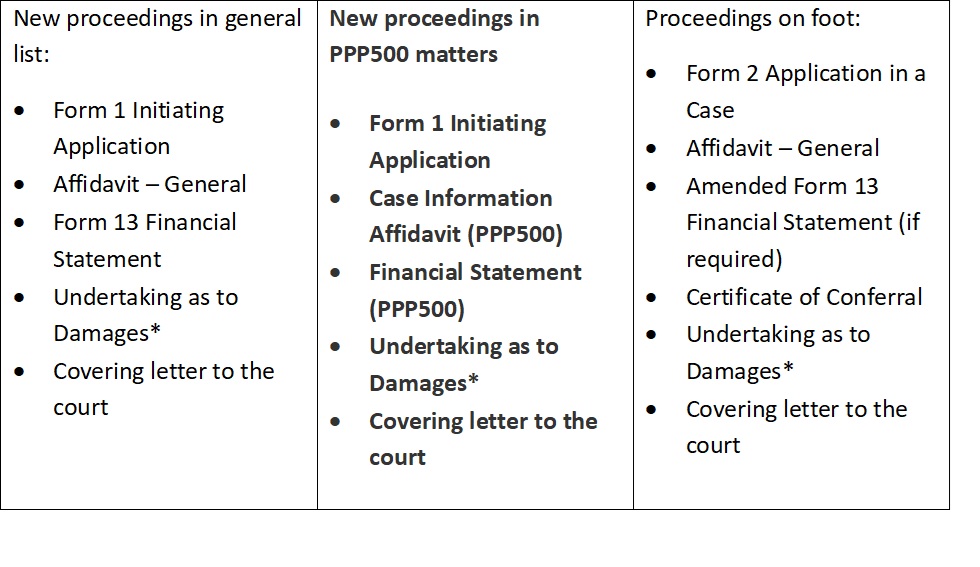
*not mandatory but recommended.
If proceedings have not yet commenced, an applicant should file a Form 1 Initiating Application. Based on your client’s instructions, consider whether to file documents for a standard matter or whether the matter meets the guidelines for a PPP500 case. If the matter is appropriate for a PPP500 case, file a Case Information Affidavit (PPP500) and Financial Statement (PPP500). If it is a standard matter, file an Affidavit – General and Form 13 Financial Statement. The application should set out the final orders sought and seek an interim order for exclusive occupation.
If there are proceedings already on foot, a Form 2 Application in a Case with supporting Affidavit – General would be required to be filed. A Certificate of Conferral is also required. If there has been a significant change in financial circumstances since the proceedings began, the applicant should file a new Form 13 Financial Statement (r201 FCR).
An Affidavit must support the application for exclusive occupation – General or Case Information Affidavit (PPP500) setting out the facts (why the order is sought and the harm that would be caused if it is not granted). Keep in mind that there is no cross examination in interim hearings and the court will rely upon all relevant evidence being present in a persuasive manner in the affidavit. If filing an affidavit, annex to it any relevant evidence of the parties’ financial circumstances such as income and expenses, and any open offers of settlement: r155. Keep in mind the limit of 5 documents to be attached to a party’s affidavit (r241).
A Form 13 Financial Statement or Financial Statement (PPP500) should also be filed. Particular care should be taken to complete this document, and it should preferably show either existing financial hardship or imminent financial hardship if the exclusive occupation order was not made and the party had to seek alternative accommodation.
It is good practice to include a cover letter to court, stating which documents you are seeking to file, and brief information in dot points to justify the urgency of the application, if relevant.
When seeking an injunction the applicant will almost always offer or be required to give to the court an Undertaking as to damages. The wording of the undertaking is:
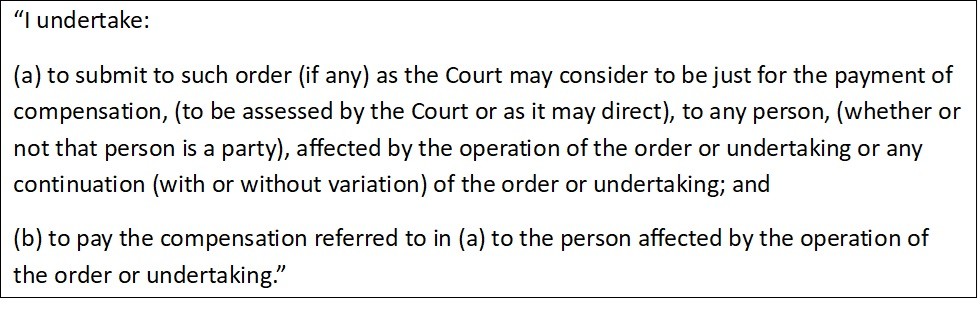
While not mandatory, it is likely your client will be required to file an Undertaking which is a promise to the court with the same force and effect as an order of the court (r316 FCR). The Undertaking should be in the correct form and filed once it is signed and dated. It is important to advise clients of the seriousness of giving an Undertaking, that it is a promise to the court, to compensate the other party for any damages caused by the injunction if it is later found the injunction should not have been ordered.
If your client instructs that they are not in a position to give an Undertaking, it is still possible to seek the injunction. Undertakings are not a precondition to the granting of an injunction and a party’s strained financial circumstances should not be a bar to justice: Blueseas Investment Pty Ltd v Mitchell & McGillivray [1999] FamCA 745. However, the lack of an Undertaking can be a relevant factor for the court in deciding whether to grant an injunction.
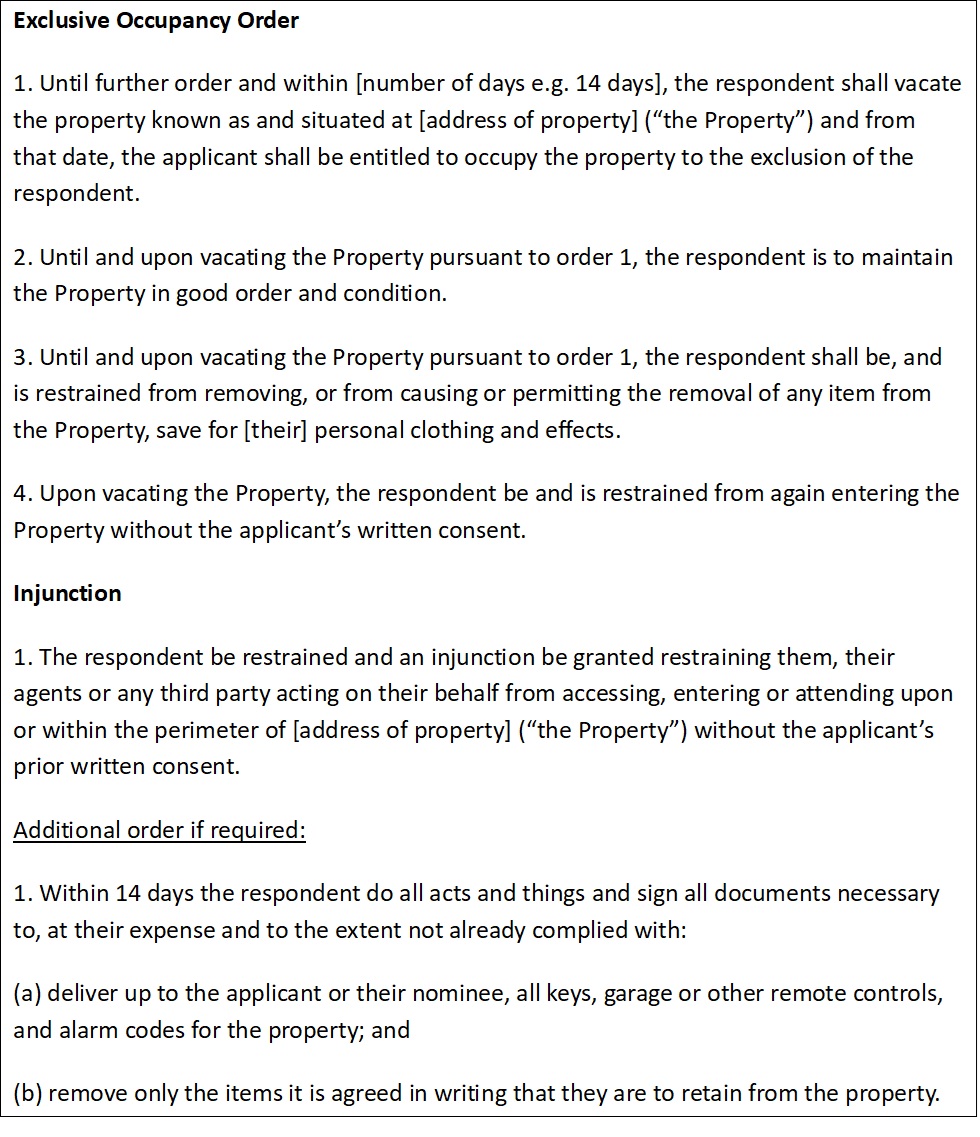
Precedent orders
The below orders are usually sought in the ‘interim or procedural orders sought’ section of the Form 1 Initiating Application or Form 2 Application in a Case.
Step 3: Service
The usual requirements for service apply. If the application is filed in a Form 1 Initiating Application, special service is required. If the application is filed in a Form 2 Application in a Case, ordinary service is acceptable. See the chapter on Service of Documents for for detailed information.
Step 4: Court hearing process
First hearing – directions hearing
Prior to the first hearing, the parties should attempt negotiations and if no agreement has been reached on the day of the hearing the parties or their lawyers should again attempt some final negotiations prior to appearing before the Judicial Officer. If unrepresented a party can seek the assistance of the duty lawyer at FCWA. If there are no duty lawyers available, the unrepresented party should be prepared to negotiate directly with the other party or their lawyer.
If there is an agreement, the parties should advise the court officer as soon as possible that a Minute of Interim Consent Orders is being prepared and signed. Once you have a signed copy of the Minute you should make a copy for each party and prepare to hand up the signed original to the Judicial Officer when the matter is called.
If there is no agreement, the Judicial Officer will address each party and ask questions to clarify facts. If the respondent has not filed documents, it is likely they will be given an opportunity and timeframe to do so.
The matter will likely be programmed to a further directions hearing or an interim hearing at the court’s next available date.
Second hearing – interim hearing
At the subsequent hearing, if there are responding documents filed, the Judicial Officer will likely listen to submissions and make a decision about exclusive occupation on an interim basis.
If there are no responding documents filed but there is proof the respondent has been properly served, the Judicial Officer may still make a decision about exclusive occupation on an interim basis, particularly if the respondent is present in court. The balance of the matter otherwise remains programmed towards further dispute resolution or Trial.
Failure of respondent to attend hearing
If a respondent fails to attend the first hearing, the court will check whether they were properly served and if there is a valid affidavit of service on file. If the court is satisfied that service has occurred, it is unlikely that the order will be made in the respondent’s absence. The matter is likely to be programmed to a further directions hearing or to an interim hearing.
If the respondent fails to attend the subsequent hearing, it is more likely that the court will make the orders sought.
Step 5: After the court hearing
If the court grants your client the exclusive occupation order and the respondent was not present in court, write to them immediately after the hearing stating your client has an injunction. Attach the order if it is available. If you do not yet have the order, write to the respondent and clearly state what the injunction stops them from doing.
Responding to an application
The respondent could oppose an application for an exclusion occupation order by submitting that:
- It is unnecessary.
- It is unduly burdensome.
- It is possible for the parties to co-exist under one roof.
- They have no alternative accommodation.
- They deny the conduct alleged by the applicant.
- There is no proper legal reason for sole use (Elliot & Hopkins (No 2) [2023] FedCFamC1A 142)
See Valentini & Valentini [2024] FedCFamC1F 602.
If the applicant has filed a Form 1 Initiating Application, the responding documents required are a Form 1A Response to Initiating Application, Affidavit – General in support or Case Information Affidavit (PPP500) and Form 13 Financial Statement or Financial Statement (PPP500).
If the applicant has filed a Form 2 Application in a Case, the responding documents required are a Form 2A Response to Application in a Case and Affidavit – General in support, and Certificate of Conferral. Consider seeking leave to file, and filing, an amended Form 13 Financial Statement if the respondent’s financial situation has changed significantly since first filed (r201).
It is good practice to include a cover letter to court, stating which documents you are seeking to file.
Responding documents need to be filed and served 7 days before the hearing date (r153 FCR). If the application has been listed on short notice, responding documents should be filed at least 2 working days before the hearing date, if possible.
Enforcement when injunction is breached
Under section 112AD FLA / section 226 FCA the court may take such action as it thinks appropriate to punish contravention of an injunction granted under section 114 FLA / section 235A FCA. The penalties include:
- Requiring a person to enter into a bond.
- Imposing a sentence by order e.g. a community service order.
- Imposing a fine.
- Imposing a sentence of imprisonment (if the contravention was intentional or fraudulent).
In the most serious cases, a court can punish a person for contempt by committal to prison or fine or both (s 112AP FLA / s 234 FCA).
An applicant seeking enforcement of an injunction is required to file a Form 2 Application in a Case, and select ‘enforcement hearing – financial obligation’ in Part C. Other documents required are an Affidavit – General and Certificate of Conferral.
A respondent who is responding to an enforcement application is required to:
- Attend court on the court date and answer questions from the Judicial Officer about why they have not complied with orders.
- Produce all documents requested by the applicant.
- File a Form 13 Financial Statement at least 7 days before the court date.