
Property Injunctions
Chapter contents
- Overview
- Different kinds of property injunctions
- Legislation
- How the court decides
- Caveats
- Factors for de facto couples
- Third party interests
- Practical guide
- Responding to an application
- Enforcement when injunction is breached
Overview
The court has the power to grant injunctions in favour of a party in property settlement proceedings, for married couples under the Family Law Act 1975 (“the FLA”) and separated de facto couples under the Family Court Act 1997 (“the FCA”). This is a wide discretionary power and will be determined on the merits of each case. An injunction interfering with property rights is not granted lightly.
The most common property injunctions are usually orders preventing a party from disposing of an asset of the relationship or from diminishing the assets available for property division under section 79 FLA / section 205ZG FCA. The purpose of the injunction is to preserve the assets of the relationship pending final property settlement.
A common scenario you may encounter in practice may be when a client seeks legal advice because they have discovered their ex-partner is about to sell or transfer ownership of a house solely owned by them, and your client is worried the sale proceeds will be distributed or spent without their consent.
Property that can be subject to an injunction can include real estate, money in bank accounts, shares, cash, cryptocurrency and digital assets, superannuation, companies, trusts, partnerships, personal effects and furniture.
Different kinds of property injunctions
The following is a non-exhaustive list of property injunctions that may be granted:
- Prohibiting a party from selling or transferring ownership of a property
- Prohibiting a party from using the proceeds from the sale of property
- Prohibiting a party from re-mortgaging or refinancing against a property
- Prohibiting a party from moving an asset out of Australia
- Requiring a party to do an act to avoid the diminution of the asset pool e.g. require a sale of an asset where the value of the asset is decreasing
- Requiring a party to appoint a receiver or manager to a business to ensure it is properly run.
This chapter does not deal with Anton Piller orders or Mareva injunctions as they are uncommon in family law proceedings.
Legislation
The court has the power to grant injunctions in property settlement cases (s 114 FLA / s 235A FCA). The court may make such order or grant such injunction as it considers proper.
There is an overarching requirement that the order be just and equitable ( s79(2) FLA / s 205ZG(3) FCA).
How the court decides
There are two requirements for an injunction to restrain a party from dealing with their property:
- There is an existing or potential claim to an order altering property interests under section 79 FLA / section 205ZG FCA. That is, is there a probability that at trial the applicant would be entitled to relief? The word "probability" in this context means a "sufficient likelihood of success" (Australian Broadcasting Corporation v O'Neill (2006) 227 CLR 57 at [65] to [72]; Beecham Group Ltd v Bristol Laboratories Pty Ltd (1968) 118 CLR 618); and
- There is a real danger that the claim may be defeated or prejudiced unless the injunction is granted: Stowe and Stowe (1981) FLC ¶91-02. The court will consider whether the likely detriment to the applicant (if the injunction were refused) outweighs the detriment the respondent would suffer if the injunction were made.
In exercising its discretion, the court should:
- direct the order to a party of the marriage or de facto relationship
- not restrain a person from ordinary business dealings or from using funds for ordinary living expenses: Martiniello and Martiniello (1981) FLC ¶91-050
- impose only the minimum restrictions that are necessary to protect the applicant’s claim for property division: Sieling and Sieling (1979) FLC ¶90-627
- go no further than necessary to prevent abuse or frustration of the court’s process: Jackson v Sterling Industries Ltd (1987) 162 CLR 612
- take into account whether there is any intention to dispose of assets: Waugh & Waugh [2000] FamCA 1183 , although in the later case of Mullen & De Bry [2006] FamCA 1380 the Full Court held it should more readily impose injunctions in financial cases where “the possibility (based on some evidence) of an intention or scheme may, with other factors, be sufficient to establish the probability of an objective risk of disposal with intent to defeat an order.”
The court will carefully consider the evidence presented by the applicant about why an injunction is necessary. Some examples are:
- The applicant has seen a ‘for sale’ listing for the property online or a “for sale” board in front of the house.
- The applicant has seen the respondent or a real estate agent preparing the house for sale, including by holding home inspections for potential buyers.
- The applicant has sighted documents relating to the potential sale or transfer.
- The applicant has heard through third parties that the respondent is going to sell the house.
- The applicant has directly asked the respondent about the potential sale and the respondent has confirmed or not denied it.
- The respondent has withdrawn a large sum of money from a joint account without the applicant’s consent and the applicant is worried they may continue to withdraw money.
- The respondent has transferred, sold or otherwise hidden cryptocurrency or digital assets without the applicant’s consent and the applicant is worried they may continue to dispose of cryptocurrency: Jingyi & Chao (No 7) [2025] FedCFamC1F 184.
Injunctions are granted during interim proceedings where the court cannot make findings about any issues of fact in dispute or test evidence by cross-examining the parties. Therefore, it is important to carefully advise your client of the likelihood of success in obtaining an injunction. It is also important to present evidence in a persuasive manner in your client’s affidavit.
Caveats
As an alternative to Family Court proceedings, your client may seek advice about registering a caveat on real property to protect their interests. The case law is clear: “a claim grounded only in an alleged entitlement to a property settlement under the Family Law Act 1975 does not create a caveatable interest in the land which may be part of the assets available for such a settlement” Ho v Ebert [2015] NSWSC 1468. The proper way to protect a party’s interest is by initiating proceedings under s 79 FLA and, if necessary, by seeking an urgent injunction to preserve assets.
This is particularly the case where your client may be relying on non-financial contributions and contributions as homemaker and parent to give them a ‘caveatable interest’.
Factors for de facto couples
There are additional factors a de facto party will need to meet when applying for property injunctions:
- The parties need to be separated, as opposed to married parties who do not need to be separated to qualify: Stanford v Stanford [2012] HCA 52.
- The application must be made within strict time limits, being 2 years from the date of separation (the time limit may not apply if made by consent or as part of a financial agreement).
- The parties must meet the requirements of a geographic connection under section 205X FCA, namely:
- one or both parties were resident in WA on the day the application is made; and
- both parties have resided in WA for at least one third of the duration of the relationship OR that the applicant made a ‘substantial contribution’ of a kind mentioned in section 205ZG FCA, in WA.
- The parties must meet the following requirements under section 205Z FCA, namely that:
- a de facto relationship of at least 2 years exists, or
- there is a child of the de facto relationship, or
- that the applicant made a ‘substantial contribution’ of a kind mentioned in section 205ZG FCA and a failure to make the order would result in serious injustice to the applicant.
The above factors should be detailed in the affidavit filed by the applicant (see more below) attached to the application seeking property injunctions.
Third party interests
Injunctions may impact on the rights of third parties. For example, a person may be restrained from selling a home even where that home is owned jointly with another person (who is not the applicant). Where an injunction is sought to direct a third party to take steps in relation to property of a party to a marriage or de facto relationship, such an order can be made under section 90AF FLA / section 205ZLG FCA only upon satisfying a number of conditions.
The court may only make an order or grant an injunction against a third party if the making of the order, or the granting of the injunction, is reasonably necessary, or reasonably appropriate (s 90AF(3)(a) FLA / s 205ZLG(3)(a) FCA).
The third party must also have been accorded procedural fairness prior to the making of the order or injunction (s 90AF(3)(c) FLA / s 205ZLG(3)(c) FCA.
The court must also have regard to the taxation and social security effect (if any) of the order or injunction on the parties to the marriage and the third party (s 90AF(4) FLA / s 205ZLG(4) FCA).
The court will consider whether and to what extent the proposed injunction will affect the rights of the third parties. Just because a third party may be adversely affected will not stop a court from making an injunction. The court looks at the balance of hardship and the balance of convenience between the parties: R v Dovey; Ex parte Ross (1979) 5 Fam LR 1.
Third parties can include a person, a bankruptcy trustee, a company, a bank, a superannuation fund, or the Australian Taxation Office .
Practical guide
Step 1: Pre-action procedures
Practical tip: If your client has concerns about funds in joint accounts being unilaterally spent by the other party, as a starting point, your client may wish to contact their bank to advise them of the parties’ separation and request that funds in joint accounts be made ‘joint signatures to withdraw’. If the bank can do this, there may be no urgent need for court proceedings. If the bank is unable to do this or the other party refuses to consent to change the bank account to ‘joint signatures to withdraw’ consider whether court proceedings are the next step.
A party who seeks a property injunction has to comply with pre-action procedures outlined in rule 199 and Schedule 1 Family Court Rules 2021 (WA) (“FCR”). This includes exchanging full and frank disclosure, negotiating by making offers and counteroffers of settlement, and attempting family dispute resolution (“FDR”).
Where there is a concern about the other party selling or transferring property solely owned by them and the client instructs the sale is not imminent, it may be best to write to the other party first and attempt to resolve the problem. Be aware that writing to the other party and giving them notice may cause them to act with haste and carry out the sale or transfer – take instructions from your client about how the other party may react to receiving a negotiation letter.
The negotiation letter should state:
- the reasons why your client believes the property will be sold without their consent;
- that they do not consent to the property being sold;
- they seek an informal undertaking that the respondent will not sell the property without an agreement in writing between the parties;
- if no response is received within the requested timeframe or there is no agreement, your client will file an application seeking an urgent property injunction without further notice.
The letter should be sent by registered post, signed, dated and a copy retained for later court use if necessary.
If the pre-action procedures are completed and there is no resolution, the next step is to advise your client on making an application.
When to seek ex parte orders
There may be circumstances where it is not possible or appropriate to attempt negotiations, such as the property is imminently about to be sold, or already has been sold and the proceeds are about to be distributed to the respondent. In those urgent cases it may be necessary to proceed with the application for injunctive orders either on an ex parte basis or on giving short notice to the respondent.
The granting of an ex parte order involves a departure from one of the primary rules of natural justice, and as such should only be exercised when the protection of a party’s interests demands immediate intervention of the court: Fontano & Fontano [2022] FCWA 171.
Some considerations when deciding whether to seek an ex parte order as opposed to an order with short notice are:
- Is there imminent risk of hardship or prejudice to the applicant if the respondent is notified of proceedings? Note that an injunction is usually intended to operate as a temporary holding measure and in the circumstances of an ex parte application the respondent will retain the ability to apply, on short notice, to discharge or vary the injunction.
- What conduct of the respondent supports this risk?
- Does the respondent have the ability to deal with property unilaterally and without the consent of the applicant?
- Would giving notice to the respondent effectively defeat the purpose of the injunction?
Step 2: Preparing the application
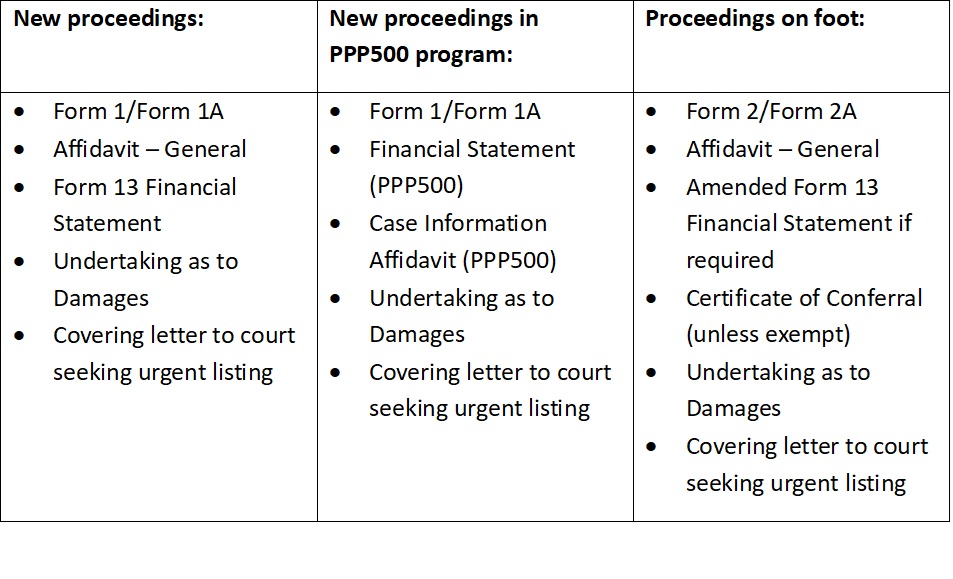
If proceedings have not yet commenced, an applicant should file a Form 1 Initiating Application. Based on your client’s instructions, consider whether to file documents for a standard matter or whether the matter meets the guidelines for a PPP500 case. If the matter is appropriate for a PPP500 case, file a Case Information Affidavit (PPP500) and Financial Statement (PPP500). If it is a standard matter, file an Affidavit – General and Form 13 Financial Statement. The affidavit should set out the final orders sought and seek the property injunction as an interim order.
If there are proceedings already on foot, a Form 2 Application in a Case with supporting Affidavit – General is required. A Certificate of Conferral is also required unless you seek an exemption using rule 79(2) FCR. In the cover letter, you should state it is not possible to make a reasonable and genuine attempt to settle the issue as doing so will cause undue delay or expense, or the applicant would be unduly prejudiced, or the application is urgent. The court has the power to waive the requirement for a Certificate of Conferral under rule 79(5).
An application for a property injunction must be supported by an Affidavit – General or Case Information Affidavit (PPP500) setting out the facts. Keep in mind that there is no cross examination during interim hearings and the court will rely upon all relevant evidence being presented in a persuasive manner in the affidavit. If filing an affidavit, annex to it any relevant evidence of relevant finances, improper conduct, attempts to obtain disclosure and negotiation attempts. Keep in mind the limit of 5 documents to be attached to a party’s affidavit (r241).
A Form 13 Financial Statement or Financial Statement (PPP500) should also be filed. Particular care should be taken to complete this document, and it should preferably show either existing financial hardship or imminent financial hardship if the injunction was not made.
It is good practice to include a cover letter to court, stating which documents you are seeking to file, and brief information in dot points to justify the urgency of the application, if relevant.
When seeking an injunction the applicant will almost always offer or be required to give to the court an Undertaking as to damages. The wording of the undertaking is:
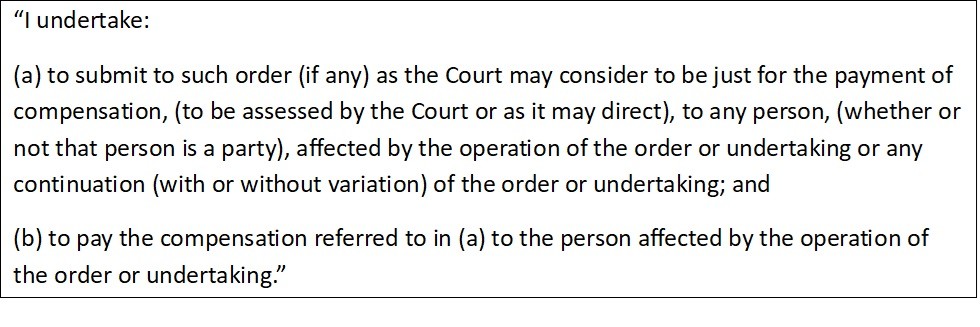 An Undertaking is a promise to the court, with the same force and effect as an order of the court (r316). The Undertaking should be in the correct form and filed once it is signed and dated. It is important to advise clients of the seriousness of giving an Undertaking; that it is a promise to compensate the other party for any damages caused by the injunction if it is later found the injunction should not have been ordered.
If your client instructs that they are not in a position to give an Undertaking, it is still possible to seek the injunction. Undertakings are not a precondition to the granting of an injunction and a party’s strained financial circumstances should not be a bar to justice: Blueseas Investment Pty Ltd & Mitchell & McGillivray [1999] FamCA 745. However, the lack of an Undertaking can be a relevant factor for the court in deciding whether to grant an injunction.
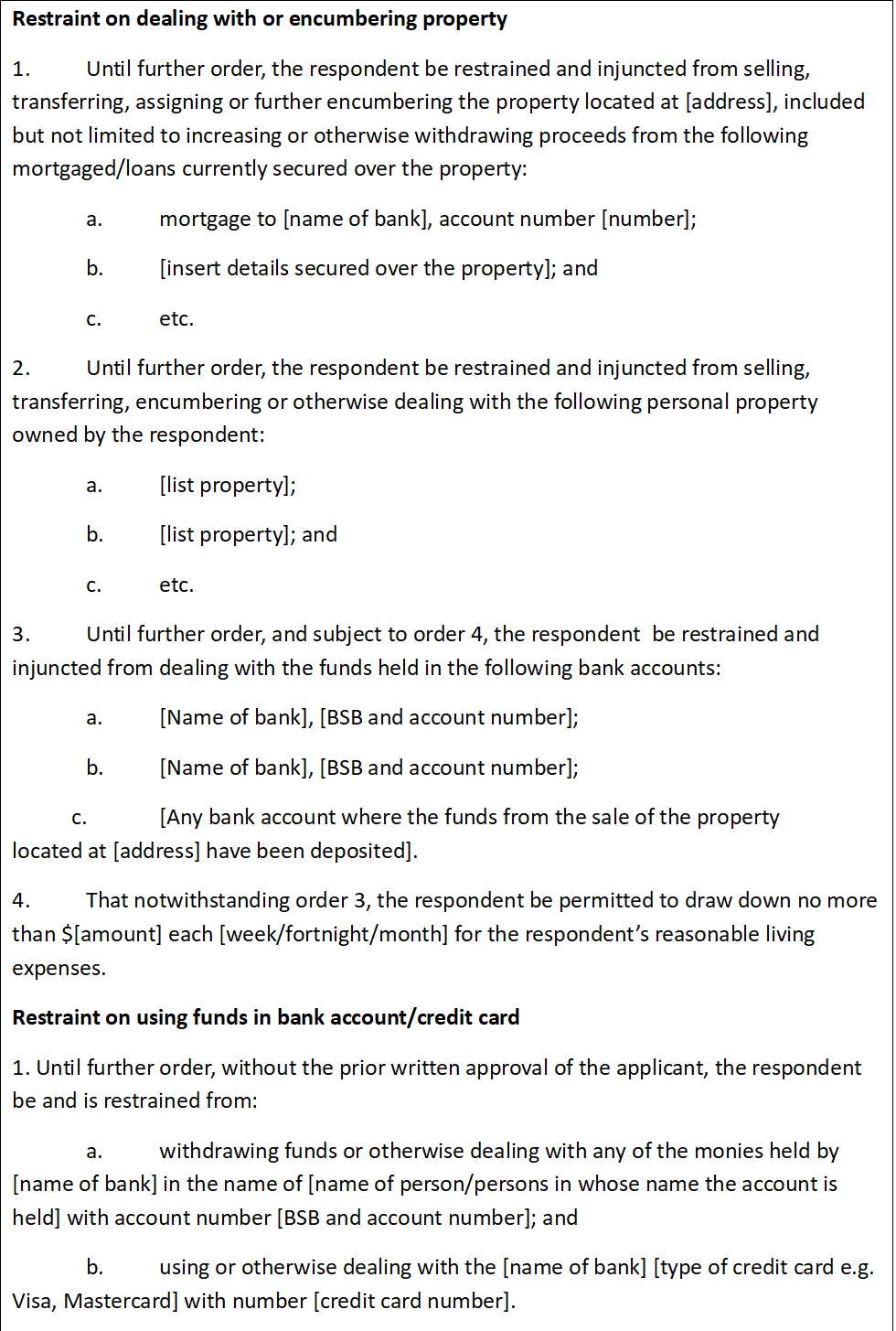
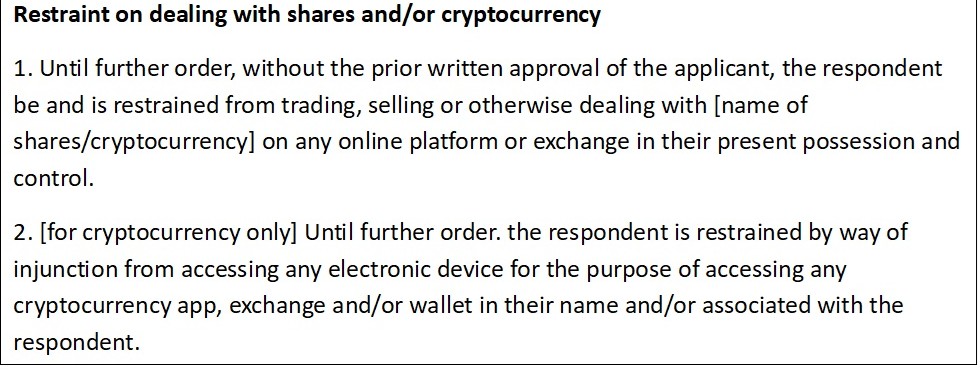
Precedent orders
The below orders are usually sought in the interim or procedural orders sought section of the Form 1/Form 1A or Form 2.
Restraint on dealing with or encumbering property
 Step 3: Service
How service should be conducted will depend on whether you are seeking orders on an ex parte basis or not.
If seeking orders on an ex parte basis (keeping in mind the high threshold of risk and urgency required) the interim orders regarding service are:

If you are not seeking an order on an ex parte basis, the usual requirements for service will apply. If the application is filed in a Form 1 Initiating Application, special service is required. If the application is filed in a Form 2 Application in a Case ordinary service is acceptable. See the chapter on Service of Documents for for detailed information.
Step 4: Court hearing process
First hearing
Ex parte – first hearing
If the matter is accepted as suitable for an urgent ex parte hearing after filing on the eCourts portal, you will receive a letter (via eCourts) from the Duty Registrar with the listing date and time, and requirements for service (that is, either no requirement, or service on short notice).
Depending on the urgency of the matter and seriousness of the risk, the court may make the interim injunctions sought at the first hearing. The court could also make orders for service if the hearing was ex parte, and bring the matter back for a further hearing in the near future. If the court is not satisfied regarding urgency, the matter will likely be programmed to a further directions hearing or an interim hearing at the court’s next available date, with orders for the respondent to be served.
Non ex parte – first hearing
Prior to the first hearing, the parties should attempt negotiations and if no agreement has been reached on the day of the hearing the parties or their lawyers should again attempt some final negotiations prior to appearing before the Judicial Officer. If unrepresented, a party can request the assistance of the duty lawyer at FCWA. If there are no duty lawyers available, the unrepresented party should be prepared to negotiate directly with the other party or their lawyer.
If there is an agreement, the parties should as soon as possible advise the court officer that a Minute of Interim Consent Orders is being prepared and signed. Once you have a signed copy of the Minute you should make a copy for each party and prepare to hand up the signed original to the Judicial Officer when the matter is called.
If there is no agreement, the Judicial Officer will address each party and ask questions to clarify facts. If the respondent has not filed documents, it is likely they will be given an opportunity and timeframe to do so. The court may make a decision about granting the injunction or not during this hearing, notwithstanding the respondent may not have filed documents. If the court is not satisfied it has all the relevant information before it, the court will set a date for an interim hearing.
Second hearing – interim hearing
At the interim hearing, if responding documents have been filed, the Judicial Officer will likely listen to submissions and make a decision about the injunction on an interim basis.
If there are no responding documents filed but there is proof the respondent has been properly served and there is urgency involved, the court may still make a decision about injunctions on an interim basis, particularly if the respondent is present in court. The balance of the matter otherwise remains programmed towards further dispute resolution or trial.
Failure of respondent to attend hearing
If a respondent fails to attend the first hearing (non ex parte), the court will check whether they were properly served and if there is a valid affidavit of service on file. If the court is satisfied that service has occurred, it is unlikely that the order will be made in the respondent’s absence. The matter is likely to be programmed to a further directions hearing or to an interim hearing.
If the respondent fails to attend the subsequent hearing, it is more likely that the court will make the orders sought.
Responding to an application
A respondent to an application for a property injunction can do the following:
- Negotiate with the applicant directly about the property injunction (and file a Minute of Consent Orders if there is agreement).
- Oppose the application by submitting it is unnecessary because they deny the conduct alleged by the applicant.
- Oppose the application by submitting they need to sell property or spend funds for legitimate living or business expenses.
- Oppose the application by submitting they need to be able conduct their financial affairs post separation and any property sold or funds spent will be appropriately taken into account and disclosed during property settlement proceedings.
If the applicant has filed a Form 1 Initiating Application, the responding documents required are a Form 1A Response to Initiating Application, Affidavit in support or Case Information Affidavit (PPP500) and Form 13 Financial Statement or Financial Statement (PPP500).
If the applicant has filed a Form 2 Application in a Case, the responding documents required are a Form 2A Response to Application in a Case and Affidavit in support, and Certificate of Conferral. Consider seeking leave to file, and filing, an amended Form 13 Financial Statement if the respondent’s financial situation has changed significantly since first filed (r201).
It is good practice to include a cover letter to court, stating which documents you are seeking to file.
Responding documents need to be filed and served 7 days before the hearing date: r153 FCR. If the application has been listed on short notice, responding documents should be filed at least 2 working days before the hearing date, if possible.
Enforcement when injunction is breached
Under section 112AD FLA / section 226 FCA the court may take such action as it thinks appropriate to punish contravention of an injunction. The penalties include:
- Requiring a person to enter into a bond.
- Imposing a sentence by order e.g. a community service order.
- Imposing a fine.
- Imposing a sentence of imprisonment (if the contravention was intentional or fraudulent).
In the most serious cases, a court can punish a person for contempt by committal to prison or fine or both (s 112AP FLA / s 234 FCA).
An applicant seeking enforcement of an injunction is required to file a Form 2 Application in a Case, and select ‘enforcement hearing – financial obligation’ in Part C. Other documents required are an Affidavit – General and Certificate of Conferral.
Reviewed: 20 August 2026