
Enforcing Property Orders
Chapter contents
- Introduction
- What kind of orders can be enforced?
- What enforcement powers does the court have?
- What are the different methods of enforcement?
- Who may seek enforcement of orders?
- Practical guide to filing for enforcement
- If an enforcement warrant is granted
- How to respond to an enforcement application
- What is a Third Party Debt Notice?
- Contravention proceedings
Introduction
When the Family Court of WA makes an order for the payment of money or the transfer of property, the payee (being the person to whom the money is owed or property is to be transferred) is entitled to enforce the order if the payer (being the person obliged to pay the money or transfer the property) does not do what is ordered. In this chapter the payee is referred to as the applicant and the payer as the respondent.
The relevant legislation is the Family Law Act 1975 (Cth) (“FLA”) for married couples, Family Court Act 1997 (WA) (“FCA”) for de facto couples, and the Family Court Rules 2021 (WA) (“FCR”).
Where the respondent has not complied with financial orders, your client may choose to file for different methods of enforcement and may also consider contravention proceedings. The processes and consequences for each are different and, in some cases, one type of application might be more appropriate than the other.
This chapter details how to seek enforcement mainly by way of sale of property and third party debt notices. The less common methods of enforcement such as contempt will not be considered here. This chapter also addresses contravention below.
See below for more details about the different types of orders.
What kind of orders can be enforced?
Under rule 370(1) the court may enforce the following orders:
- An obligation to pay money.
- An obligation to sign documents under section 106A FLA.
- An order that entitles a person to possess real property.
- An order than entitles a person to transfer or deliver personal property.
Under rule 370(2) an obligation to pay money includes:
- A provision requiring a payer to pay money under the FLA, FCA or Child Support (Assessment) Act 1989 or Child Support (Registration and Collection) Act 1988, or registered parenting plan, or a registered arbitration award, or maintenance agreement, or financial agreement, or overseas maintenance orders, among others.
- A liability to pay arrears accrued under an order or agreement.
- A child support debt or liability.
- A fine or the forfeiture of a bond.
- Legal costs, including the costs of enforcement.
What enforcement powers does the court have?
Section 105 FLA gives the court the power generally to enforce a court order. This power is discretionary, including the discretion not to enforce one of its own orders: Ramsey v Ramsey [1982] FamCA 42 and Wells (Deceased) (by her Legal Personal Representative, Ms M) and Wells & Anor [2016] FCWA 45.
The court has the power to:
- Require a person to attend court to answer questions and produce documents.
- Require the transfer of property.
- Require the transfer of possession of a chattel.
- Issue fines.
- Require a person to enter into a bond.
- Issue warrants for arrest.
Case law
Case law about the court’s enforcement power generally states that:
- The discretion to enforce the order or obligation is based on facts or circumstances arising since the date of the orders, including the parties’ conduct: Ramsey v Ramsey. In this case the parties resumed cohabitation after divorce and final property settlement. The parties then jointly improved their home. On separating again, the wife sought to enforce the property settlement orders. The husband successfully argued on appeal to the Full Court that it would be inequitable to enforce the orders when the parties had conducted themselves inconsistently with the orders.
- The court will consider whether in all the circumstances it is inequitable to enforce the order, according to “general notions of fairness”: McMillan & McMillan [2016] FamCA 387 at [39].
- The onus to show it would be inequitable to enforce the order falls on the payer or the party in default: Ramsey v Ramsey, Yilmaz & Yilmaz [2014] FamCA 663, [205].
- Where the applicant asks the court to make a “machinery” type order (that is, an order consequential upon the substantive orders) the court cannot vary the substantive orders. However the court may modify the “machinery” provisions of a property provided it does not affect the substantive property rights or cause undue hardship to either party: McDonald and McDonald [1976] FamCA 29, [13], Ravasini & Ravasini [1982] FamCA 62, [17], [26].
- It is best not to delay seeking enforcement of court orders, as the respondent could seek to rely on that delay to establish that it would not be equitable to enforce the order: McMillan & McMillan at [60] and [66]. A delaying party could be seen to have “acquiesced or assented to the other party’s conduct or position”, or the delaying party’s delay could have caused the other party to “prejudicially change their circumstances” McMillan & McMillan at [66]. Delay may mean that “[m]emories fade, records are lost and the defaulting party can assume that the other party has waived or agreed to the default. Importantly, the defaulting party may make other decisions relying on the fact that the obligation has not been enforced.” Barrington & Downton [2015] FamCA 426, [107]. In Barrington, the wife delayed enforcing a deed for 14 years after the first alleged default, explaining she trusted that the husband would eventually meet his obligations, that he told her many times he could not afford to pay at that time, that he tended to find funds when needed and that she wanted to keep a good relationship with him for the sake of the children. Effectively, the wife agreed or acquiesced to changes in the obligations in the deed. The court did not enforce the deed.
- “Failure to press for enforcement… could justify the court in exercising its discretion not to enforce an order”, including enforcing interest for the periods that enforcement was not “actively” pursued: Yilmaz & Yilmaz at [213]. This finding could be made even if the party held off enforcing “for the most altruistic of reasons”: Yilmaz & Yilmaz at [213].
What are the different methods of enforcement?
The court has several methods to ensure compliance with court orders under rule 374 , such as:
- Enforcement warrants for seizure and sale of real or personal property (Part 20 Division 3 FCR).
- Third party debt notices (Part 20 Division 4 of FCR).
- Sequestration of property (Part 20 Division 5 FCR).
- An order appointing a receiver (Part 20 Division 6 FCR).
- Execution of instrument by Registrar (s 106A FLA).
A party may also seek to recover monies owed by filing a contravention application, seeking an order for the court to punish the other party in breach of orders.
Who may seek enforcement of orders?
Under rule 373 the following persons may enforce orders:
- A party to the proceedings when the original orders were made.
- If the obligation is to pay money for the benefit of a party or a child, the obligation can be enforced by that party or child, or a person entitled by law to enforce the obligation for the party or child.
- A Marshal or officer of the court if the obligation is a fine or an order to forfeit a bond.
- The Child Support Registrar or person entitled to enforce a child support liability.
Practical guide to filing for enforcement
Step 1: Before filing documents
Parties are expected to attempt to negotiate a settlement before filing for enforcement.
Then, before applying for an enforcement order, it is recommended that the applicant obtain information to aid enforcement. The applicant can serve the respondent with a written notice requiring the respondent to complete and serve a Form 13 Financial Statement within 14 days after receiving the notice (r 379).
Alternatively, the applicant can file a Form 2 Application in a Case and supporting Affidavit – General without notice to the respondent, seeking the respondent:
- Complete and file a Form 13 Financial Statement or
- Disclose information or provide disclosure documents about the respondent’s finances to the applicant.
If the respondent does not comply with the notice or order to complete a Financial Statement or produce disclosure documents to the applicant, they commit an offence of strict liability, with a penalty of $5,500.
Step 2: Documents for enforcement hearing
If you have not been able to reach agreement on how to resolve the dispute by writing to the respondent, the next step is to file your documents for enforcement. The orders you seek in your application will depend on what your client wishes to occur:
- Enforcement warrant - if you want the respondent’s real or personal property to be sold to pay the debt or obligation.
- Third party debt notice - if you want the respondent’s employer or bank to pay you the money directly.
- Sequestration of property - if you want the respondent’s property or business to be temporarily placed in the hands of a sequestrator who has the power to collect rents, takings or profits from a property or business and pay the amounts to you instead. The court must be satisfied that there is an obligation with which the payer is refusing or failing to comply and that sequestration is the most appropriate enforcement method.
- Order appointing a receiver - if you want the respondent’s property or business to be placed in the hands of a receiver who has the power to secure repayment of the debt by sale or possession of the respondent’s or the business’ assets. The court must consider the amount of debt, the amount likely to be retained by the receiver and the probable cost of the receiver. The court can authorise the receiver to do anything that the payer is authorised to do. The court may require the receiver to provide accounts (which can be inspected by a party with notice) to ensure they are fulfilling their responsibilities. The court may require the receiver to provide security to realise their appointment.
- Execution of instrument by Registrar - if you want the respondent to sign a document to enable something to occur, such as a sale or transfer of property, and the respondent refuses to do so (s 106A FLA).
The documents to be filed are:
- Form 2 Application in a Case and
- supporting Affidavit – General, complying with rules 375 and 238.
Once these documents have been filed on the eCourts portal, a date will be allocated for the enforcement hearing, usually within 28 days.
The applicant may also seek orders for information to aid enforcement, requiring the respondent to produce documents at the enforcement hearing by serving with the application a list of the documents required and a written notice requiring that the documents be produced.
Affidavit of applicant
There are specific rules of the content of an affidavit supporting an application for enforcement orders (r 375). The affidavit must:
- state the orders sought
- attach the orders or agreement the applicant seeks to enforce
- set out the facts relied on including:
- name and address of the payee
- name and address of the payer
- that the payee is entitled to proceed to enforce the obligation
- that the payer is aware of the obligation and is liable to satisfy it
- that any condition has been fulfilled
- detail any dispute about the amount of money owed
- state the total amount of money currently owed including
- how the amount is calculated
- interest if any (rate as per rule 313)
- state the date and amount of any payments already made
- whether any other legal action has been taken to enforce the obligation including any other current applications
- state the amount claimed for costs including costs of proposed enforcement
- if seeking to appoint a sequestrator or receiver, attach a consent to the appointment as sequestrator or receiver, signed by the proposed person
- be sworn no more than 2 days before being filed.
Note: when seeking costs, the court will refer to the circumstances in section 114UB(3) FLA (s 237(3) FCA) to determine whether costs should be awarded to the applicant.
Example orders - enforcement by sale of property
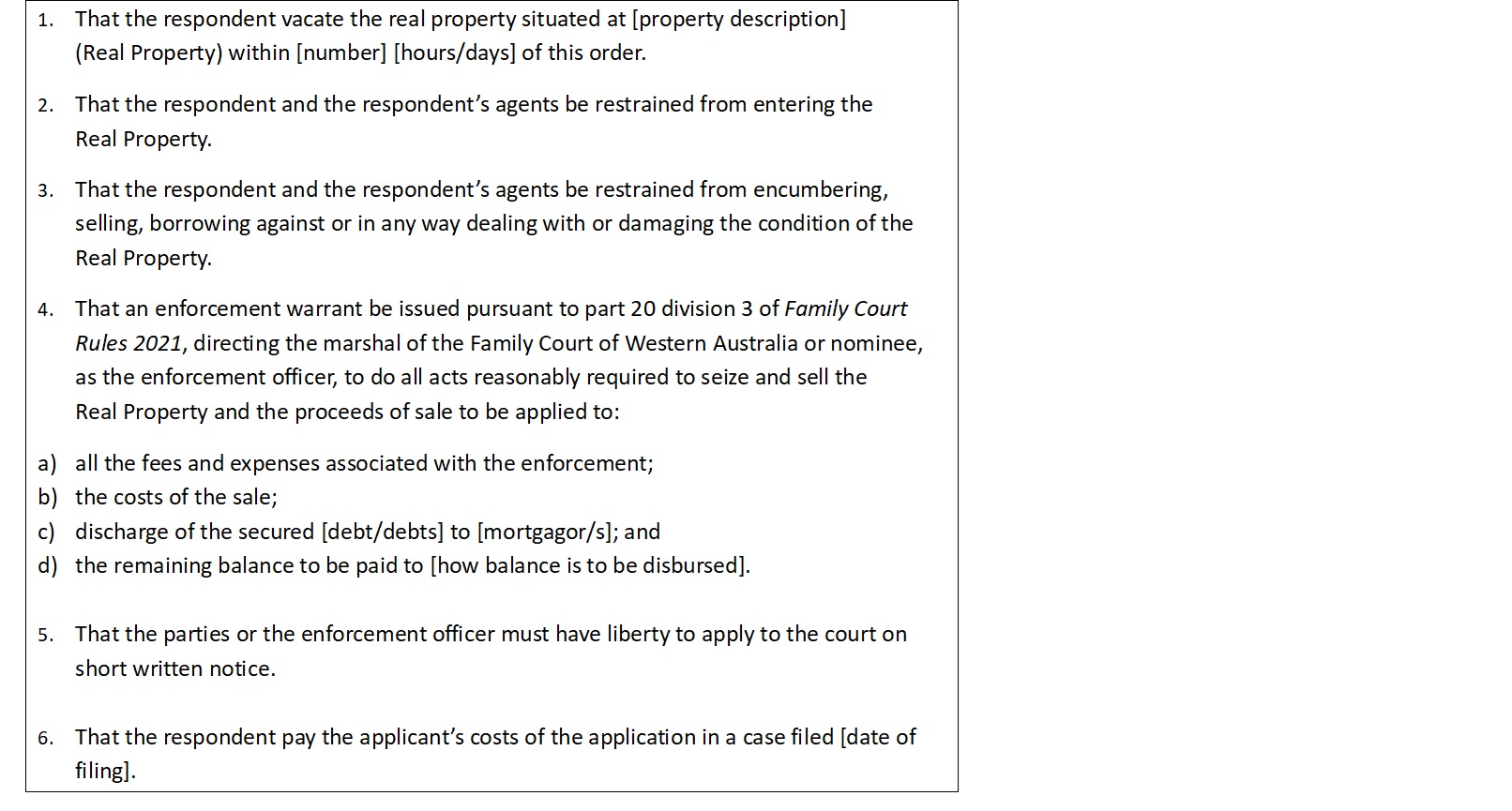
Note: See below for:
- Ancillary orders for real property where an enforcement warrant has been requested or issued
- Ancillary orders for personal property where an enforcement warrant has been requested or issued
- Example order – Third Party Debt Notice.
Execution of instrument by order of court (s 106A FLA)
Some court orders have a section 106A FLA order included as a default machinery provision if a party fails to execute an instrument, authorising an officer of the court to sign documents necessary to give effect to a court order when a party fails to do so. This can avoid the need for enforcement proceedings. However, in practice in the Family Court of WA, parties do not tend to seek these orders as part of final financial orders sought.
Example wording of default s 106A orders
- The Applicant is granted liberty to apply on reasonable written notice under Section 106A of the Family Law Act 1975/ s 221 of the Family Court Act 1997, in respect of enforcing the Respondent's obligations under these orders in the event of default.
Where a section 106A FLA order is not included in court orders, an applicant needs to wait until the other party has refused or failed to comply with their obligation before applying to the court. It is recommended that the applicant makes a written request to the other party to comply with court orders within a certain timeframe, failing which the applicant will seek a section 106A FLA order. Evidence of this request and non-compliance by the other party needs to be included in the affidavit in support. The documents to be filed are a Form 2 Application in a Case and supporting Affidavit – General.
Example wording of section 106A orders sought
- Pursuant to [section 106A of the Family Law Act 1975 (Cth) / section 221 of the Family Court Act 1997 (WA)] the principal registrar execute the documents required to implement paragraph [number] of the orders made [date] that are annexed to this application and marked “[number]” on behalf of [name of other party].
- That [name of other party] pay the applicant’s costs of and incidental to this application.
Step 3: Service
The applicant’s documents, along with the brochure Enforcement Hearings should be served on the respondent by special service at least 14 days before the date of the hearing (r 380).
Step 4: The enforcement hearing
The enforcement hearing is usually listed within 28 days of the application being filed.
The purpose of an enforcement hearing is to obtain information to help the enforcement of an order or other obligation and to help the court to determine a dispute or issue an enforcement order. The focus is on establishing the respondent’s capacity to pay the debt owed.
At the enforcement hearing, both parties must attend, with lawyers if represented.
It is expected that the parties will attempt negotiations prior to entering the court room. If there is agreement, the parties should as soon as possible advise the court officer that a Minute of Consent Orders is being prepared and signed. A Minute of Consent Orders is a signed written agreement made between the parties. Once there is a signed Minute, each party should have a copy, and the original Minute should be ready to hand up to the judicial officer when the matter is called.
If there is no agreement, the judicial officer will ask questions, and the respondent may also be cross-examined by the applicant or their lawyer. Typical questions will focus on:
- clarifying the respondent’s income, assets, liabilities and financial resources
- details of any property sold or disposed of since the orders were made, and
- reasons the respondent has failed to comply with orders.
The respondent is also entitled to cross-examine any witnesses.
A respondent who fails to serve a financial statement or the documents requested or to attend the hearing or fails to answer questions put to them is liable to be treated as a contempt of court and a penalty may be imposed. In Western Australia, the penalty is $5,500 (r 383). If the respondent fails to attend court, the court can issue a warrant for their arrest or adjourn the proceedings.
In practice, the court will give the parties the opportunity to fairly present their case and provide reasons for non-compliance. It may take more than one hearing for the court to establish that previous orders were not obeyed and enforcement is necessary.
After hearing the evidence, the court must determine the total amount owed before making any orders. The court can then make any of the following orders:
- a declaration of the total amount owing under an obligation
- that the amount be paid in full or by instalments by a certain date
- state the method of enforcement to be used
- that the obligation to pay remains
- refuse to enforce the order
- stay the enforcement application
- vary, suspend or discharge an enforcement order
- orders to prevent wastage or dissipation of assets
- require a respondent to file a Financial Statement or produce documents.
- make an order for costs.
The enforcement order
If the court decides to enforce the orders as per the application, the order must state:
- What kind of enforcement orders is made.
- The full name and address for service of the payee.
- The full name and address of the payer.
- The total amount to be paid, including:
- The amount owing under the obligation to pay money
- The amount of interest owing if any
- Any costs of enforcing the order.
Step 5: Enforcement warrants
An enforcement warrant appoints an enforcement officer to sell real estate or to seize and sell personal property.
If during the hearing it appears that the respondent is either unwilling or unable to repay the debt, the applicant can ask for an enforcement warrant to issue. You may wish to have the Enforcement Warrant (Form 16) pre-filled and ready to hand up in court, if the court is willing to issue the warrant.
The warrant asks the court to authorise the sale of the respondent’s real or personal property to repay the debt. There are two ways to do this:
- request the court issues an enforcement warrant and the Marshal/Sheriff of the court is then directed to seize and sell such real or personal property of the respondent that satisfies the payment of the total amount owed, and the costs of enforcing this warrant (r 385).
- make a further Application in a Case for an order for appointment of a trustee for the sale of the property (r 395).
An enforcement warrant must:
- Be signed, dated and sealed.
- Have an affidavit attached to it complying with rule 375 (see above) and including an undertaking to meet the enforcement officer’s expenses.
An enforcement warrant remains in force for 12 months from the date of issue.
Ancillary orders for real property where an enforcement warrant has been requested or issued
Where in relation to real property an enforcement warrant has been requested or issued, or an enforcement order for seizure and sale has been made, a payee, payer or enforcement officer may apply for ancillary orders under rule 395. These include an order that the real property be transferred or assigned to a trustee
- that a party sign all documents necessary for the transfer or assignment
- in aid of or relating to the sale of the real property, including an order:
- about possession or occupancy until sale (an enforcement officer might need to repossess property in order to sell it under an enforcement warrant)
- specifying the kind of sale (by contract conditional on approval by the court, private sale, tender or auction)
- setting a minimum price
- requiring payment of the purchase price to a trustee
- setting the particulars and conditions of sale
- for obtaining evidence of value
- specifying the remuneration to be allowed to an auctioneer, estate agent, trustee or other person
- about the disposition of the sale proceeds
- in relation to the reasonable fees and expenses of the enforcement (r 395(2)).
The court may hear an application under rule 395(2) in chambers (r 395(3)).
Enforcement warrants are only effective once they have been served on the respondent. If you expect that the respondent might abscond once served with an enforcement warrant, you should consider applying for a warrant of seizure and detention first. The respondent will have no notice of the application (they will first become aware of it when the enforcement officer is at their door about to take possession of their items). An enforcement warrant can then be issued (if the respondent still does not comply), authorising the enforcement officer to sell their items.
Example orders - enforcement by appointing the applicant as sole trustee for sale of property:
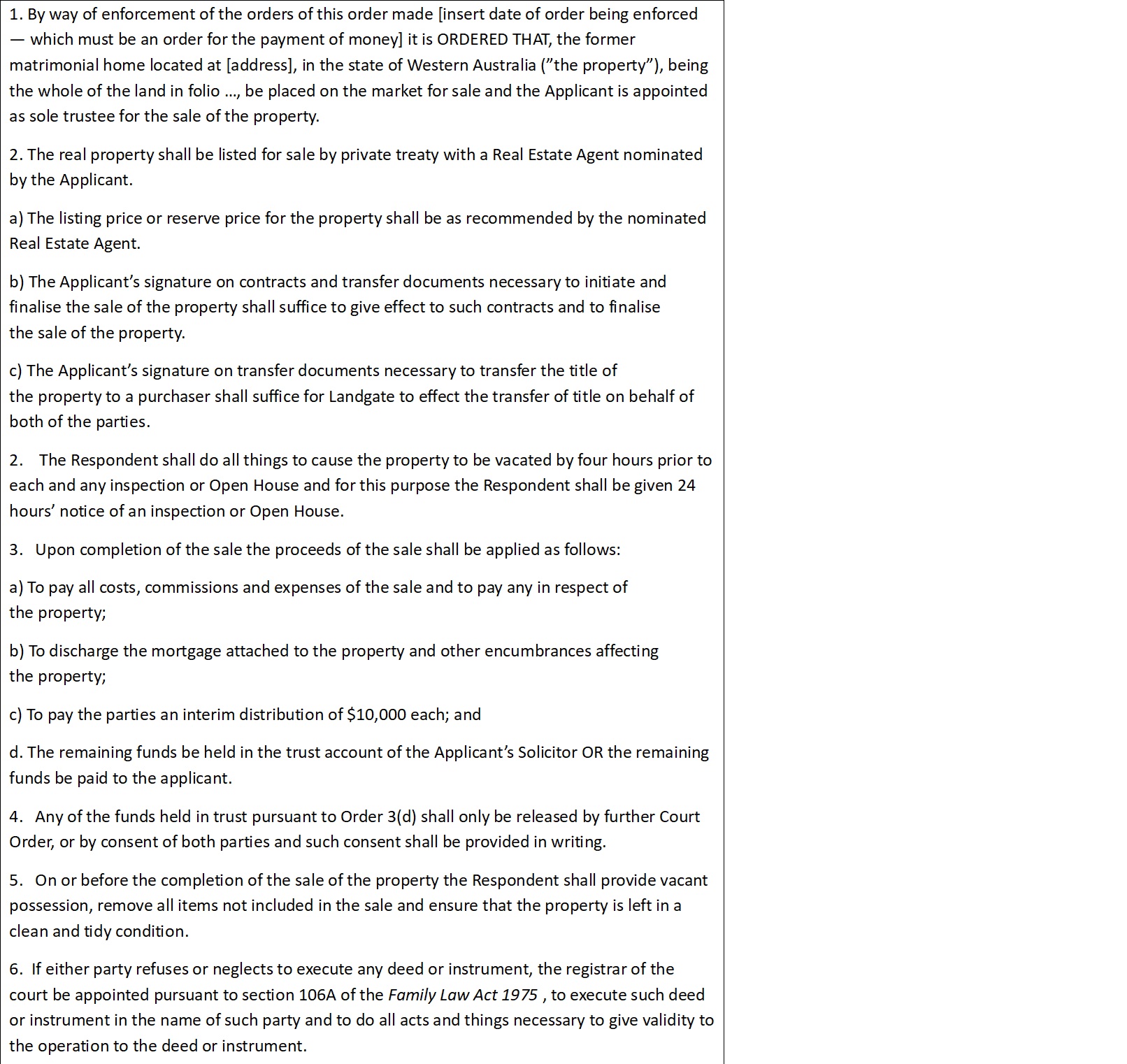
 Ancillary orders for personal property where an enforcement warrant has been requested or issued
If the court orders that a payer is to deliver personal property and they fail to do so, you can apply for the court can issue a warrant for delivery, without notice to the defaulting party, by filing Form 2 Application in a Case and supporting Affidavit – General (r 426). The warrant for delivery authorises the enforcement officer to seize the item and delivery it to the receiving party (r 426).
If the court makes an order specifying the time for compliance and a payer fails to comply, you can apply for a warrant for the seizure and detention of all the payer’s real and personal property, without notice to the payer, by filing Form 2 Application in a Case and supporting Affidavit – General (r 427(1)). The warrant authorises the enforcement officer to seize and detain the property until compliance with the order. Once it is complied with, the enforcement officer must return the items to the payer, after the payer has paid the enforcement officer’s costs (r 427(2)).
If an enforcement warrant is granted
Duties of enforcement officers
An enforcement officer is defined in rule 4 as a Marshal, delegate of the Marshal or any other office of the court, or a person appointed by the court for the purpose of enforcing an order.
Under the FCR, an enforcement officer has specific duties in relation to the way in which they conduct the seizure and sale of property. In particular:
- Unless the seized property is perishable, prior to selling, an enforcement officer must publish a notice of the sale, at least once before the sale, in a newspaper circulating in the town or district in which the sale is to take place stating the time and place of the sale; and the details of the property to be sold. A copy of the notice must be served on the payer at least 14 days before the intended date of sale. If the property in question is real property, the notice of sale must also include:
- a concise description of the real property, including its location, which would enable an interested person to identify it;
- a general statement about any improvements of the real property;
- a statement of the payer's last known address;
- a statement of the payer's interest, and any entries in the land titles register, which affect or may affect the real property as at the date of the notice; and
- a statement about where a copy of the contract for sale of the property can be obtained (r 390).
- The enforcement officer must, in good faith and with reasonable care having regard to all circumstances relevant to the sale of property, fix a reasonable price for the property, taking into consideration the current value of the property, and the amount of the highest bid received for the property at any auction of the property (r 391).
- The enforcement officer must specify as a condition of the sale of the property that the buyer must pay:
- a deposit of at least 10% of the price fixed for the property when the enforcement officer accepts the buyer’s offer for the property; and
- the balance of that price within the period determined by the enforcement officer (with the period to be no longer than 42 days); or
- the whole of the price fixed for the property when the enforcement officer accepts the buyer's offer for the property (r 392).
- Within 7 days after the day of settlement of a sale of property, the enforcement officer must file a notice in the court stating:
- the details of the result of the sale; and
- the reasonable fees and expenses of the enforcement (r 393(1)).
- The enforcement officer must pay from the money received from the enforcement:
- any amount still owing to the enforcement officer for the reasonable fees and expenses of the enforcement;
- the balance of any amount owed to the payee under the enforcement warrant; and
- the remaining amount (if any) to the payer (r 393(2)).
Duties of payees
When applying for an enforcement order in relation to real property, at least 28 days before an enforcement officer sells real property the payee must:
- send to the payer, at the payer's last known address, and to any mortgagee or other person who has an encumbrance registered on the title to the property that has priority over the enforcement warrant, written notice stating:
- that the warrant has been registered on the title to the property
- that the enforcement officer intends to sell the property to satisfy the obligation if the total amount owing is not paid, or arrangements considered satisfactory to the payee have not been made by a date specified in the notice
- the enforcement officer's name and address (r 394(1)(a)).
- provide to the enforcement officer of:
- proof of compliance with the written notice requirement
- evidence of registering the warrant on the land titles register
- details of the real property proposed to be sold, including the address and description of the land title of the property
- details of any encumbrance registered against the real property
- the costs incurred to register the enforcement warrant
- the current value of the real property, as stated in a real estate agent's market appraisal (r 394(1)(b)).
The payee must pay the enforcement officer the reasonable fees and expenses of enforcement. These may be included in the costs of the enforcement warrant, which are recoverable under the warrant.
In relation to personal property, the payee should provide to the enforcement officer details to assist with collection of specific items, such as the location and whether any other person might have an interest in the property (e.g. as a part owner or under a hire purchase agreement, lease or lien).
The payee should properly notify any third party whose rights may be affected by the enforcement application (e.g. part owners or creditors).
Objecting to an enforcement warrant
Any person affected by an enforcement warrant (the affected person - the payer) may serve a notice of claim on the enforcement officer (r 396(1)). The notice of claim must:
- Be in writing.
- State the name and address of the affected person.
- Identify each item of property forming the subject of the claim.
- State the grounds of the claim (r 396(2)).
The enforcement officer must serve a copy of the notice of claim on the payee (r 396(3)).
The enforcement warrant must not be executed until at least 7 days after the notice of claim was served on the payee (r 396(4)).
A payee served with a notice of claim must give the enforcement officer written notice about whether the payee admits or disputes the claim, within 7 days after the notice of claim was served (r 397).
If a payee admits an affected person’s claim, the enforcement officer must return the property to its lawful owner in a way consistent with the affected person’s claim (r 398).
If the payee either disputes or does not admit the claim or fails to respond to it, each party to the warrant, the affected person or the enforcement officer may apply for an order to determine the claim (r 399(1), (2)). The Registry Manager must fix a date for hearing this application as close as practicable to 14 days after filing (r 399(3)). The application must be served at least 7 days prior to the hearing on each party to the warrant, the affected person and the enforcement officer (r 399(4)).
On the hearing of an application under rule 399, the court may:
- allow the claim; and
- order that the affected person and anyone claiming under the affected person be barred from prosecuting the claim against the enforcement officer or payee.
How to respond to an enforcement application
Under rule 381 the respondent must:
- prepare and file a Form 13 Financial Statement and serve it on the applicant at least 7 days before the hearing
- attend the hearing
- produce any requested documents
- answer questions asked of them by the judicial officer.
A respondent may be penalised for failing to meet these obligations.
Although not required, the respondent may additionally file:
- A Form 2A Response to Application in a Case seeking to discharge, suspend or vary the order (r 378).
- A supporting Affidavit – General explaining:
- if they are seeking to discharge or suspend the order, why the order has not been complied with
- how their financial position has changed since the order was made such that it is difficult or impossible to comply with the order
- if they are seeking the vary the order, how the order should be varied.
What is a Third Party Debt Notice?
A Third Party Debt Notice is a document issued by the court at the request of the applicant to enforce an obligation to pay money. It is directed to a person (third party) who it is alleged owes money to the payer or is the employer of the payer.
It is seeking that a third party who allegedly owes money to an ex-partner, e.g. the ex-partner’s employer or a bank that is holding funds on deposit, pays that money to the applicant to satisfy the debt owed. The documents to be filed are Form 17 Third Party Debt Notice and supporting Affidavit – General (complying with rule 375 – see above), outlining the circumstances surrounding the debt owed. These documents, along with the brochure Third Party Debt Notices should be served on the respondent and the third party.
Once a Third Party Debt Notice is issued, it comes into force at the end of 7 days after the order is served on the third party debtor and it remains in force until the total debt is paid or the notice is set aside (r 407).
The payer must give the court written notice if:
- They stop being employed by the relevant third party.
- They have a new employer.
Third Party Debt Notices attached to a person’s employer are generally successful where a payer wants to stay in their particular job (e.g. a long-term government or company employee who will lose superannuation or other benefits by leaving). Some payers, however, will be prepared to leave their job to avoid a Third Party Debt Notice. They may become self-employed, or they may not inform the court of their new employment. In these situations, using a Third Party Debt Notice should be a method of last resort or perhaps even avoided.
Example order – Third Party Debt Notice
1. Seven days after you are served with this notice, you must deduct from the respondent's (payer's) earnings and commission each pay day an amount of 20%, calculated as follows:
Amount $20% of payments due to respondent
Less administrative expenses $5
= Amount Deducted
(Then the correct figure needs to be inserted in that part D, being the figure of e.g. $29,232.45).
Duties of employer third parties
Under a Third Party Debt Notice, the payer’s employer has a number of duties in relation to the debt, including:
- deducting from the payer’s earnings the amount specified in the notice;
- paying the amount deducted to the person specified in the notice;
- providing the payer with a notification specifying the deductions; and
- ensuring that an amount deducted from the payer’s earnings does not reduce those earnings to less than the protected earnings rate (r 406).
The employer is entitled to deduct from the payer’s earnings an administrative charge of $5 per deduction (r 406(1)(b)).
A third party commits an offence if they do not comply with a Third Party Debt Notice or unfairly treat an employee as a result of the notice.
Responding to a Third Party Debt Notice
Any person affected by a Third Party Debt Notice may apply for an order determining the claim (r 410). This party must file and serve on the other parties a Form 2 Application in a Case and an Affidavit General in support containing the facts and circumstances relied upon.
The third party who has been served with the notice may dispute the payer’s ability to pay by applying to dispute the liability or for procedural orders (r 408(1)). The third party debtor must file and serve on the payer and the payee a Form 2 Application in a Case and an Affidavit General in support containing the facts and circumstances relied upon.
A registrar may hear this application in chambers (r 408(2)). However, the registrar can decline to make orders in chambers and list the matter for hearing before a judge. The court may:
- stay the enforcement of the Third Party Debt notice;
- order that a party produce further information or evidence;
- dismiss the application;
- vary, suspend or dismiss the Third Party Debt Notice;
- order that any money that has been paid out in error to the payee be paid into and held in court, returned to the third party debtor or sent to the payer or a co-owner of the debt;
- if the third party debtor has not paid what was required to be paid, order that the third party debtor pay all or part of what was required; and
- make a costs order (r 408(3)).
Contravention proceedings
Definition of contravention
A contravention is a failure to comply with financial orders. A person may contravene an order by intentionally failing to comply with it or by making no reasonable attempt to comply with it (s 112AB(1)(a) FLA, s 224(1)(a) FCA).
You can bring a contravention application against a party or a third party. Parties may contravene orders, as can third parties who are not bound by the orders, if they prevent a party’s compliance or if they aid or abet a contravention by a party (s 112AB(1)(b) FLA, s 224(1)(b) FCA).
The applicant (the person filing the contravention application) files a Form 18 Application – Contravention with a supporting Affidavit – General setting out the facts about the money owed by the respondent.
Defence to contravention
A defence to contravention is having a reasonable excuse for contravention. The two grounds for reasonable excuse are:
- the respondent did not understand the obligations imposed by the order; and
- the court is satisfied that the respondent ought to be excused for the contravention (s 112AC FLA, s 225 FCA).
Hearing of a contravention application and the onus and standard of proof
If the respondent denies a contravention, the court will hear the matter and determine it based on the evidence of the parties and any witnesses.
Usually, the applicant will be cross-examined on their evidence as contained in their affidavit. If the respondent would like to give evidence, it is usually done orally and tested by cross-examination.
The onus is on the applicant to prove the contravention occurred. The onus is on the respondent to prove reasonable excuse. The standard of proof is on the balance of probabilities (In the Marriage of Lindsey [1995] FamCA 117, at [29] and [42], section 226(1)(b) FCA as to the standard of proof for any reasonable excuse).
The court’s powers when a contravention is found
If the court finds that the respondent has contravened the orders without reasonable excuse, under section 112AD FLA (or s 226 FCA), the court can:
- Require the respondent to enter into a bond in accordance with section 112AF FLA (s 228 FCA).
- Punish the respondent with a fine (under the FLA, a fine of not more than 60 penalty units, a maximum of $19,800, under the FCA not more than $6,600 for a natural person and not more than $33,000 for a body corporation).
- Punish the respondent with imprisonment in accordance with section 112AE FLA (s 227 FCA) (a last resort).
Orders made under section 112AD FLA may be to take effect:
- immediately
- at the end of a specified period, or
- on the occurrence of a specific event (s 112AD(3) FLA, s 226(5) FCA).
Where the court makes orders under section 112AD FLA (or s 226 FCA), the court may make such orders that it considers necessary to ensure compliance with the order that was contravened (s 112AD(4) FLA, or s 226(6) FCA). This could include putting the respondent on notice that if they continue to breach the orders they will be punished and enforcing the orders under rule 376.
If enforcing the orders under rule 376, the court may do so by:
- seizing and selling real or personal property
- issuing a Third Party Debt Notice
- a sequestration order; and
- appointing a receiver
- an order for costs.
The court that made the order may vary or discharge orders made under section 112AD FLA or section 226 FCA (s 112AK(1) FLA, s 231(1) FCA). If the court varies the order, the varied order must be an order that could be made under section 112AD FLA or section 226 FCA (s 112AK(2) FLA, s 231(2) FCA). If the court discharges the order, the court may make another order under section 112AD FLA or section 226 FCA (s 112AK(3) FLA, s 231(3) FCA). Where the court varies or discharges an order made under section 112AD FLA or section 226 FCA, it may give such directions as to the effect of the variation or discharge as it considers appropriate (s 112AK(4) FLA, s 231(4) FCA).
Bonds
A bond is to be for a specified period of up to 2 years (s 112AF(2) FLA, s 228(2) FCA).
A bond may be:
- with or without surety; and
- with or without security (s 112AF(3) FLA, s 228(3) FCA).
The conditions that may be imposed by a bond include a condition requiring the respondent to be of good behaviour (s 112AF(4) FLA, s 228(4) FCA).
Subsections 112AF(5) FLA and 228(5) FCA sets out the court’s duty to explain the bond to the respondent, before requiring the respondent to enter into the bond. In language likely to be ready to be understood by the respondent, the court must explain:
- the purpose and effect of the proposed requirement, and
- the consequences that may follow if the respondent fails to enter into the bond or, having entered into the bond, fails to act in accordance with it.
Imprisonment
The court is not to impose a term of imprisonment in respect of a maintenance order unless it is satisfied that the contravention was intentional or fraudulent (s 112AD(2A) FLA, s 226(4) FCA).
A sentence of imprisonment must be for:
- a specified period of 12 months or less or
- a period ending when the person complies with the order concerned or has been imprisoned for 12 months or such lesser period as specified by the court;
whichever happens first (s 112AE(1) FLA, s 227(1) FCA).
The maximum sentence is 12 months in respect of each offence (In the Marriage of Schwarzkopff [1992] FamCA 30 at [47]). The court can impose separate sentences for several breaches of orders dealt with at one time (Schwarzkopff at [47]).
The court is not to sentence a respondent to imprisonment unless it is satisfied, in all the circumstances of the case, that it would be not be appropriate for the court to deal with the contravention pursuant to any other paragraphs of section 112AD(2) FLA or section 226(3) FCA (s 112AE(2) FLA, s 227(2) FCA).
If the court sentences a respondent to imprisonment, the court must:
- state the reasons why it was satisfied in accordance with s 112AE(2) FLA or s 226(3)(d) FCA; and
- cause those reasons to be entered into the court’s records (s 112AE(3) FLA, s 227(3) FCA).
However, the court’s failure to comply with section 112AE(3) FLA or section 227(3) FCA does not invalidate a sentence (s 112AE(4) FLA, s 227(4) FCA).
A court sentencing a respondent to imprisonment may:
- Suspend the sentence on terms and conditions determined by the court and terminate a suspension (s 112AE(4A) FLA, s 227(4a) FCA).
- If it considers it appropriate, direct that the respondent be released upon the respondent entering into a bond after they have served a specified part of their term of imprisonment (s 112AE(5) FLA, s 227(5) FCA). This bond (with or without surety) is that the respondent will be of good behaviour for a specified period of up to 2 years (s 112AE(6) FLA, s 227(6) FCA).
Without limiting the circumstances in which a court may discharge an order under section112AK FLA or section 231 FCA, a court that has sentenced a respondent to imprisonment for a period in accordance with section 112AE(1)(b) may order the release of the respondent if satisfied that the respondent will, if released, comply with the order concerned (s 112AE(7) FLA, s 227(7) FCA).
A respondent who serves a sentence of imprisonment for failure to make a payment under a maintenance order is still liable to make the payment (s 112AE(8) FLA, s 227(8) FCA).
Where the respondent is being prosecuted for offences under other laws
If an act or omission by the respondent constitutes an alleged contravention of an order and an alleged offence under any other law and the respondent is prosecuted in respect of that offence, the court must:
- dismiss any proceedings in relation to the alleged contravention, or
- adjourn those proceedings until the prosecution has been completed (s 112AM(1), (2) FLA, s 232(1) and (2) FCA).
Nothing in section 112AM FLA or section 232 FCA renders a respondent liable to be punished twice in respect of the same act or omission (s 112AM(4) FLA, s 232(4) FCA).
Reviewed: 20 August 2026