
Interim Property Settlement Orders (including Litigation Funding)
Chapter contents
- Introduction
- Interim property settlement since the 2025 amendments to section 79 FLA and Shinohara & Shinohara [2025] FedCFamC1A
- The court’s power to make interim property settlement orders
- Interim orders must comply with the requirements of section 79 FLA and section 205ZG FCA and must be able to be varied or reversed
- The circumstances in which an interim property settlement order may be appropriate
- The court’s power under s 79FLA or s 205ZG can be exercised in a succession of orders
- The “claw back issue”
- Litigation funding orders
- Practical Guide to applying for litigation funding orders
- Responding to an application for litigation funding
Introduction
Generally, section 79 Family Law Act 1975 (Cth) (“the FLA”) and section 205ZG Family Court Act 1997 (WA) (“the FCA”) are used to make final property settlement orders. In some cases, however, it may be appropriate to seek interim property settlement orders. A common example is where one party needs a lump sum for a particular purpose, such as to purchase a home, pay a debt, or pay legal costs, accounting fees or valuation fees.
A party cannot seek interim property settlement orders unless an application for final property settlement orders is also on foot.
Interim property settlement since the 2025 amendments to section 79 FLA and Shinohara & Shinohara [2025] FedCFamC1A
Most case law and commentary on interim property settlement arose before the recent decision of Shinohara & Shinohara [2025] FedCFamC1A.
In Shinohara, the Full Court of the Federal Circuit and Family Court of Australia confirmed that section 79 FLA does not permit add-backs of notional property as dollar amounts to the property pool. This position was confirmed by the commencement of section 79(3)(a) FLA (added by the Family Law Amendment Act 2024 (Cth) from 10 June 2025):
The court “is to identify:
(i) the existing legal and equitable rights and interests in any property of the parties to the de facto relationship or either of them; and
(ii) the existing liabilities of the parties to the de facto relationship or either of them”.
While Shinohara was decided before the commencement of section 79(3)(a) FLA, the Full Court referred to it as an amendment coming in the Family Law Amendment Act 2024 (Cth) (at [121]:
“The text of s 79(3)(a)(i) is clear. Only the existing property of the parties is to be identified and only that existing property is to be divided or adjusted.”
The Full Court also considered new ss 79(4) and (5) FLA at [123]-[125], holding that:
- Section 79(4), “Considerations relating to contributions”, could cover any contributions up until the date of trial, which would include any use of property disposed of until that date.
- Section 79(5), “Considerations relating to current and future circumstances”, covers the effect of waste on property or financial resources (s 79(5)(d)) and contributions to any property and financial resources up until trial (s 79(5)(n) - which could cover interim property settlement). The “catch all” provision now to be in s 79(5)(v) could also cover property disposed of prior to trial or expenditure on legal fees.
The Full Court said (at [127]):
“As notional property does not exist, it cannot be identified to form part of the balance sheet recording the current items of the parties’ property.”
Some have suggested that parties may be less likely to agree to consent orders for interim property settlement now (including orders for litigation funding), because there is no certainty that the court will add the dollar value back to the property pool. Rather, the court’s preference is to make a percentage adjustment, which may disadvantage the party who did not receive an interim property settlement.
However, O’Brien J in the FCWA decision of Neville and Bowen [2025] FCWA 226 took a different view in considering the issue of addbacks post-Shinohara and the amendments to section 79 FLA. His Honour held:
- Shinohara leaves room for property disposed of post-separation to be considered using limited mathematical calculations and percentages as part of a holistic assessment of contributions and prospective factors in the broad exercise of the discretion under s 79 FLA, but it is not to be done at the first stage of s 79(3)(a)(i) – identifying the existing assets and liabilities on the balance sheet (at [82]-[100]).
- Interim property distributions and litigation funding are to be considered in this way, rather than as forming part of the balance sheet in the first stage (at [103]).
- A cautious approach needs to be taken to ensure these considerations are not given disproportionate weight by the use of mathematical calculations (as opposed to considerations which are less quantifiable) (at [101]).
In relation to interim property settlements, his Honour stated (at [105]):
“…it is not uncommon for interim orders altering property interests to be made, particularly in the course of long‑running proceedings. Where those orders effect equal interim distributions to the parties, little difficulty arises. Where, however, they effect a distribution only to one party, or otherwise unequal distributions, attention must still be paid to them in determining the justice and equity of the final outcome. That will often be appropriately achieved by direct reference to the value of the property received by either party as a result of that interim alteration, whether or not that property still exists.”
This is an area to watch in the future, as more decisions are made.
The court’s power to make interim property settlement orders
Interim orders must comply with the requirements of section 79 FLA and section 205ZG FCA and must be able to be varied or reversed
A final property settlement order must comply with the requirements of section 79 FLA and section 205ZG FCA, including being just and equitable under section 79(2) FLA and section 205ZG(3) FCA.
However, an interim property settlement order does not bind the court making the final property settlement order (Gabel & Yardley [2008] FamCAFC 162). The Full Court in Strahan & Strahan (interim property orders) [2009] FamCAFC 166 agreed (at [111] and [136]) with the Full Court in Gabel & Yardley (at [69]) that any interim order made must be able to be varied or reversed without recourse to section 79A FLA or an appeal. Otherwise, the orders might not be permitted under section 79(2) FLA because they would not be just and equitable.
The circumstances in which an interim property settlement order may be appropriate
The Full Court of the Family Court of Australia in Harris & Harris [1993] FamCA 49 (at [43]) noted the following about the court’s power to make interim property settlement orders:
In most cases, it is preferable (considering the interests of the parties and the court) for property settlement to be considered only once at a final hearing. Interim property settlement orders should be made only in the most “compelling” circumstances arising before a final hearing can determine the matter.
Interim property settlement is determined under section 79 FLA. While the court is unlikely to have all the evidence at an interim stage, the determination must be made within the “general framework” of section 79 FLA based on the evidence available at the time.
The court must exercise this power “conservatively”, because it is going to be “a somewhat imprecise exercise”. The court must be satisfied that there is sufficient remaining property to meet the reasonable expectations of both parties at the final hearing, or that the interim order could be reversed or adjusted if this was later considered necessary.
The Full Court partially overruled Harris in Strahan, rejecting the first consideration (at [132]:
A party seeking an interim property settlement order does not need to demonstrate “compelling circumstances”, but must show that “it is appropriate to exercise the power”. The court has a “wide and unfettered discretion” under s 79 FLA, but the court must consider that the usual order under s 79 FLA is a “once and for all order made after a final hearing”.
The court’s power under s 79FLA or s 205ZG can be exercised in a succession of orders
The Full Court in Gabel & Yardley noted (at [57] and [67]) that the court’s power under section 79 FLA does not have to be exercised in one go and can be exercised “in a succession of orders” until the power is “exhausted” (that is, when there remains no more property which could be the subject of an order under section 79 FLA). The Full Court in Strahan agreed (at [110] and [113]).
This approach was taken by the Family Court of Australia in Salters & Salters [2020] FamCA 138. The court had made interim property orders permitting the wife to roll out 50% of the total value of a self-managed super fund. Each party had $3,773,447 in superannuation at that point. At trial 7 months later, the wife had invested her superannuation and the value had decreased to $2,673,583, but the husband’s superannuation had increased to $4,087,762. The husband argued that the superannuation values at the time of the interim property settlement should be used in working out the final property division at trial. The court rejected this argument and used the values as at the time of trial, holding this was just and equitable. The court held, with reference to Gabel & Yardley, that there can be only one exercise of power under section 79 FLA (but the power can be exercised in stages and by making orders on different dates (at [66]-[67]). The court held, again with reference to Gabel & Yardley, that the “overriding obligation is to make a just and equitable order” (at [82]).
The “claw back issue”
The Full Court in Strahan addressed the “claw back issue” (at [139]):
A party seeking an interim property settlement order must establish more than “the mere fact that upon the final hearing [they] would receive the property being sought (or an amount in excess of the funds being sought) from the other party”.
The “claw back issue” was previously considered by the Full Court in Zschokke & Zschokke [1996] FamCA 79.
The “claw back issue” was argued in Levy & Prain [2012] FamCAFC 92. Here the wife appealed an order for litigation funding of $250,000, arguing that it could not be clawed back if the husband received less than this amount at a final hearing. The Full Court upheld the trial judge’s decision, noting it was consistent with Zschokke (at [70]). The Full Court noted that there was no evidence to establish that the husband was likely to receive less than this amount in a final property settlement. The trial judge could not and was not required to find that that the husband would receive at least $250,000 by way of final property settlement before ordering the litigation funding.
Litigation funding orders
Litigation funding orders, which are interim property settlement orders to enable a party to pay their legal costs are colloquially called “interim costs orders” or “litigation funding orders” or “interim or partial property settlement”. For the purpose of this chapter, they will be referred to as “litigation funding orders”.
Note: litigation funding orders in this chapter are different from a costs order application made at the end of proceedings, such as an application for costs on a party/party or indemnity costs basis, which is intended to reflect the outcome of the matter where one party has been wholly unsuccessful or the conduct of a party warrants such an order. See this chapter which deals with costs.
Keep in mind that a litigation funding order can be made in either a parenting or a property settlement matter.
The court’s power to make litigation funding orders
The court can make litigation funding orders under three heads of power, summarised in Paris King Investments Pty Ltd v Rayhill [2006] NSWSC 578:
Under s 80(1) FLA / s 205ZI FCA interim property order, which directs the court to section 79 FLA / section 205ZG FCA alteration of property interests. The court may make such as an order as it considers appropriate provided it is satisfied that it is just and equitable to make the order.
Under section 114UB(2) FLA / section 237(2) FCA costs order, either to fund ongoing litigation or as security to prevent abuse of court process. The court may make such order as it considers just provided there are justifying circumstances.
Under section 72 FLA / section 205ZC FCA and section 74 FLA / section 205ZCA FCA spousal maintenance orders. The court may make such order as is proper.
This chapter will deal with applications made under heads of power 1 and 2 as above. Applications made under spousal maintenance are covered separately. See the chapter on urgent and interim spousal maintenance
In many cases, the court will make an order for the release of funds to a party and will leave the final categorisation of the funds for determination by the trial judge. This means that at the final hearing, the court will decide if funds previously released were made on the basis of an interim property settlement, interim costs order or interim spousal maintenance order. However, in making the interim litigation funding order, the court must still identify the source of the power relied on (even if the “nature” or “basis” of the interim order may later be changed). The Full Court majority in Kyriakos & Kyriakos [2013] FamCAFC 22 explained (at [37]) that “This is because, as Brereton J succinctly explained in Paris King Investments, it is “the source of power that determines the necessary preconditions and relevant considerations for making the order.””
In Kyriakos, the Federal Magistrate made an interim litigation funding order in favour of the wife against a third party, the husband’s father (who conceded the court had the power to make the order). However, the Full Court allowed the third party’s appeal, holding that that the Federal Magistrate failed to identify the source of the power for the interim litigation funding order.
How the court decides
There is a general rule that each party must bear their own costs in family law proceedings (s114UB(1) FLA / s 237 FCA). However, it is not uncommon for a party to seek funds at an interlocutory stage in proceedings.
The court considers the following factors when deciding whether to make a litigation funding order under section 114UB(2) FLA / section237(3) FCA:
The financial circumstances of each party, such as:
- Is the respondent in a financially stronger position?
- Is the respondent able to meet their own litigation costs?
- Is the applicant unable to meet their own litigation costs?
- Whether any party receives legal aid and the terms of the grant of aid;
- The conduct of the parties in the proceedings such as:
- Has one party breached previous orders of the court?
- Has one party not complied with the rules of the court, such as the requirement to provide disclosure?
- Has one party been deliberately evasive or deceptive?
- Has one party been wholly unsuccessful in the proceedings?
- Has one party made a written offer to the other party and in what terms?
- Any other matters the court considers relevant, such as:
- Is it a complex financial case requiring expert reports?
The above same factors can also be considered when deciding to make a litigation funding order under section 79 FLA / section 205ZG FCA, with the additional requirement that the order must be just and equitable.
Other factors the court considers are:
- The applicant should have at least an arguable case for substantive relief which deserves to be heard: Chester v Chester (1995) FLC 92-612; Paris King Investments Pty Ltd v Rayhill [2006] NSWSC 578, [30].
- There should be evidence of the applicant’s likely costs of the litigation: In the Marriage of Wilson (1989) 13 Fam LR 205; Chester v Chester; Paris King Investments, [30].
- There should be a clearly identified source of the respondent’s income, property or financial resources, from which to pay the applicant’s costs incurred or future costs.
- The provision for litigation expenses should be made at a rate that appears to be reasonable in all the circumstances: Paris King Investments, [31].
- The order can be made for costs already incurred as well as of future costs: Paris King Investments, [31].
- It is not essential to show that the applicant’s lawyer will not continue to act unless costs are paid or secured on an ongoing basis but it is relevant to the discretion of whether the court will make the order and its quantum: In the Marriage of Columb (Family Court of Australia, Fogarty J, 27 November 1987, unreported cited in Paris King Investments, [30].
- The order should be framed to protect the parties from any risk of injustice arising from the manner in which the funds are used, and this can be done by requiring the funds to be administered solely by the applicant’s lawyers, and applied only to meet the expenses referred to in the order. See Paris King Investments, [32].
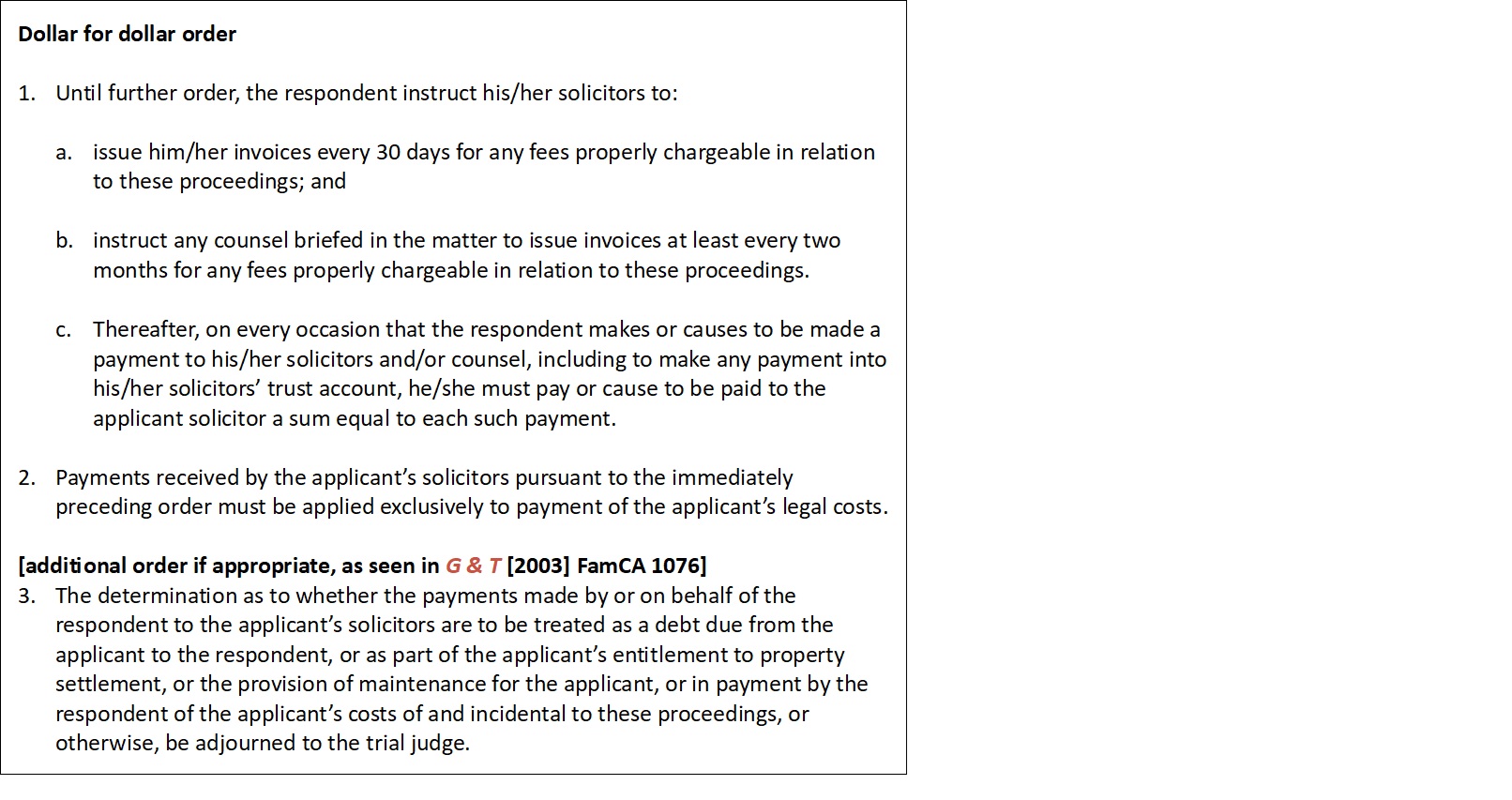
- The court can make a ‘dollar for dollar’ order where “for any dollar the financially advantaged party spends on legal costs and disbursements on the case, the disadvantaged party is also provided a dollar to spend on their case” Verdon & Verdon [2020] FamCA 824. The making of a dollar-for-dollar order is discretionary and usually made only as an order of last resort to “level the playing field”. This kind of order aims to address inequalities in parties’ ability to have legal representation, or when one party appears to be incurring disproportionately high legal fees. See G & T [2003] FamCA 1076.
See Zschokke for a case example on an application for litigation funding.
Factors for de facto couples
There are additional factors a de facto party will need to meet when applying for litigation funding orders:
- The parties need to be separated, as opposed to married parties who do not need to be separated to qualify: Stanford v Stanford [2012] HCA 52
- The application must be made within strict time limits, being 2 years from the date of separation (if made by consent or as part of a financial agreement, the time limit may not apply)
- The parties must meet the requirements of a geographic connection under section 205X FCA namely:
- One or both parties were resident in WA on the day the application is made; and
- Both parties have resided in WA for at least one third of the duration of the relationship OR that the applicant made a ‘substantial contribution’ of a kind mentioned in s 205ZG FCA, in WA
The parties must meet the following requirements under section 205Z FCA, namely that:
- a de facto relationship of at least 2 years exists, or
- there is a child of the de facto relationship, or
- that the applicant made a ‘substantial contribution’ of a kind mentioned in section 205ZG FCA and a failure to make the order would result in serious injustice to the applicant.
The above factors should be detailed in the affidavit filed by the applicant (see more below) attached to the application seeking litigation funding orders.
Practical Guide to applying for litigation funding orders
Step 1: Provide notice to the other party
When there is a dispute about if a party should receive funds when proceedings have already commenced, and how much they should receive, it is best to make a request in writing, in the first instance, with a requested date by which to respond.
The negotiation letter should:
- state how much money your client is seeking and whether the payment is sought periodically or in a lump sum
- state the reasons why your client is seeking funds, in line with what factors the court considers valid, as detailed above
- provide updated evidence of your client’s financial status as per your client’s duty of disclosure
- identify the source of the funds (e.g. money in a particular bank account, selling or transferring shares or cryptocurrency)
- state whether your client will seek to have the funds treated as interim property settlement, or interim spousal maintenance or interim costs or leave the characterisation to the court at trial
- include a date by which to respond, and if no response is received or there is no agreement, notice that your client intends to make an application to the court
- be made “without prejudice save as to costs”.
Step 2: Ascertaining if pre-action proceedings are required before filing application
If there is no urgency, pre-action procedures outlined in rule199 Family Court Rules 2021 (“FCR”) and Schedule 1 FCR require parties to make a genuine effort to resolve the dispute. This includes exchanging full and frank disclosure, negotiating by making offers and counteroffers of settlement, and attempting family dispute resolution (“FDR”). If the pre-action procedures are completed and there is no agreement (as is common), the next step is to advise your client on making an application.
Step 3: Preparing the application
An interim order for release of funds may be sought in the interim or procedural part of an Initiating Application, or more commonly, in a Form 2 Application in a Case.
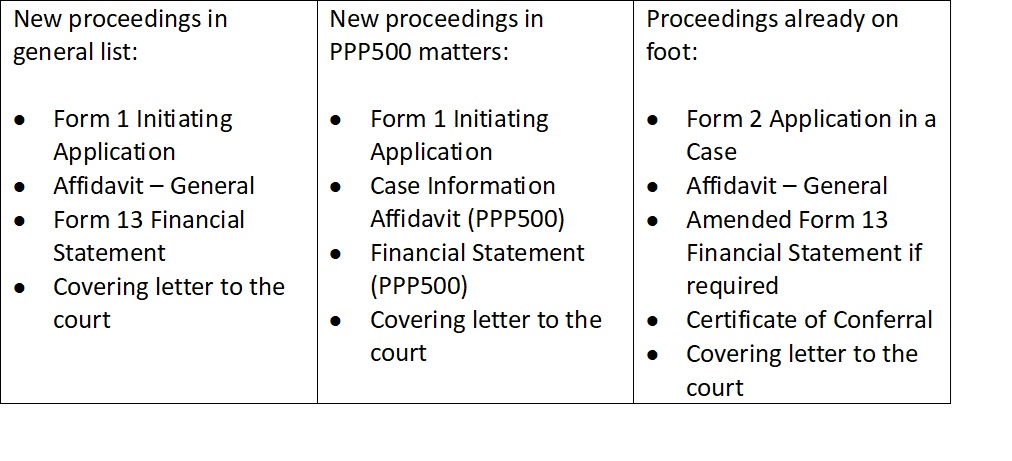
If proceedings have not yet commenced, an applicant should file a Form 1 Initiating Application. Based on your client’s instructions, consider whether to file documents for a standard matter or whether the matter meets the guidelines for a PPP500 case. If the matter is appropriate for a PPP500 case, file a Case Information Affidavit (PPP500) and Financial Statement (PPP500). If it is a standard matter, file an Affidavit – General and Form 13 Financial Statement. The application should set out the final orders sought and seek an interim order for litigation funding.
If there are proceedings already on foot, a Form 2 Application in a Case and supporting Affidavit – General must be filed. A Certificate of Conferral is also required. If there has been a significant change in financial circumstances since the proceedings began, the applicant should file a new Form 13 Financial Statement (r201 FCR).
An application for litigation funding orders must be supported by an Affidavit – General or Case Information Affidavit (PPP500) setting out the facts, in line with the relevant factors detailed above. Keep in mind that there is no cross examination in interim hearings and the court will rely upon all relevant evidence being present in a persuasive manner in the affidavit. If filing an Affidavit, attach evidence of financial circumstances, such as legal bills incurred and anticipated, as well as attempts to obtain funds from bank loans, selling assets, loans from family and friends, entitlement to legal aid, and any other avenues exhausted to obtain funds. Keep in mind the limit of 5 documents to be attached to a party’s affidavit (r241 FCR).
A Form 13 Financial Statement or Financial Statement (PPP500) should also be filed. Particular care should be taken to complete this document, and it should preferably show either existing financial hardship or imminent financial hardship if the litigation funding order was not made.
It is good practice to include a cover letter to court, stating which documents you are seeking to file, and brief information in dot points to justify the urgency of the application, if relevant.
Precedents
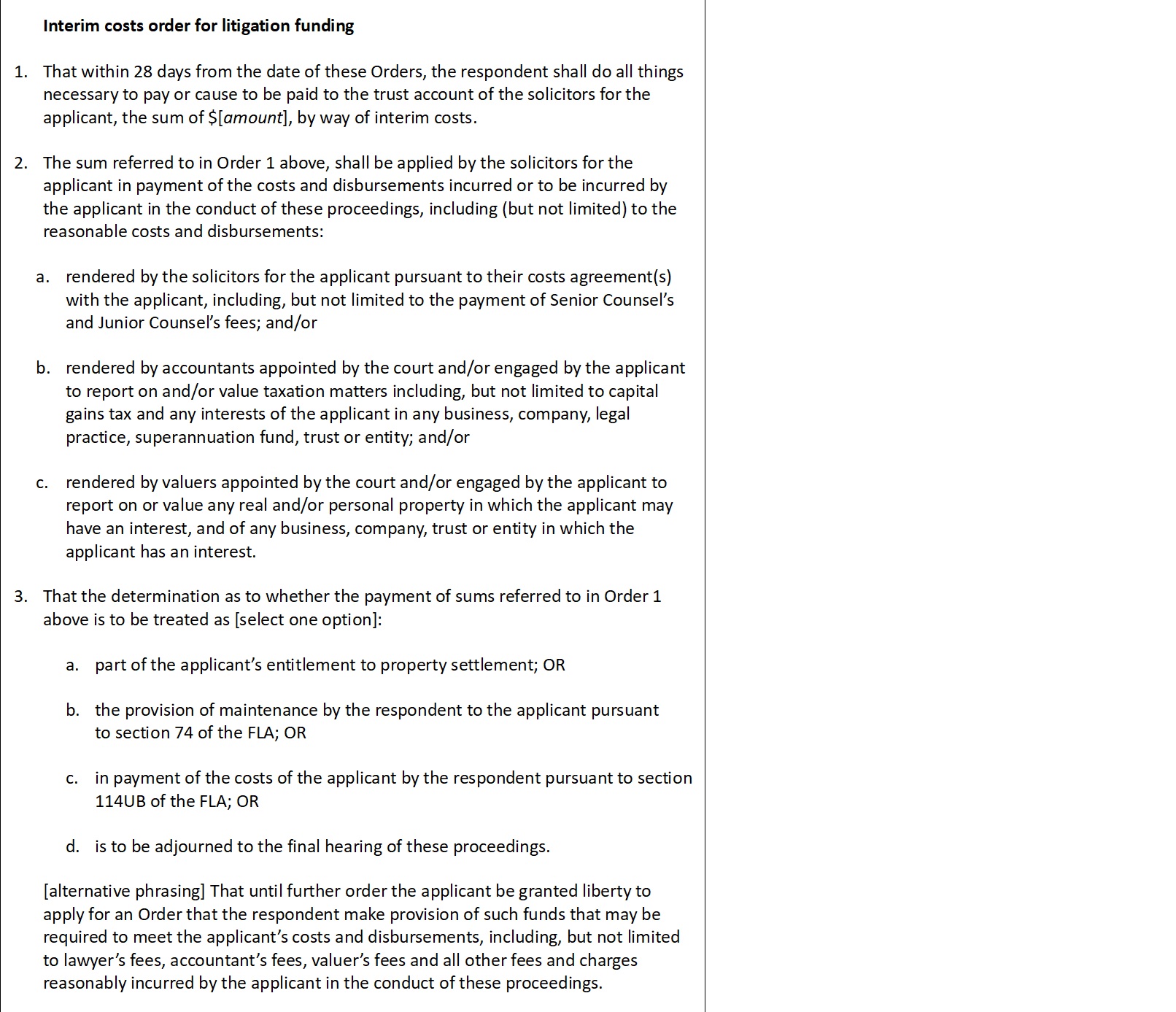
The below orders are usually sought in the interim or procedural orders sought section of the Form 1 or Form 2.
 Step 4: Service
The usual requirements for service apply. If the application is filed in a Form 1 Initiating Application, special service is required. If the application is filed in a Form 2 Application in a Case, ordinary service is acceptable. See the chapter on Service of Documents for further detailed information.
Step 5: Court hearing process
First hearing – directions hearing
Prior to the first hearing, the parties should attempt negotiations and if no agreement has been reached on the day of the hearing the parties or their lawyers should again attempt some final negotiations prior to appearing before the Judicial Officer. If a party is unrepresented, they should be prepared to negotiate directly with the other party or their lawyer.
If there is an agreement, the parties should as soon as possible advise the court officer that a Minute of Interim Consent Orders is being prepared and signed. Once you have a signed copy of the Minute you should make a copy for each party and prepare to hand up the signed original to the Judicial Officer when the matter is called.
If there is no agreement, the Judicial Officer will address each party and ask questions to clarify facts. If the respondent has not filed documents, it is likely they will be given an opportunity and timeframe to do so. In very limited circumstances the Judicial Officer can make a decision based on the limited evidence before the court, and in the absence of responding documents. If this is the case, the matter will be brought back for another directions hearing in the near future.
The matter will likely be programmed to a further directions hearing or an interim hearing at the court’s next available date. There may be orders for both parties to file further documents.
Second hearing – interim hearing
At the subsequent hearing, if responding documents have been filed, the Judicial Officer will likely listen to submissions and make a decision about litigation funding orders on an interim basis.
If responding documents haven’t been filed but there is proof the respondent has been properly served, the Judicial Officer can still make a decision about litigation funding orders, particularly if the respondent is present in court. The balance of the matter otherwise remains programmed towards further dispute resolution or trial.
Responding to an application for litigation funding
A respondent to a litigation funding order application can do the following:
- Negotiate with the applicant directly about the amount to be paid (and file a Minute of Consent Orders if there is agreement).
- Deny the applicant requires the amount sought and give reasons why.
- State the applicant has not clearly identified the amount sought.
- Deny that the respondent has the means to pay the amount sought.
- State the applicant has not clearly identified the source of the respondent’s funds to meet the amount sought.
- Provide evidence of their financial circumstances in support of their position that they do not have means.
- State they have not spent a disproportionate amount on their own legal fees, or state that the amount spent has been in proportion to what was necessary to fairly advance their case.
If the applicant has filed a Form 1 Initiating Application, the responding documents required are a Form 1A Response to Initiating Application,
Affidavit – General in support or Case Information Affidavit (PPP500) and Form 13 Financial Statement or Financial Statement (PPP500).
If the applicant has filed a Form 2 Application in a Case, the responding documents required are a Form 2A Response to Application in a Case and Affidavit – General in support, and Certificate of Conferral. Consider seeking leave to file, and filing, an amended Form 13 Financial Statement if the respondent’s financial situation has changed significantly since first filed (r201 FCR).
It is good practice to include a cover letter to court, stating which documents you are seeking to file.
Responding documents need to be filed and served 7 days before the hearing date (r153 FCR). If the application has been listed on short notice, responding documents should be filed at least 2 working days before the hearing date, if possible.
Reviewed: 20 August 2026