
Urgent and Interim Spousal Maintenance
Chapter contents
- Overview
- Legislation
- Other factors the court considers
- Practical guide
- Responding to an application
- Enforcement when maintenance order is breached
Overview
There may be circumstances when your client will seek urgent advice about the other party paying for their living expenses. The court has the power to order one party to pay maintenance to the other, for married parties under the Family Law Act 1975 (Cth) (“FLA”) and separated de facto parties under the Family Court Act 1997 (WA) (“FCA”). The main purpose of spousal maintenance is to adjust any disparity between the income or earning capacities of the parties, based on their needs. An application for maintenance can be made at the same time as an application for final property settlement orders or as standalone proceedings.
This chapter will deal with urgent and interim spousal maintenance.
Whether an interim spousal maintenance payment is characterised as spousal maintenance or partial property settlement can be left to be determined at Trial.
Urgent spousal maintenance is usually ordered in limited circumstances, where the respondent is served on short notice and does not have the opportunity to file responding documents. Orders for urgent spousal maintenance are made until the matter is brought back into court for a further hearing, in a matter of weeks or months. The applicant must be “in immediate need of financial assistance, but it is not practicable in the circumstances to determine immediately what order, if any, should be made…” as per section 77 FLA / section 205ZE FCA.
Practical tip: if your client instructs the parties have a modest asset pool available for division but the other party has a significantly higher income, this should prompt you to consider your client’s entitlement to spousal maintenance as well as property settlement.
Types of spousal maintenance orders
The court has the power to make different types of spousal maintenance orders such as:
- Periodic payments such as $X amount per week/fortnight/month into the applicant’s nominated bank account, for a fixed period of time. This is the most common form of order.
- Lump sum payment such as $X amount into the applicant’s nominated bank account, as a once-off. For example, in Brown v Brown [2007] FamCA 151, the wife was allocated a lump sum as spousal maintenance to put towards the purchase of another home.
- Transfer or right of ownership of a home.
- Personal right to occupy a home.
- Personal right to use a car or have a car loan be paid by the other party.
- Personal right to use chattels.
Legislation
Each party has a duty to financially support the other party, only to the extent that the first-mentioned party is reasonably able to do so, if and only if, that other party is unable to support themselves adequately (s 72 FLA / s 205ZC FCA).
The threshold question to be determined is:
- Does the applicant have a need for spousal maintenance due to:
- caring for a child, or
- age or capacity for gainful employment, or
- any other adequate reason? and
- Does the respondent have the capacity to pay spousal maintenance?
The court has the power to make interim spousal maintenance orders under section 80(1) FLA / section 205ZI FCA and urgent spousal maintenance orders under section 77 FLA / section 205ZE FCA.
Under section 74(1) FLA / section 205ZCA FCA the court is able to make such order as it considers proper. The court does this by considering the factors in section 75(2) FLA / section 205ZD FCA, being (among others):
- For married parties only, the effect of any family violence one party has been subjected to by the other party (there is no equivalent section for de facto couples in the FCA yet).
- The age and state of health of each party.
- The income, property and financial resources of each party and the physical and mental capacity for gainful employment.
- The extent to which either party has the care of a child of the relationship, including the need to provide housing for the child.
- The commitment of each party to support themselves and a child.
- The responsibility of either party to support any other person.
- A standard of living that in all the circumstances is reasonable.
- The extent to which spousal maintenance would allow a party to undergo education or training or establish themselves in a business or obtain an adequate income.
- The extent to which the party seeking spousal maintenance payment has contributed to the income, earning capacity, property and financial resources of the other party.
- The duration of the relationship and how it has affected the earning capacity of the party seeking spousal maintenance payment.
- The need to protect a party who wishes to continue their role as a parent
- If either party is cohabitating with another person, the financial circumstances relating to the cohabitation.
- And miscellaneous other factors.
Other factors the court considers
In determining what is an adequate level of support under section 72 FLA / section 205ZC FCA, the court said it is far removed from the level of ‘bare necessity’ or ‘subsistence’ and the court looks at “the standard of living to which a party was accustomed” as a factor: In the Marriage of Evans (1978) 30 FLR 570. Citing In the Marriage of Nutting (1978) 30 FLR 556, the court in Walsh & Walsh [2015] FCCA 3590 held that “the word “adequately” in the context presently relevant imports a standard of living which is reasonable in the circumstances including the circumstance that the parties are no longer husband and wife and that the assets and resources which were formerly available to them both in common have now been divided between them.”
It is not necessary for an applicant “to use up all of her assets and capital in order to satisfy the requirement that she is unable to support herself “adequately”. Where the line is to be drawn will depend upon the circumstances of individual cases”: In the Marriage of Mitchell (1995) 19 Fam LR 44. However, there is no general rule that the pre-separation standard of living should be maintained simply because the other spouse can afford to do so: Bevan & Bevan [1993] FamCA 95. An applicant is not entitled to live at a level of considerable luxury or comfort merely because the other party is very wealthy: In the Marriage of Evans (1978) 30 FLR 570.
The court follows this process summarised in Badir & Badir [2022] FedCFamC1A 109 (referring to Saxena & Saxena (2006) FLC 93-268) when considering an application for spousal maintenance:
- To what extent can the applicant support themselves?
- What are the applicant’s reasonable needs?
- What capacity does the respondent have to meet an order?
- If steps 1-3 favour the applicant, what order is reasonable having regard to s 75(2) FLA / s 205ZD FCA factors?
Interim spousal maintenance is commonly awarded for up to 3 years, to allow a spouse to undertake a course of training or education, or an apprenticeship, and thereby increase their income and earning capacity. This takes into account that “there is a significant gap between theory and reality for employment, especially for people in middle age, lacking experience and confidence, and who have been out of the skilled work-force for many years”: In the Marriage of Mitchell (1995) 19 Fam LR 44.
Keep in mind, the applicant’s entitlement to any income-tested pension, allowance or benefit is expressly disregarded from consideration (s 75(3) FLA / s 205ZD(4) FCA), even though such income is recorded in the applicant’s Financial Statement.
There is a balancing act in determining a party’s capacity to pay maintenance towards their former spouse and child, when they have a new spouse and child/ren, and there is no automatic favouring of the needs of either the old or the new spouse: Re Elei v Dodt [2018] FamCAFC 92.
Factors for de facto couples
There are additional factors a de facto party will need to meet when applying for spousal maintenance:
- The parties need to be separated, as opposed to married parties who do not need to be separated to qualify: Stanford v Stanford [2012] HCA 52
- The application must be made within strict time limits, being 2 years from the date of separation (if made by consent or as part of a financial agreement, the time limit may not apply)
- The parties must meet the requirements of a geographic connection: section 205X FCA namely:
- One or both parties were resident in WA on the day the application is made; and
- Both parties have resided in WA for at least one third of the duration of the relationship OR that the applicant made a ‘substantial contribution’ of a kind mentioned in section 205ZG FCA, in WA
- The parties must meet the following requirements under section 205Z FCA, namely that:
- A de facto relationship of at least 2 years exists, or
- There is a child of the de facto relationship, or
- That the applicant made a ‘substantial contribution’ of a kind mentioned in section 205ZG FCA and a failure to make the order would result in serious injustice to the applicant.
The above factors should be detailed in the affidavit filed by the applicant (see more below) seeking spousal maintenance orders.
Practical guide
Step 1: Pre action procedures
A party who seeks spousal maintenance payments must comply with pre-action procedures outlined in rule 199 and Schedule 1 Family Court Rules 2021 (WA) (“FCR”), the same as required for property settlement applications. This includes exchanging full and frank disclosure, negotiating by making offers and counteroffers of settlement, and attempting family dispute resolution (“FDR”). If the pre-action procedures are completed and there is no resolution, the next step is to advise your client on making an application.
Note: for urgent spousal maintenance, you may decide to make an application to court before pre-action procedures can be satisfactorily completed, in order to obtain urgent relief for your client. The duty of disclosure is ongoing and your client will likely be ordered to attend FDR or a Conciliation Conference after the court process has begun.
Step 2: Preparing the application
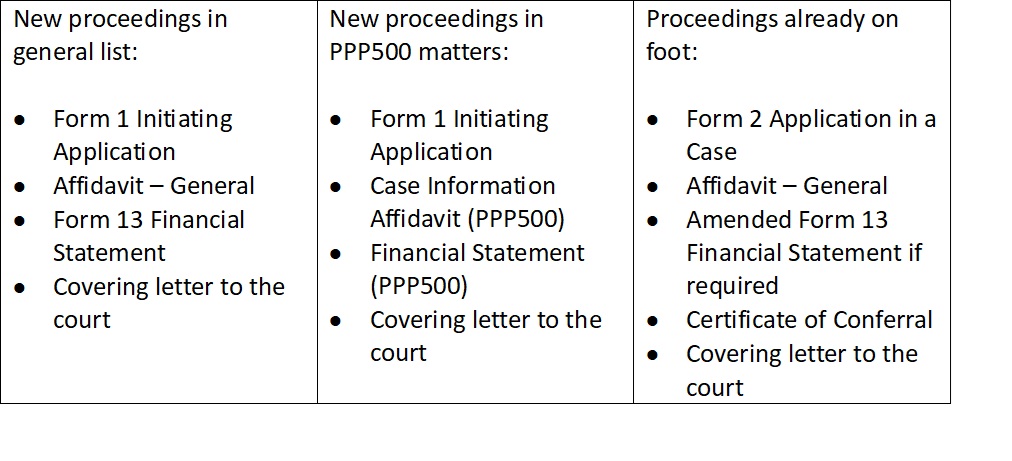
If proceedings have not yet commenced, an applicant should file a Form 1 Initiating Application. Based on your client’s instructions, consider whether to file documents for a standard matter or whether the matter meets the guidelines for a PPP500 case. If the matter is appropriate for a PPP500 case, file a Case Information Affidavit (PPP500) and Financial Statement (PPP500). If it is a standard matter, file an Affidavit – General and Form 13 Financial Statement. The application should set out the final orders sought and seek an interim order for spousal maintenance or urgent spousal maintenance.
If proceedings are already on foot, a Form 2 Application in a Case with supporting Affidavit – General should be filed. A Certificate of Conferral is also required unless you seek an exemption using rule 79(2). In the cover letter, you should state it is not possible to make a reasonable and genuine attempt to settle the issue as doing so will cause undue delay or expense, or the applicant would be unduly prejudiced, or the application is urgent. The court has the power to waive the requirement for a Certificate of Conferral under rule 79(5).
If there has been a significant change in financial circumstances since the proceedings began, the applicant should file a new Form 13 Financial Statement: r201.
The application for spousal maintenance must be supported by an Affidavit – General or Case Information Affidavit (PPP500) setting out the facts. Keep in mind that there is no cross examination in interim hearings and the court will rely upon all relevant evidence being present in a persuasive manner in the affidavit. If filing an Affidavit – General, attach relevant evidence of the parties’ financial circumstances such as income and expenses, and any open offers of settlement (r155). Keep in mind the limit of 5 documents to be attached to a party’s affidavit (r241).
A Form 13 Financial Statement or Financial Statement (PPP500) should also be filed. Particular care should be taken to complete this document, and it should show either existing financial hardship or imminent financial hardship if the interim or urgent spousal maintenance order was not made. Part N ‘Orders for maintenance, child support, financial enforcement’ should be completed in detail. Carefully check the weekly expenses in Part G ‘Personal expenditure’ as these are closely analysed by the other party and the court.
Tip: do not include compulsory employer super contributions in paragraph 20, and use the total in Part N to complete paragraph 32 ‘Total of all other expenditure’.
It is good practice to include a cover letter to court, stating which documents you are seeking to file, and brief information in dot points to justify the urgency of the application, if relevant.
Precedent orders
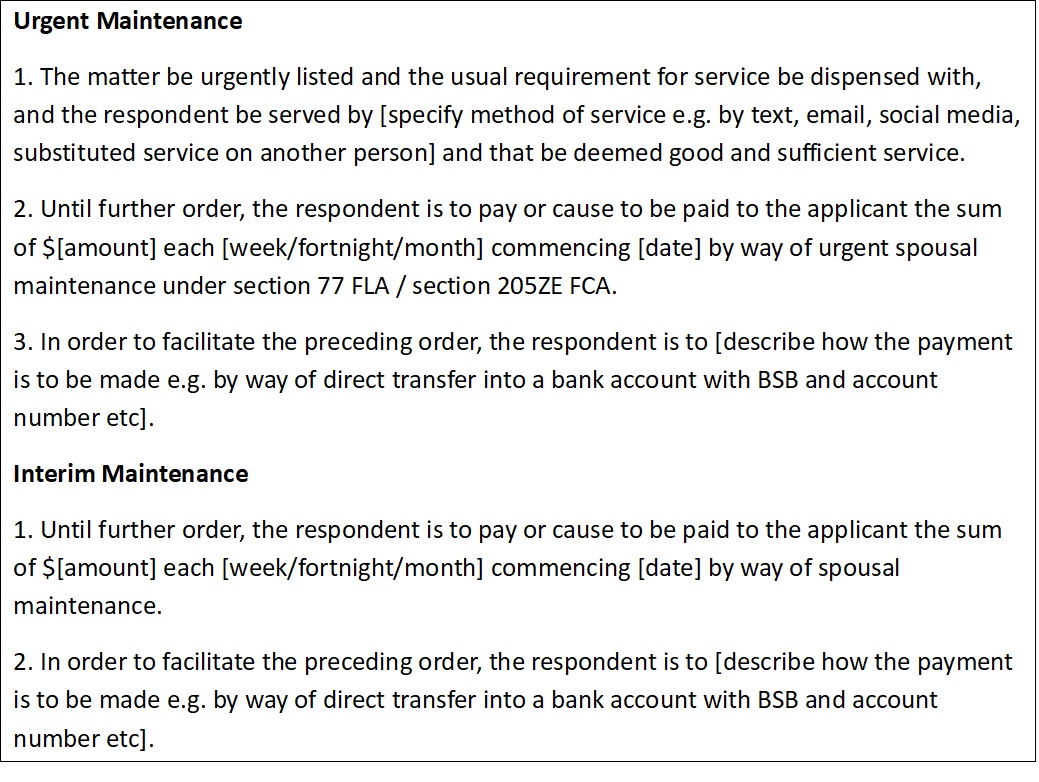
The below orders are usually sought in the interim or procedural orders sought section of the Form 1or Form 2:
Step 3: Service
For urgent maintenance, the applicant may seek an order for urgent listing and dispensation of service/substituted service as outlined above.
For interim maintenance, the usual requirements for service apply. If the application is filed in a Form 1 Initiating Application, special service is required. If the application is filed in a Form 2 Application in a Case ordinary service is acceptable. See the chapter on Service of Documents for detailed information.
Step 4: Court hearing process
First hearing – directions hearing
Prior to the first hearing, the parties should attempt negotiations and if no agreement has been reached on the day of the hearing the parties or their lawyers should again attempt some final negotiations prior to appearing before the Judicial Officer. If a party is unrepresented, they should be prepared to negotiate directly with the other party or their lawyer.
If there is an agreement, the parties should as soon as possible advise the court officer that a Minute of Interim Consent Orders is being prepared and signed. Once you have a signed copy of the Minute you should make a copy for each party and prepare to hand up the signed original to the Judicial Officer when the matter is called.
Interim spousal maintenance application
If there is no agreement, the Judicial Officer will address each party and ask questions to clarify facts. If the respondent has not filed documents, it is likely they will be given an opportunity and timeframe to do so.
The matter will likely be programmed to a further directions hearing or an interim hearing at the court’s next available date. There may be orders for both parties to file further documents.
Urgent spousal maintenance application
If there is no agreement, the Judicial Officer can make a decision based on the limited evidence before the court, and in the absence of responding documents. If urgent spousal maintenance is ordered, the matter will be brought back for another directions hearing in the near future.
Second hearing – interim hearing
At the subsequent hearing, if there are responding documents filed, the Judicial Officer will likely listen to submissions and make a decision about spousal maintenance on an interim basis.
If there are no responding documents filed but there is proof the respondent has been properly served, the Judicial Officer can still make a decision about interim spousal maintenance, particularly if the respondent is present in court. The balance of the matter otherwise remains programmed towards further dispute resolution or trial.
Responding to an application
A respondent to a spousal maintenance application can do the following:
- Negotiate with the applicant directly about the amount to be paid (and file a Minute of Consent Orders if there is agreement).
- Agree that the applicant has a need for spousal maintenance but for a lower amount than sought.
- Deny that the applicant has a genuine need for spousal maintenance because the applicant can support themselves.
- State that the applicant is not gainfully employed despite being able (for example, if the applicant’s child/ren are in full time school or are aged over 18 years) or the applicant is qualified to work but has chosen not to do so.
- State that the applicant is ‘underemployed’, for example, they work on a casual or part time basis when they could work on a full time basis.
- State that the respondent has a lower income than alleged, or the respondent has been demoted, or has not received bonuses as per previous years.
- State that the respondent’s living expenses are such that there is insufficient income left over to pay for the applicant’s living expenses.
- State that the respondent has re-partnered and has to provide for their new partner and/or child/ren or the respondent has to provide for other dependents such as aging relatives.
- If a spousal maintenance order has already been made, the respondent can make an application seeking to discharge or vary the amount ordered, based on changed circumstances, in line with factors the court considers relevant.
If the applicant has filed a Form 1 Initiating Application, the responding documents required are a Form 1A Response to Initiating Application, Affidavit – General in support or Case Information Affidavit (PPP500)and Form 13 Financial Statement or Financial Statement (PPP500).
If the applicant has filed a Form 2 Application in a Case, the responding documents required are a Form 2A Response to Application in a Case and Affidavit – General in support, and Certificate of Conferral. Consider seeking leave to file, and filing, an amended Form 13 Financial Statement if the respondent’s financial situation has changed significantly since first filed (r201).
It is good practice to include a cover letter to court, stating which documents you are seeking to file.
Responding documents need to be filed and served 7 days before the hearing date (r153). If the application has been listed on short notice, responding documents should be filed at least 2 working days before the hearing date, if possible.
Enforcement when maintenance order is breached
Under section 112AD FLA / section 226 FCA the court may take such action as it thinks appropriate to punish contravention of a maintenance order granted under section 80(1) FLA / section 205ZI FCA or under section 77 FLA / section 205ZE FCA. The penalties include:
- Requiring a person to enter into a bond
- Imposing a sentence by order e.g. a community service order
- Imposing a fine
- Imposing a sentence of imprisonment (if the contravention was intentional or fraudulent).
In the most serious cases, a court can punish a person for contempt by committal to prison or fine or both (s 112AP FLA / s 234 FCA).
An applicant seeking enforcement of an injunction is required to file a Form 2 Application in a Case, and select ‘enforcement hearing – financial obligation’ in Part C. Other documents required are an Affidavit – General and Certificate of Conferral.
A respondent who is responding to an enforcement application is required to:
- Attend court on the court date and answer questions from the Judicial Officer about why they have not complied with orders.
- Produce all documents requested by the applicant.
- File a Form 13 Financial Statement at least 7 days before the court date.
Reviewed: 20 August 2026