
Application and response procedures and drafting documents
Chapter contents
Family Court procedures
The Family Court procedures are contained in the:
- Family Court Rules 2021 (WA) (the Rules)
- Case Management Guidelines of 7 May 2012 (CMGs), and
- Information Notes and Practice Directions issued by the court.
The Rules
The Rules apply to federal and non-federal jurisdictions of the Family Court of WA (the FCWA) and the Magistrates Courts throughout WA.
Case Management Guidelines
The CMGs set out the court’s case management system.
The FCWA is in the process of updating the CMGs. In the event of any inconsistencies between the Rules and CMGs, the Rules prevail (see Family Court of WA Practice Direction 1 of 2021).
The CMGs only apply to proceedings that are commenced in the FCWA (and the Magistrates Court, 150 Terrace Road, Perth) and to country circuits of those courts where appropriate. This has the effect that procedures in regional areas may be different and vary from place to place.
Information notes and Practice Directions
Please visit the Family Court of WA’s website for an up to date list of current Information Notes and Practice Directions.
Filing documents
All application and response documents must be filed on the eCourts Portal of WA.
Rule 487(1) mandates the electronic filing of documents with some exceptions including:
- if leave to file by another means is granted by the registrar (r 487(1)(c)), or
- filed by a person who is exempt from this requirement under the CMGs or Rules (r 487(d)).
Clients need access to an email address and a mobile phone to be able to register for the eCourts Portal of WA. For urgent cases (for example, where the applicant’s phone has been broken during a family violence incident), the client will need to seek leave in their cover letter to the court to request to have their documents accepted for filing other than by the eCourts Portal of WA.
In practice, prisoners are able to file documents other than by electronic means. They need to make it clear in their covering letter to the court that they are in custody.
Note: The original signed documents lodged electronically must be kept by the client or their solicitor until the end of the case and be made available for inspection upon request (r 489(a)).
Infosheet: Family Court of WA: Signing and filing documents is a resource which can be provided to clients which provides information about to register for the eCourts Portal of WA and lodge documents.
Commencing proceedings
Step 1: Preparing an initiating application
All applications must be efiled on the eCourts Portal of WA.
1. Payment of court filing fee
If a client has a Commonwealth Concession card including Austudy, Abstudy and Youth Allowance they can ask for a fee exemption as part of filing their application on the eCourts Portal of WA, they do not need to complete an extra form. The systems are linked, and the client will be prompted to enter their Customer Reference Number (CRN) for fee reduction.
If a client can show proof of other forms of low income including:
- a Grant of Legal Aid
- they are under 18, or
- they are an inmate of a prison or legally detained in a public,
they need to complete a Fee exemption - General (Form NP13). eCourts Portal WA requires it to be filed as a PDF along with evidence of low income, for example, proof of age card - both sides of the card (scan the form and proof all together as one document).
If a client is not eligible for a general fee exemption, they may be able to apply for a fee exemption based on financial hardship by completing a Fee exemption - Financial Hardship (Form NP14). eCourts Portal WA requires it to be filed as a PDF. They need to show that their income, day-to-day living expenses, debts and assets would mean that if they paid the fee, it would cause them financial hardship.
2. Marriage Certificate (if parties were married)
eCourts Portal of WA requires it to be filed as a PDF
If the client doesn’t have this, they will need to file a cover letter with the Court undertaking that they will provide it to the court asap and then upload it via eCourts as a PDF.
If the document is not in English it will need to be translated prior to filing. The document and the translation will need to be attached to an Affidavit of Translation sworn or affirmed by the translator before an authorised witness. There is a fee involved in having a document translated.
3. Form 1 - Initiating Application
Form 1 - Initiating Application
In this form you will set out both the interim and final orders that your client is seeking. You must include final orders sought or the application will not be accepted for filing.
Rule 77(1)(a) provides a party may apply for an interim, procedural, ancillary or other incidental order in relation to a cause of action only if the party has made an application for final orders in that cause of action.
4. Affidavit – General or Case Information Affidavit (PPP500)
Affidavit – General or Case Information Affidavit (PPP500)
Use the Case Information Affidavit (PPP500) if the matter meets the guidelines for a PPP500 case - if the case involves total net property excluding superannuation of $500,000, or less, and there are no entities that might require expert investigation such as companies or trusts, and your client is not seeking parenting orders.
Answer the questions in the Case Information Affidavit (PPP500).
See below regarding Affidavits – General.
5. Form 13 Financial Statement or Financial Statement (PP500)
Form 13 Financial Statement or Financial Statement (PP500)
6. A copy of any current family violence orders (if any)
Required to be provided by rule 32.
Additional documents when filing an urgent interim application
7. Letter to the court
The letter should be addressed to the Deputy Registrar and request an urgent hearing. In the letter you will need to explain why the matter is urgent and what harm will be avoided or remedied or lessened by an earlier hearing of the matter.
Affidavits - Procedural requirements
An affidavit must be divided into consecutively numbered paragraphs, with each paragraph being, as far as possible, confined to a distinct part of the subject matter (r 238). A reference to a date in an affidavit (except the name of a month), number or amount of money must be written in figures (r 239(3)).
The court will commonly make orders limiting the number of pages of interim affidavits and the number of attachments. If you go over these limits, your client’s affidavit may not be accepted for filing.
Annexures
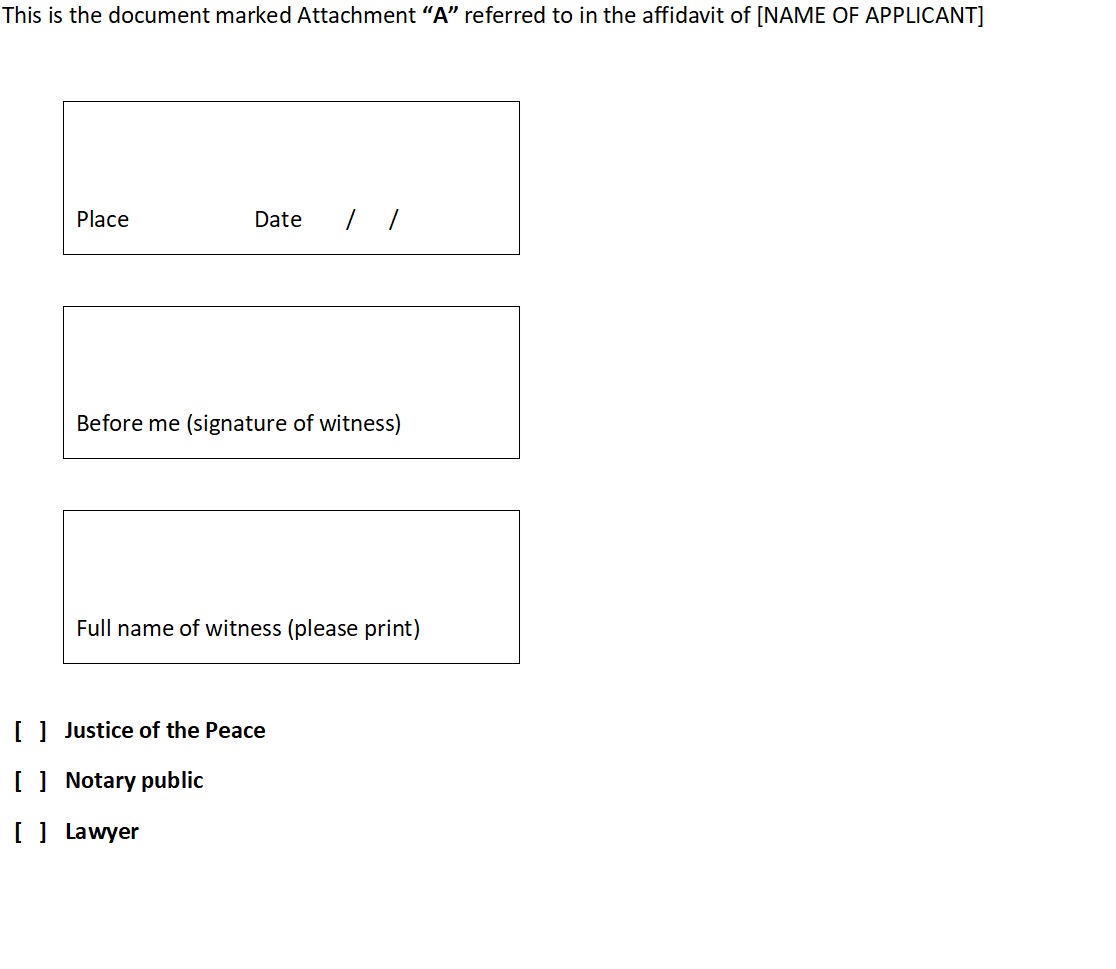
If a client wants to rely on a document such as a payslip or bank statement, you can annex (attach) it to your client’s affidavit. You must refer to the attachment in your affidavit and refer to each annexure by a number or letter. For example, ‘The Respondent alleges that I am not working. I dispute that this is the case. Annexed and marked with the ‘A’ is a copy of my most recent payslip’.
You need to number all of the pages of the affidavit and attached annexures consecutively from the first page of the affidavit through to the last page of the last document attached (r 241(6)).
Annexures to interim affidavits must be limited to:
- no more than 5 documents for an affidavit of a party (r 241(2)(a)), and
- and not more than 2 documents for an affidavit of a witness (r 241(2)(b)).
Annexures to trial affidavits must be limited to:
- no more than 15 documents for an affidavit of party (r 241(3)(a)), and
- no more than 5 documents for an affidavit of a witness (r 241(3)(b)).
If a party seeks to rely at a hearing or trial on documents that cannot be attached to an affidavit because of rule 241(2) or (3) each additional document needs to be identified in the body of the affidavit (but not annexed) and a copy of the document served at the same time as the affidavit. An application to be permitted to rely on the document will then need to be made at the relevant hearing or trial (r 241(5)). An application to rely on the document may only be considered by court if the party has complied with rule 241(5).
Example affidavit annexure cover page
Affidavit - Contents
The starting point is that the rules of evidence apply to affidavits filed in financial proceedings.
As of June 2025, Division 4 of the Family Law Act 1975 (Cth) (“the FLA”) expressly sets out the court’s powers to more actively manage any type of family law proceeding through a less adversarial approach, to reduce intimidation and stress of court processes (see s 102NE FLA regarding the principles for conducting proceedings). This may include using facilitating remote attendance where there are allegations of family violence, or allowing evidence of the occurrence and effect of family violence which may not otherwise be admissible (see ss 102NH, 102NN FLA).
The approach also suspends parts of the rules of evidence, unless the court orders they should apply to an issue in proceedings in exceptional circumstances (see s 102NL FLA).
Previously, the approach could only be applied in Part VII proceedings (about parenting) and in property or financial proceedings where there were concurrent or past proceedings involving parenting matters, and only with the parties’ consent.
Now, the less adversarial approach will apply to all Part VII proceedings automatically (s 102ND(1) FLA). The less adversarial approach will only apply to non-Part VII proceedings (including property and financial matters) either with the consent of the parties or at the discretion of the court (s 102ND(2), (3) and s 102NG FLA).
The Explanatory Memorandum to the Family Law Amendment Bill 2024 (Cth) indicates that these amendments support the elimination of discrimination against women by allowing their full participation in family law proceedings and removing barriers against pursuing property settlement proceedings. Evidence of the occurrence and effect of family violence can be considered in property proceedings and spousal maintenance proceedings.
These changes will only apply to proceedings in which parties were married. Also, the reality is the court will place more weight on traditionally admissible evidence, and you should draft affidavits using best evidence.
Where parties were not married, section 202H(3) Family Court Act 1997 (WA) (“the FCA”) provide that the court may decide to apply one or more of the provisions of the evidence act to an issue in the proceedings, if:
- the court is satisfied that the circumstances are exceptional, and
- the court has taken into account (in addition to any other matters the court thinks relevant) –
- the importance of the evidence in the proceedings,
- the nature of the subject matter of the proceedings,
- the probative value of the evidence, and
- the powers of the court (if any) to adjourn the hearing, to make another order or to give a direction in relation to the evidence.
Rule 242 also provides that the court may order material to be struck out of an affidavit if the material is:
- inadmissible,
- unnecessary,
- irrelevant,
- unreasonably long,
- scandalous or argumentative, or
- sets out the opinion of a person who is not qualified to give it.
The best evidence is that which people can see, hear and feel.
Rule 239 provides that an affidavit must be confined to facts about the issues in dispute and confined to admissible evidence.
You will need to assess on a case-by-case basis the information that is relevant to the matter in dispute. However, below is a checklist of matters that are typically useful to include.
Important dates
Examples:
- date of marriage
- date of separation
- duration of de facto relationships
- dates of birth of parties
- dates of birth or at least ages of other significant adults
- dates of birth of children
- duration of any period of any reconciliation
De facto relationships (if relevant)
- at least one party resides in WA on the day the application is made; and
- either one of these situations applies:
- The parties lived in a de facto relationship for at least 2 years; or
- The parties lived in a de facto relationship for less than 2 years but:
- there is a child of the relationship and failure to make orders would result in serious injustice to the party caring for the child; or
- the applicant has made substantial financial, non-financial or homemaker/parent contributions and failing to make orders would result in serious injustice; and
- there is a connection to WA being:
- both parties lived in WA for at least one third of the length of the relationship; or
- substantial financial, non-financial or homemaker/parent contributions have been made by you or the other party while residing in WA.
Reasons for application
Including any reasons of urgency if relevant
Details of finances from the start of the relationship
- employment status and income,
- if either party owned property and how much it was worth,
- if either party had debts and how much was owed.
Details of finances during the relationship
- employment status and income,
- if either party owned property and how much it was worth,
- if either party had debts and how much was owed,
- any lump sum received such as inheritances, gifts or pay-outs.
Details of real estate owned by either or both parties during the relationship
- the address of property and the purchase price,
- the sale price of the property if sold, and date of sale,
- the amount of net sale proceeds if sold, and how those funds were used,
- mortgage amount when bought and current mortgage amount if still owing,
- whether the property is still owned and if so its value,
- how the mortgage was paid,
- who maintained and/or renovated the property.
Children
- Who was the primary carer?
- How was the children’s care usually divided between the parties?
Details of finances post-separation
- Who moved out of the former family home?
- Who pays the mortgage and who pays rent?
- What property has been bought and sold since separation?
- Who drives which car?
- Who is responsible for which debt?
Family violence
See Chapter 4 for the definition of family violence and abuse and how the court considers its impact on contributions and current and future needs
Details of any family violence experienced by a party including the effect of:
- family violence on a party’s ability to make contributions to the relationship,
- family violence on any current or future needs of a party,
- family violence on any spousal maintenance sought by a party,
- any intentional or reckless wastage caused by a party and the impact on the parties’ current and future circumstances.
Current and future needs of the parties including
- age, and mental and physical health,
- income, property and financial resources of each party,
- the need to provide a home for dependent children,
- access to government benefits or pension or allowance,
- care of children and dependents,
- a reasonable standard of living
- liabilities: where the parties incurred any liabilities, the court can consider the nature of the liabilities, the circumstances relating to them and the impact of those liabilities on the financial future of the parties
- new partners and other factors.
Companion animals (treatment of pets) – if relevant (married parties only)
See Chapter 4 for the law regarding companion animals:
- the circumstances in which the companion animal was acquired
- who has ownership or possession of the companion animal
- the extent to which each party cared for, and paid for the maintenance of, the companion animal
- any family violence to which one party has subjected or exposed the other party
- any history of actual or threatened cruelty or abuse by a party towards the companion animal
- any attachment by a party or a child of the marriage to the companion animal
- the demonstrated ability of each party to care for and maintain the animal in the future without the support or involvement of the other party
- any other factor circumstance which, in the opinion of the court, the justice of the case requires to be taken into account.
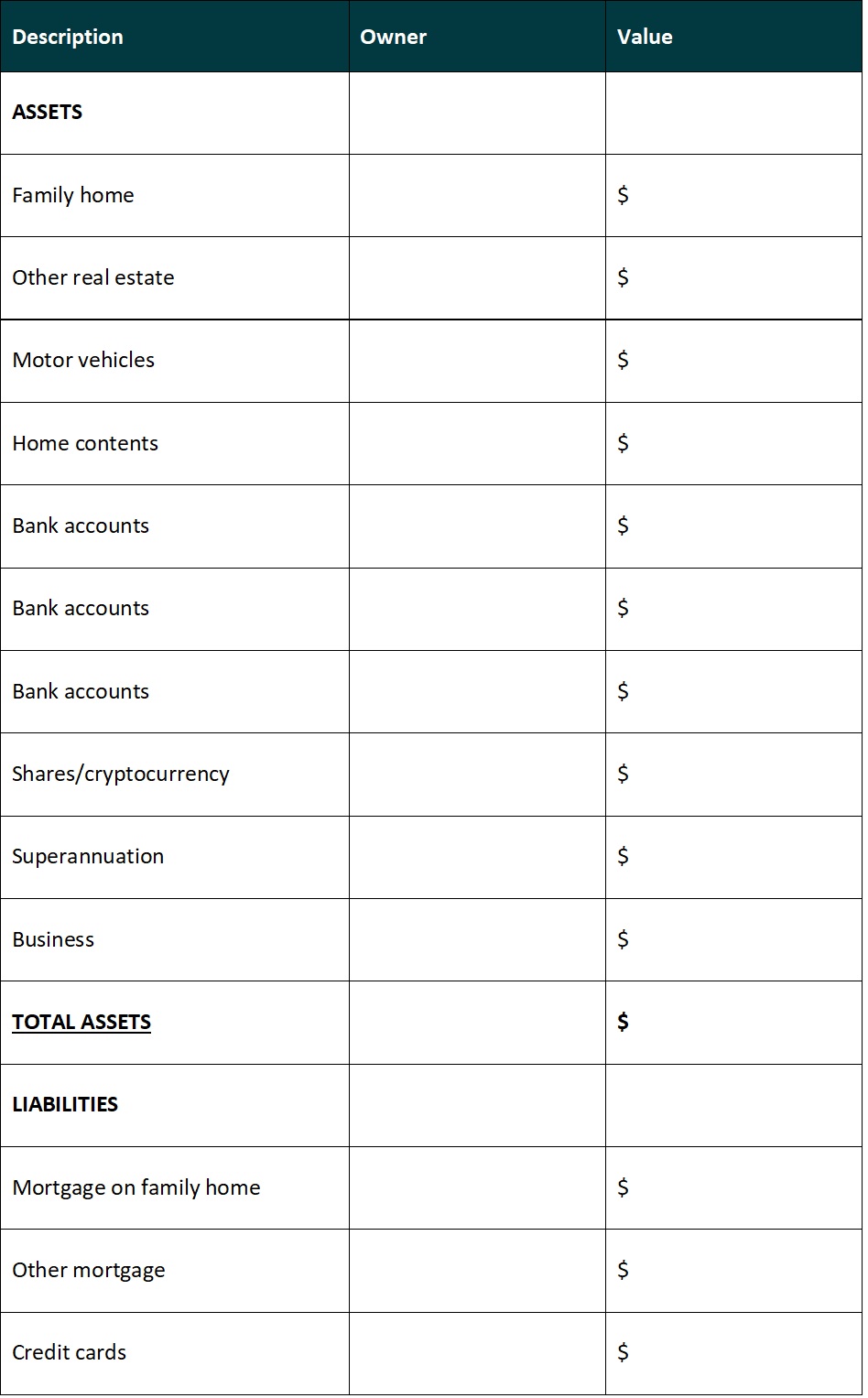
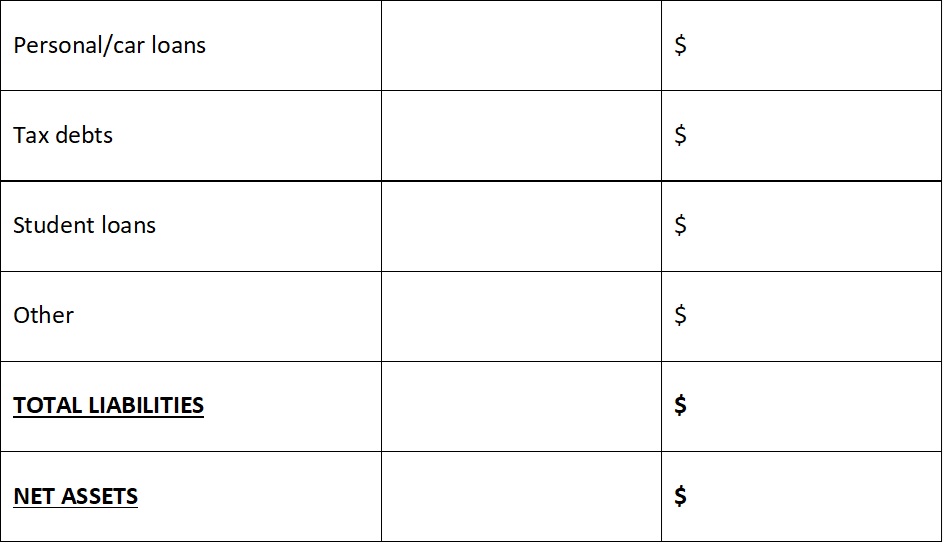
You should include a table of the known assets and liabilities owned jointly and by each party. You can use this example below:
 Swearing/affirming an affidavit
An affidavit to be used in family proceedings must be sworn or affirmed. Any insertion in, or erasure or other alteration of, an affidavit must be initialled by the deponent and the witness (r 239(2)).
There are special rules for an affidavit of someone who is illiterate, blind, or incapable of signing an affidavit. The witness before whom the affidavit is made must certify, at the end of the affidavit, that:
- the affidavit was read to the deponent,
- the deponent seemed to understand the affidavit, and
- for a deponent physically incapable of signing, the deponent indicated that the contents were true.
If a deponent does not have an adequate command of English:
- a translation of the affidavit and oath must be read or given in writing to the deponent in a language that the deponent understands, and
- the translator must certify that the affidavit has been translated (r 240(1)).
Serving Documents
Once you have filed your client’s documents via the eCourts portal you need to serve a copy of the filed documents on the other party/parties as soon as possible (r122(1)(b)). Service is required to satisfy the court that the other party has received your client’s documents. If your client’s filed documents are not served prior to the next court date, your client’s matter may be adjourned to allow the other party time to respond to the documents.
For details regarding service, see Chapter 6
Step 2: Initial court listing
If interim orders are sought in the Form 1 – Initiating Application, the Registry Manager must fix a date for a hearing or a procedural hearing on a date that is as near as practicable to 28 days after the application was filed (r 80(1)).
The Registry Manager may fix an earlier date for the hearing of an initiating application in which interim orders are sought if:
- the reason for the urgency is significant and credible, and
- there is a harm that will be avoided, remedied, or mitigated by hearing the application earlier (r 80(4)).
Responding
Step 1: Assessing the application
You will need to find out the following:
- the next court date,
- is the applicant seeking any urgent interim orders (such as an injunction),
- what the court listing is for, and
- have any court orders been made in relation to the application and, if so, have directions been made about the filing of documents.
If a respondent to an initiating application opposes the orders sought in the initiating application or wants to ask the court to make different orders, they need to file a response (r 146).
Step 2: Preparing and filing response documents
1. Payment of court filing fee or application for exemption.
See above.
2. Form 1A – Response to initiating application
Form 1A – Response to initiating application
In this form you will set out both the interim and final orders that your client is seeking.
A response may:
- consent to an order sought by the applicant,
- ask that the application be dismissed, or
- ask for orders in another cause of action (e.g., if only property orders are sought in the initiating application the respondent might choose to start a parenting case by seeking parenting orders in their response. This would be a new cause of action) (r 146(3)).
A response must not include a request for:
- a divorce order,
- annulment of a marriage,
- a declaration as to validity of a marriage, divorce or annulment, or
- an order under Part 4 Division 2 Subdivision 3 authorising a medical procedure (r 146(4)).
3. Affidavit – General or Case Information Affidavit (PPP500)
Affidavit - General or Case Information Affidavit (PPP500)
In the response the client must state:
- the facts in the application with which they disagree
- what they believe the facts to be, and
- full particulars of the orders they seek (r 146(2)).
4. Form 13 Financial Statement or Financial Statement (PP500)
Form 13 Financial Statement or Financial Statement (PP500)
5. A copy of any current family violence orders (if any)
Required to be provided by r 32 if the respondent is aware of a family violence order and it hasn’t already been provided to the court by the applicant.
Serving response documents
A Form 1A Response and accompanying documents must be served on the other party by ordinary service (if the person has given an address for service). In this situation, you can serve documents by:
- putting the documents in a sealed envelope addressed to the person and:
- delivering them to the address given for service, or
- posting them to the address given for service, or
- sending the documents to a fax number or email address provided in the applicant’s address for service (or Form 1 Initiating Application).
If a lawyer representing the other party agrees, in writing, to accept service of the document, you can send it to the lawyer instead.
Reviewed: 20 August 2026