
Pre-action Procedures
Chapter contents
- How to get started: pre-action procedures
- Exemptions to pre-action procedures
- Consequences for failing to follow pre-action procedures
- Parenting arrangements and property settlement
- Divorce and property settlement
- Time limits for property settlement
- Step 1: Exchange disclosure documents
- Step 2: Advise about range of entitlement
- Step 3: Negotiating and making offers
- Step 4: Attending Family Dispute Resolution (FDR)
- Step 5: Parties reach agreement - consent orders
- Step 6: We can't reach agreement - what next?
- More information
How to get started: pre-action procedures
Pre-action procedures are steps the law requires people who are separating to take before starting a property case in the Family Court. The aim of pre-action procedures is for people to make a genuine attempt to work out their property dispute outside of court.
Pre-action procedures are set out in Schedule 1 of the Family Court Rules 2021.
There are 3 pre-action steps that need to be completed:
- Disclosure (sharing information about property and finances).
- Dispute Resolution (for example, negotiating with the other party or attending Family Dispute Resolution or arbitration).
- Exchanging letters with the other party about offers to settle the property dispute.
Exemptions to pre-action procedures
Parties may be exempt from complying with pre-action procedures if one of the following applies:
- there are allegations of family violence
- the application is urgent (for example, if the other party has threatened to sell or hide assets)
- the time limit is close to expiring
- there are allegations of fraud
- there is a genuinely intractable dispute
- your client would be unduly prejudiced if required to comply with pre-action procedures
- there is a genuine dispute about whether there was a de facto relationship.
A party will be required to explain why they should be exempt from pre-action procedures in any affidavit filed in support of an application in court.
Consequences for failing to follow pre-action procedures
There can be serious consequences if parties don't follow the pre-action procedures including:
- not being allowed to continue their court case until they have completed the pre-action procedures, or
- having to pay some, or all, of the other party’s legal costs.
Parenting arrangements and property settlement
It may be easier to sort out parenting arrangements such as care of the children, before sorting out property. This is because parenting arrangements affect the court’s consideration of how property should be divided.
Sometimes, it may not be possible to sort out parenting arrangements first if there is a dispute or one person starts a parenting case in court. In that case, property settlement can still occur, either simultaneously, or before the parenting case is sorted. The children’s care arrangements at the time of agreement or court decision will be taken into account for property settlement.
Divorce and property settlement
Parties do not need to be divorced to start the property settlement process. They can begin at any time after separation. Either party can apply for divorce 12 months after separation, regardless of whether property settlement has been sorted out. The property settlement process is separate from divorce, parenting arrangements and child support.
Time limits for property settlement
Parties must observe strict time limits when starting a property settlement case in court. If parties are negotiating and getting close to the time limit, they should get legal advice about starting a case in court to preserve their position.
If a party was married and has been divorced, they need to start a property case within 1 year of the date of divorce (s 44(3) Family Law Act 1975 (Cth) (“the FLA”)). This time limit does not apply where the divorce order was made outside Australia (Anderson & McIntosh [2013] FamCAFC 200, applied in Gruber & Duhon [2026] FedCFamC1A 120).
If a party was married, has separated but is not yet divorced, there is no time limit to start a property case.
If a party was in a de facto relationship, they need to start a property case within 2 years of the date of separation (s 205ZB Family Court Act 1997 (WA) (“the FCA”)).
In rare cases, the court may allow a party to start a property case if they are outside these time limits, if they can show that they or their child would suffer hardship.
Step 1: Exchange disclosure documents
Parties in family law proceedings have a positive duty to the court and to each other to give full and frank disclosure of all information relevant to the case, in a timely manner (r 197(1) and s 71B(1) FLA). The duty begins with the pre-action procedures before an application is filed with the court and continues until the case is finalised (r 197(2) and s 71B(2) FLA).
Note: The general duty of disclosure does not apply to a respondent in an application alleging contravention or contempt (r 197(3) and s 71B(4) FLA).
The June 2025 amendments to the FLA have elevated the duty of disclosure in property and financial proceedings from the FCR into the FLA. Parties have a duty to give all relevant financial information and documents to each other and to the court. The duty applies from pre-action procedures and throughout the proceedings until the matter is resolved.
There is a new obligation on legal practitioners and family dispute resolution practitioners to make parties aware of their duty of disclosure and encourage compliance by informing them about the duty and possible consequences of non-compliance and (s 71B(10) FLA).
Consequences of non-compliance with the duty of disclosure can be significant and include:
- punishment for contempt of court with a fine or imprisonment
- costs orders against a party
- the court taking the non-compliance into account in determining what orders (if any) to make in a property settlement and (s 71B FLA).
Write to your client’s ex-partner, and invite them to exchange financial documents, in a process known as disclosure. Give the other party at least 14 days to respond. If there is no response, follow up on the letter and give the other party another 7 days to respond. See Schedule 1 of the Family Court Rules 2021 regarding the information that needs to be disclosed.
Create a disclosure list
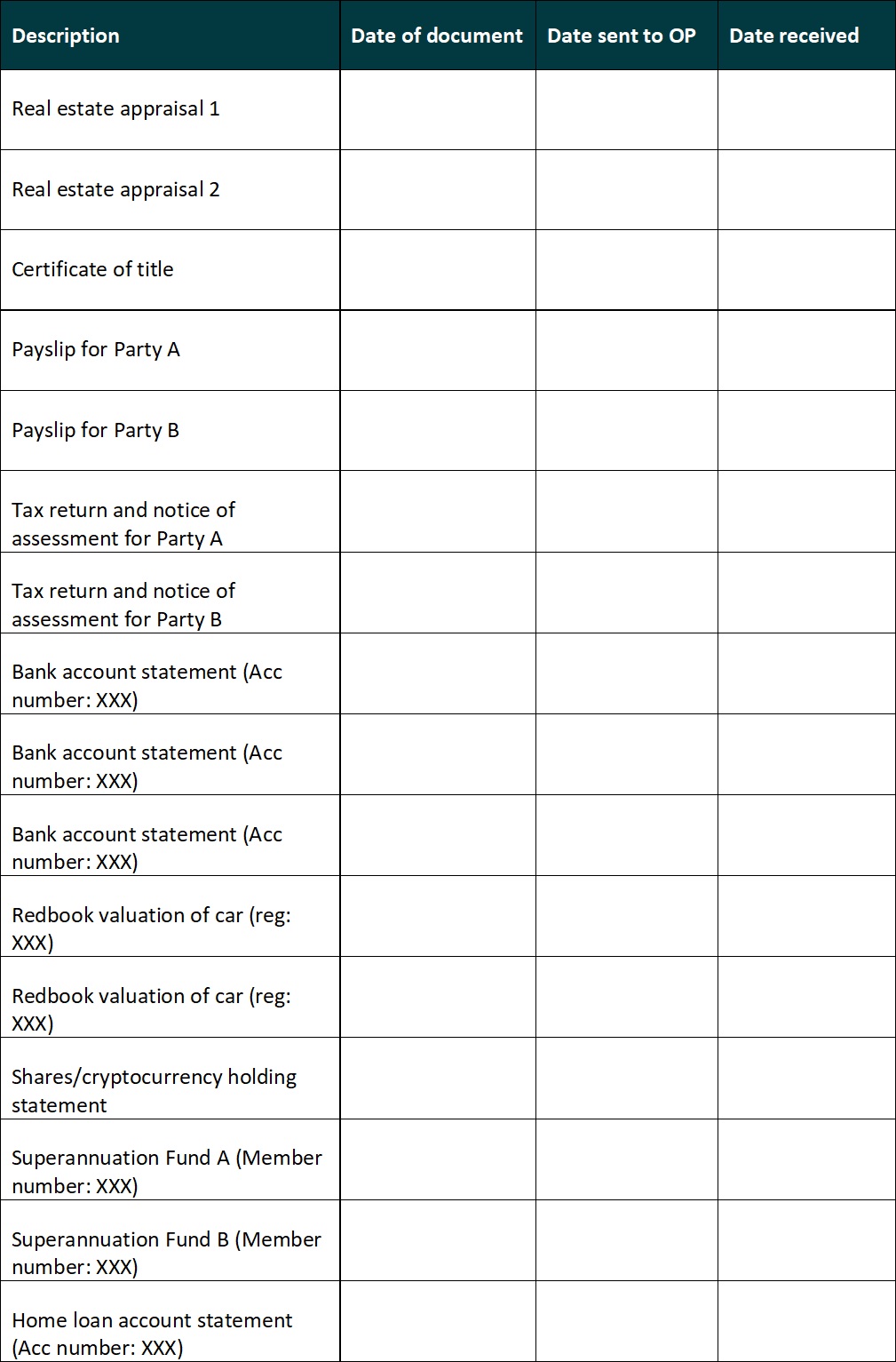
Once you start receiving financial documents from the other party and sending your client’s financial documents, it can be helpful to keep track of the documents in a disclosure list. You can keep track of what document was sent, the date of the document, and when it was sent or received.
Having a disclosure list makes it easier to cross-check what documents are missing and what documents need to be updated. You can use the example below:

Create an Asset & Liability Schedule
An Asset & Liability Schedule is a useful tool to record what property there is to divide and what percentage of the asset pool each person receives. Adjusting the Schedule when making offers and counter-offers of settlement allows you to calculate how much each person would receive. You can use the example below:
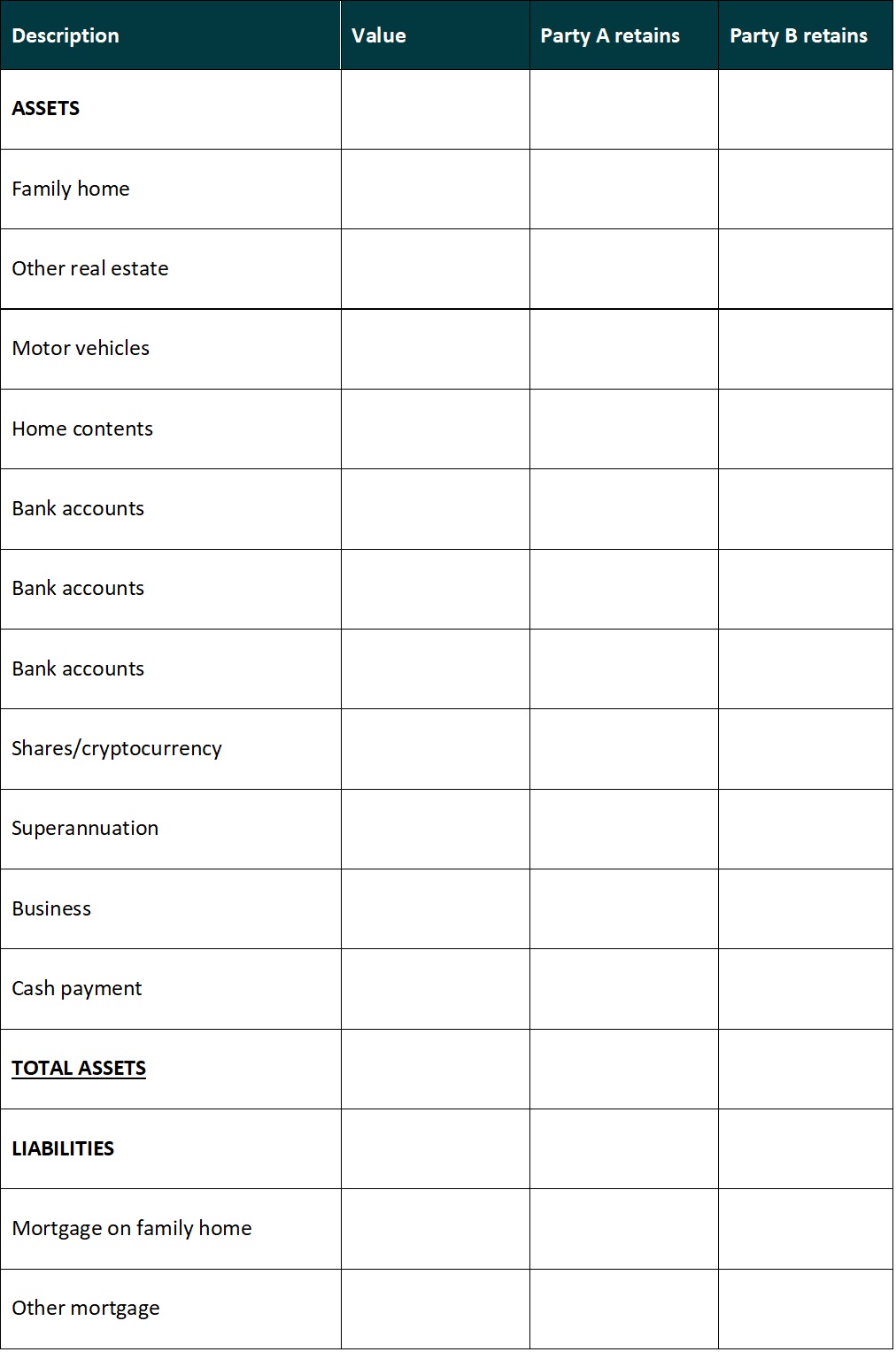
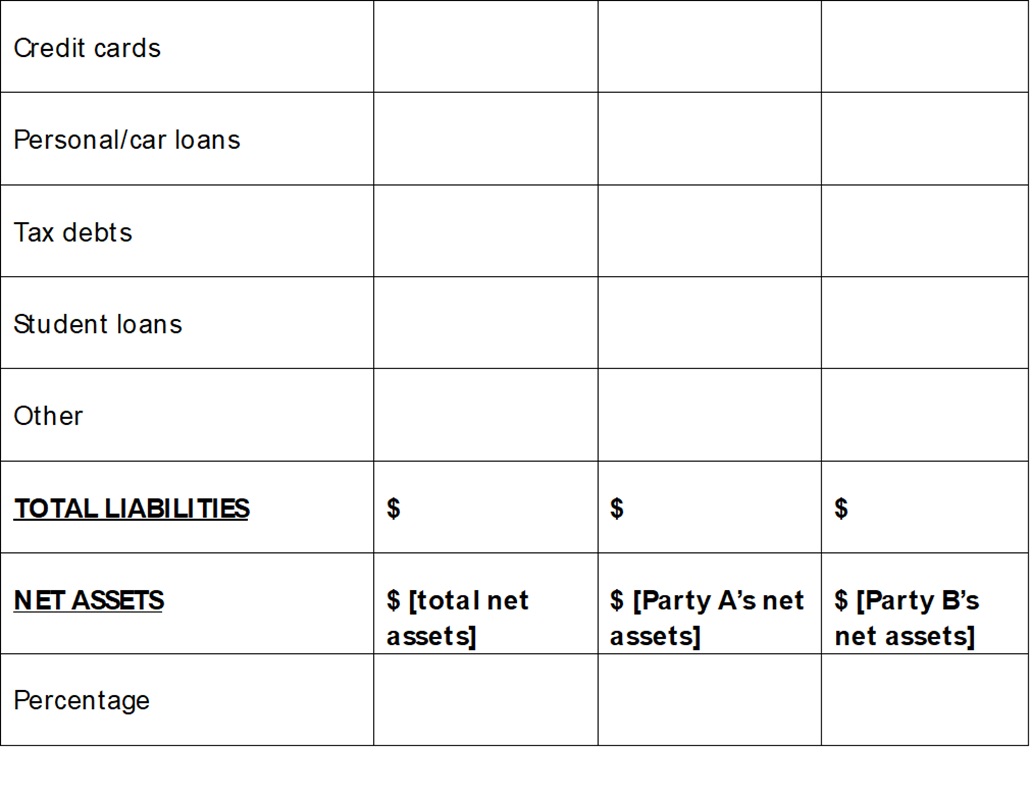
To calculate each party’s percentage of property division, divide that party’s net assets with the total net assets.
Step 2: Advise about range of entitlement
Take instructions on the history of your client’s relationship, what financial and non-financial contributions each party made to the relationship, including as homemaker and parent and what current and future needs each person has. Take instructions on any family violence and if Family Violence Restraining Orders exist.
You will then be able to give your client a 10-15% range of what they are entitled to, based on their instructions and considering the factors in section 79 (FLA) or sections 205ZD and 205ZG (FCA). For example, your client might be entitled to 40-50% of the net asset pool. This range could change depending on disclosure received from the other party and if your client’s circumstances change.
Initial contributions
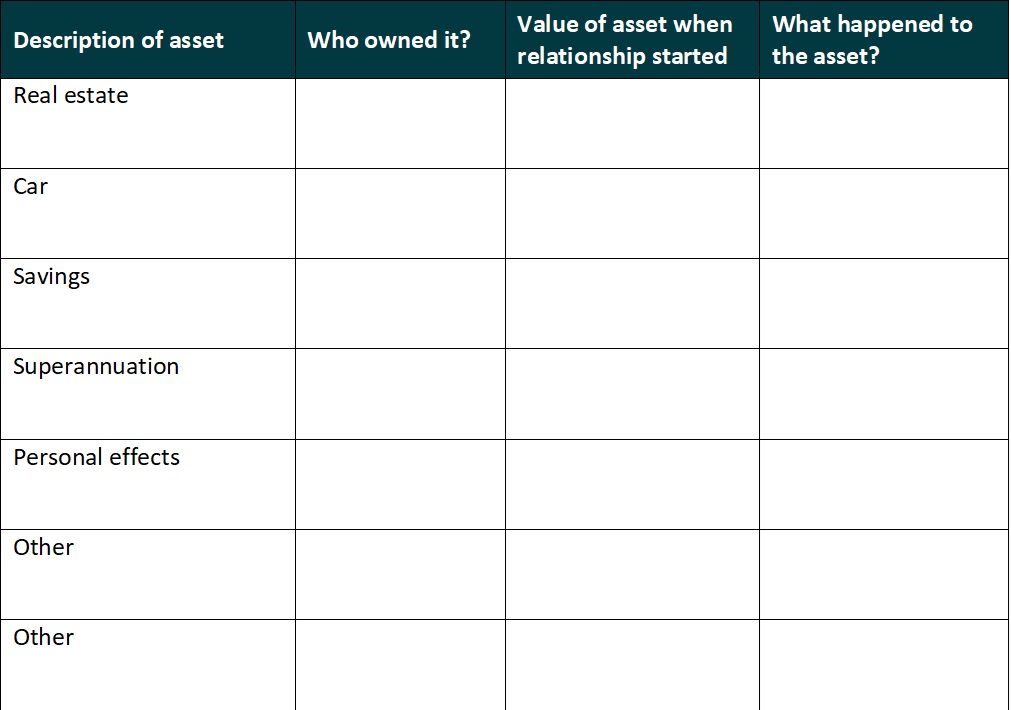
Use this table to work out the assets brought by your client and the other party into the relationship. Use an estimate of the value of the assets when the relationship started. Explain what happened to the asset. For example, was it sold, given away, or does either party still have it? If it was sold, what happened to the money from the sale?
Table 1
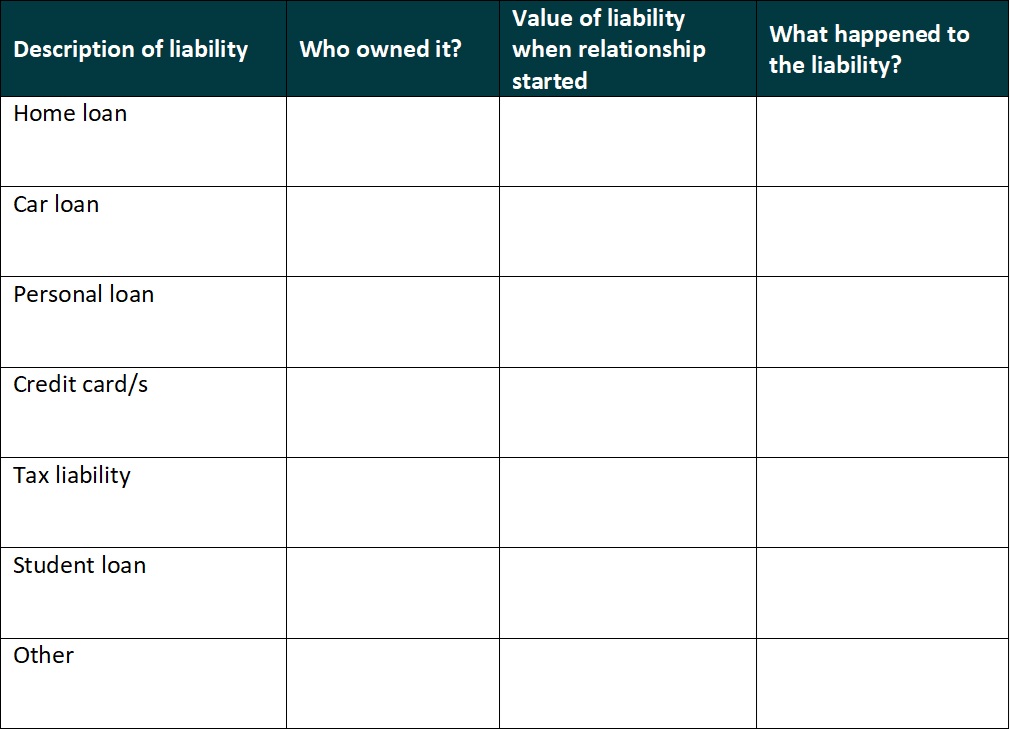
Use this table to work out the liabilities brought by the parties into the relationship. Use an estimate of the value of the liabilities when the relationship started. Explain what happened to the liability. For example, was it paid off, when was it paid off, who paid it off, or is the liability still owing?
Table 2
Contributions during the relationship
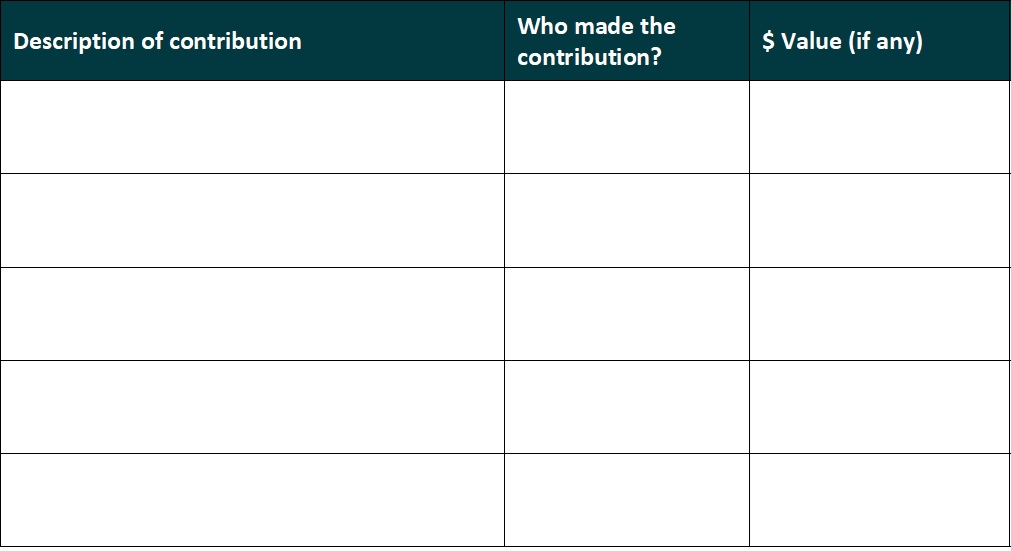
Use this table to work out the financial and non-financial (including homemaker and parent) contributions made by the parties during the relationship. Where possible, use an estimate of the value but be aware that many contributions may not have a financial value.
Some questions to consider are:
- Who worked outside the home during the relationship? How much did they earn?
- Who stayed home to look after any children?
- Who organised and took the children to school, medical appointments, extra-curricular activities?
- Who undertook domestic tasks like housework, cooking, cleaning, laundry?
- Who paid for household expenses or was it shared?
- Did either party improve any property, such as by undertaking repairs and renovations?
- Did either party receive any inheritance, or gifts from family members?
- Did either party receive any compensation pay-out or windfall such as lottery?
- Are there allegations of family violence, and if so, what has been the effect of the family violence on one person’s ability to make contributions?
Table 3
Contributions after separation
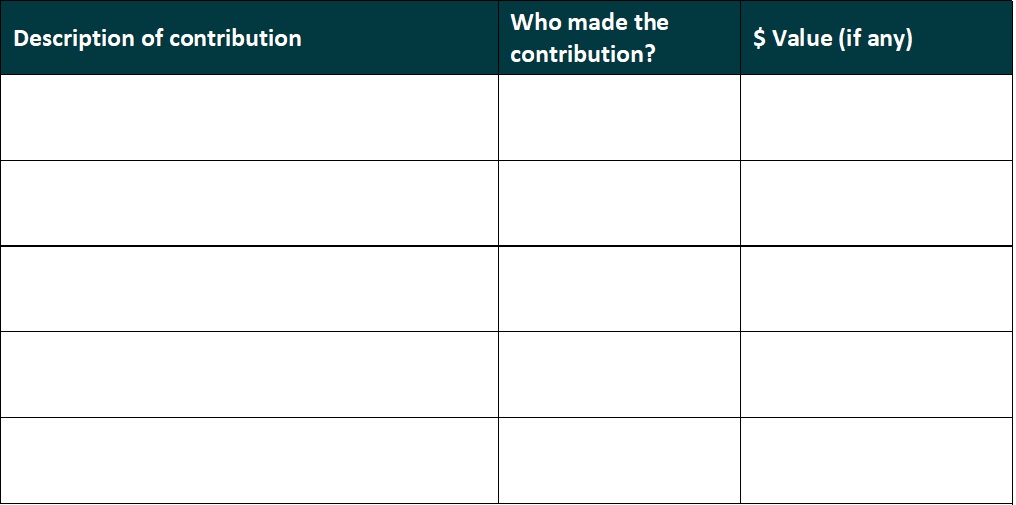
Use this table to work out the contributions made by the parties after the relationship ended. Use an estimate of the value of the contributions where possible.
Some questions to consider are:
- Who stayed in the home and who moved out and/or rented?
- How was the mortgage paid?
- Who paid for any repairs or renovation to the home?
- Who paid for school fees, medical expenses and other costs?
- Who pays child support and how much?
- Who is caring for children or dependent family members?
- Did either party sell, give away or dispose of any assets? If so, what happened to the asset and/or the money from the sale?
Table 4
Assessment of contributions
This step involves carefully considering the contributions in Table 1 – 4 and deciding what percentage split would be a fair division of property based on contributions alone. For example, the parties made equal contributions such that a 50/50% division is fair, or Party A made greater contributions such that a 70/30% division is fair.
Current and future needs
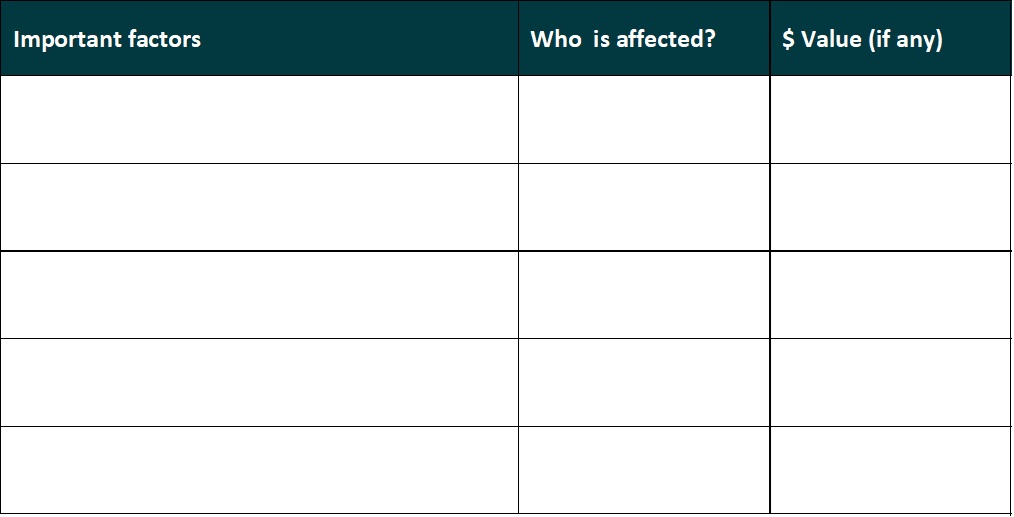
Use this table to work out what current and future needs the parties have.
Some questions to consider are:
- What are the parties’ ages, and what is the status of their mental and physical health?
- Do either party work and how much do they earn?
- How much could either of them earn in the future?
- Is either party responsible for the care of any children, or other dependent person?
- Is either party eligible for a pension, allowance or benefit?
- Is either party paying child support and how much?
- How long was the relationship and how did that affect each person’s ability to earn income?
- Are there allegations of family violence and if so, what is the effect of the family violence on a person’s current and future needs?
Table 5
Assessment of needs
This step involves carefully considering the current and future needs of both people in Table 5 and deciding what percentage should be added or subtracted from the percentage split earlier.
Overall assessment of property division
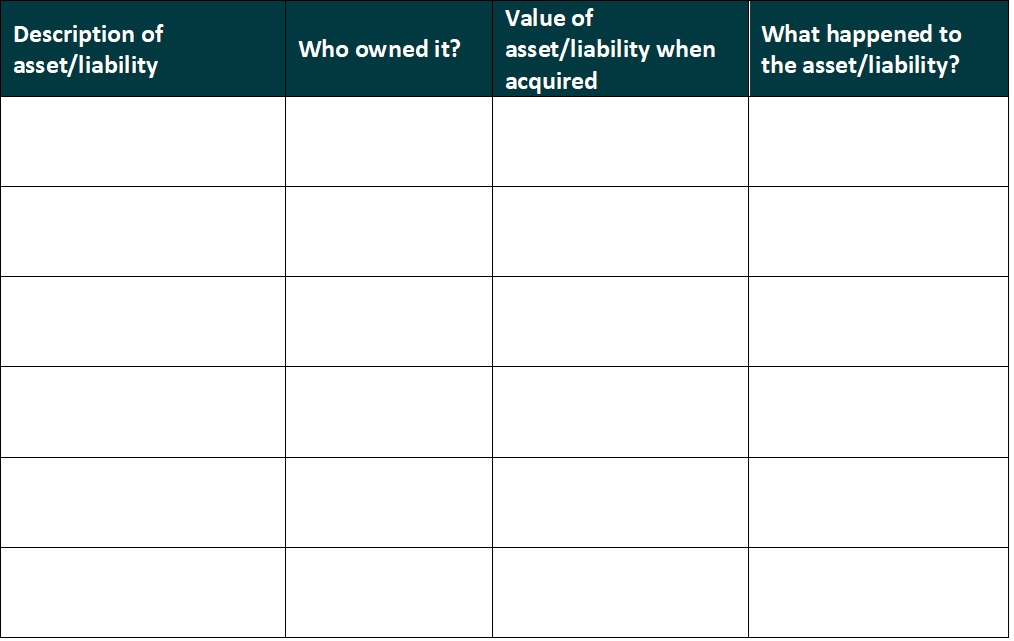
Use this table to update assets and liabilities acquired during the relationship.
Table 6
The court must not make an order altering interests in property (even by consent) unless it is just and equitable to make the order (s 79(2) FLA and s 205ZG(3) FCA).
The term “just and equitable” has a special meaning in family law, and is based on the law and previous cases that have been decided. The court considers a wide variety of factors when deciding whether the proposed division of property is just and equitable.
Assess whether the court would consider the overall percentage division of property between the two parties to be just and equitable.
For example, both parties contributed equally during the relationship, so a 50/50% division of property is fair. Taking into account the parties’ current and future needs, a 10% adjustment to Party A is necessary, so overall a 60/40% division of property in Party A’s favour is just and equitable.
What about pets? Companion animals
Family law treats animals as property to be divided like any other type of property. You may need to consider whether your client’s property settlement should include any animals. You do not have to include animals in an agreement or consent orders (or seek orders about them) if there is no dispute about who will be responsible for them following separation.
As of 10 June 2025, the FLA was amended by the Family Law Amendment Act 2024 (Cth) and there have been changes to the law about family pets (“companion animals”). Where parties cannot agree about the ownership of companion animals following separation, the court can consider this dispute separate from other property under section 79(6) FLA. These changes will apply in all cases commenced on or before 10 June 2025 (except cases in which a trial commenced before 10 June 2025).
These changes do not apply in cases where parties were not married, who are covered by the FCA (that is, the court will treat disputes about pets in the same way as other property to be divided).
“Companion animals” are defined in section 4(1) FLA as animals kept primarily for companionship. Companion animals do not include assistance animals or animals kept as part of a business, for agricultural purposes or for use in laboratory tests or experiments. Animals kept for more than one purpose are not considered companion animals (e.g., a working sheep dog that is also a companion).
The Explanatory Memorandum to the Family Law Amendment Bill 2024 (Cth) notes that animal abuse is a recognised form of family violence and that family pets may be used as a tool of coercion and control. The amendments aim to assist victim-survivors to retain the companion animal in property proceedings.
If a dispute about a companion animal goes to court, under section 79(7) FLA the court must consider things like:
- the circumstances in which the companion animal was acquired
- who has ownership or possession of the companion animal
- the extent to which each party cared for, and paid for the maintenance of, the companion animal
- any family violence to which one party has subjected or exposed the other party
- any history of actual or threatened cruelty or abuse by a party towards the companion animal
- any attachment by a party or a child of the marriage to the companion animal
- the demonstrated ability of each party to care for and maintain the animal in the future without the support or involvement of the other party
- any other factor circumstance which, in the opinion of the court, the justice of the case requires to be taken into account.
The court has a broad discretion to assess and weigh these factors. Under section 79(6) FLA, the court can order that:
- only one party is to have ownership of the companion animal;
- the companion animal be transferred to another person who has consented to the transfer; or
- the companion animal be sold.
The court cannot make an order for shared ownership, shared care or shared responsibility for the costs of a companion animal. This means that consent orders cannot propose joint ownership or possession of a companion animal or joint responsibility for their costs.
Parties might want to make separate, informal arrangements for their pet’s care. Some families make these arrangements in the context of their parenting arrangements. For example, they might agree that the family pet stays with a child as they move between homes.
The first instance decision of Ziskind & Greco (No 2) [2026] FedCFamC1F 378 provides an example of how the court approaches companion animal cases (see [233] onwards). Here, both parties applied to keep the family dog, and the court granted the mother’s application. The court held the dog was a companion animal (at [242]) and considered the relevant s 79(7) FLA factors (at [243]-[253]). The court found at [254]-[255] that the mother was responsible for the dog’s care and maintenance until separation and that putting the dog in the mother’s care would mean the children spent more time with the dog (both parties agreed the children had a close attachment to the dog).
Step 3: Negotiating and making offers
Once you have exchanged disclosure with the other party and have given advice about your client’s range of entitlement to the asset pool, it is time to begin negotiations.
Negotiations can occur in writing by exchanging letters with the other party, or by attending FDR.
Some common ways that property can be divided (either by people reaching an agreement or by the court making a decision) are:
- one person makes a cash payment to the other person (this could be paid in a lump sum or over time)
- one person keeps the home (and usually the home loan)
- both people decide to sell the home and divide the sale proceeds
- one person splits their superannuation and transfers an amount into a superannuation account in the other person's name
- one person transfers a motor vehicle to the other person
- both people agree to be responsible for their own debts, and
- both people agree to keep the money and personal items which belong to them.
It is a good idea to include an Asset & Liability Schedule with the suggested split of assets in your negotiation letter.
It is common to exchange at least two offers and counter-offers with the other party. If you are unable to progress further however, the next step is to invite the other party to FDR.
It is suggested to use the words “Without prejudice save as to costs” in any offer letter. This means you are making a confidential offer during negotiations, without affecting your client’s legal rights in court. A letter marked as ‘without prejudice’ cannot be used by the other party as evidence in court.
There may be times when you wish to make an ‘open offer’, that is an offer that can be used by either party as evidence in court. This can be when you want the court to know you made a reasonable offer and if you are seeking costs, for example.
Step 4: Attending Family Dispute Resolution (FDR)
If the parties have exchanged disclosure documents and made offers of settlement without success, the next step is to attend FDR. FDR is a voluntary mediation process where a qualified independent family dispute resolution practitioner helps people affected by separation to resolve their disputes with each other regarding the division of their property.
Confidentiality of FDR process
FDR is a confidential process unless the disclosure is required or authorised by section 10H FLA (s 53 FCA).
A communication (including an admission) disclosed during FDR may be disclosed by an FDR practitioner if consent is given by the person who made the communication.
An FDR Practitioner is required to disclose a communication if:
- They believe the disclosure is necessary for the purpose of complying with a law of the Commonwealth, State or Territory (s 10H(2) FLA and s 53(2) FCA).
- If they reasonably believe that the disclosure is necessary for the purpose of:
- protecting a child from the risk of harm (whether physical or psychological),
- preventing or lessening a serious and imminent threat to the life or health of a person,
- reporting the commission, or preventing the likely commission, of an offence involving violence or a threat of violence to a person,
- preventing or lessening a serious and imminent threat to the property of a person,
- reporting the commission, or preventing the likely commission, of an offence involving intentional damage to property of a person or a threat of damage to property, or
- if an independent children’s lawyer is representing a child’s interests, assisting the lawyer to do so properly (s 10H(4) FLA and s 53(4) FCA).
Exemptions
Parties may skip FDR (and any or all of the pre-action procedures) by seeking an exemption in certain circumstances, as noted above.
Step 5: Parties reach agreement - consent orders
If the parties can reach agreement, it is a good idea to apply for consent orders from the Family Court of WA.
This formalises the agreement and makes it legally binding. For example, if the orders require a person to list a house for sale or sign transfer papers but they fail to do this, you can apply to the court to enforce the orders.
Step 6: We can't reach agreement - what next?
If the parties make a genuine effort to complete Steps 1 and 2 but are unable to reach an agreement, your client is required to write to the other party setting out:
- they intend to start a property court case
- the issues the parties have been unable to agree about
- what orders or outcome your client wants from the court
- a genuine offer to settle the property dispute, and
- the time they want the other party to respond within (you need to give them at least 2 weeks to respond).
The other party is required to respond setting out the following:
- the issues which are still in dispute
- what orders or outcome they want from the court
- a genuine offer to settle the property dispute, and
- the time they want your client to respond within (they need to give you at least 2 weeks to respond).
If the parties are unable to reach agreement after completing the pre-action procedures, then they may wish to commence a case in the court.
More information
- The Family Court of WA website provides more information about pre-action procedures.
- Fact sheet - Family Dispute Resolution at Legal Aid WA property
- Information sheet - Preparing for mediation property
- Family Law Property Starter Kit
Reviewed: 10 September 2026