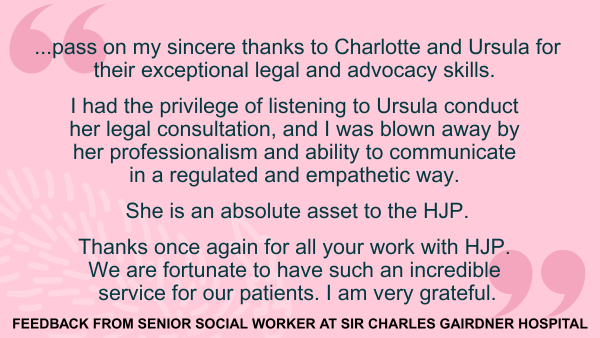
“Thanks… for all your work with HJP. We are fortunate to have such an incredible service for Sir Charles Gairdner Hospital patients. I am very grateful.”
This feedback was received in February from a Senior Social Worker at Sir Charles Gairdner Hospital – one of the hospitals where Legal Aid WA has established a Health Justice Partnership (HJP).
The HJP program is a collaboration between Legal Aid WA and East Metropolitan Health Service, North Metropolitan Health Service, South Metropolitan Health Service, and Child and Adolescent Health Service.
This collaboration has our lawyers based at Royal Perth Hospital, Bentley Health Service, Sir Charles Gairdner Hospital, Fiona Stanley Hospital, Perth Children’s Hospital, and Armadale Hospital, delivering legal services to vulnerable patients in each of these hospitals.
By bringing legal help into healthcare settings, we aim to effectively address clients’ interconnected health and legal issues, such as debt, mortgage hardship, tenancy, employment, family breakdown, and domestic and family violence.
For example, a person who is very ill over a prolonged period may become unable to work, lose their employment or become unable to pay their mortgage. Reaching clients at a crucial point can enable the HJP to prevent problems from escalating and provides a holistic model of service through the collaboration between health and legal services.
A day in the life of a Health Justice Partnership lawyer
A day in the life of an HJP solicitor is dynamic, collaborative, and purpose driven, balancing legal expertise with community engagement and social impact.
An HJP lawyer must be:
- trauma-informed, due to the vulnerability of our clients who have often found themselves in extreme situations,
- flexible, as we must fit in with our clients’ medical treatment, which can change without notice,
- resilient, as we face our clients’ trauma, physical injuries, and/or mental illness,
- willing to engage with hospital stakeholders, so that we work as a collaborative team, and
- passionate about social justice and public health, to address our clients’ intersecting needs.
Our day starts in a dedicated HJP office in the partnered hospital. Each of our hospital-based offices were set up to provide us with a convenient space to conduct our work and hold our in person and/or phone appointments.
We also need to be prepared to go to our clients who often have special medical requirements and are unable to attend the HJP office. This means that we need to be familiar with the layout of the hospital and find where the various wards are located.
Referrals are received in advance from hospital social workers who identify vulnerable and disadvantaged patients who have intersecting health and legal problems. Appointments provide an opportunity to receive comprehensive instructions from our clients to triage their legal matters.
At this point we will provide legal advice if the matter is within our area of expertise, undertake associated legal tasks to assist the client, and facilitate referrals to other internal Legal Aid WA or external services to ensure the client receives the legal assistance they require.
Health Justice Partnerships
Harry’s story* (not the client’s real name)
Harry was referred to the HJP by a social worker at a partnered hospital for legal advice regarding debts relating to a utility account. Confusion around direct debits from his bank account by the utility provider had resulted in an outstanding amount owing to the provider.
Harry was on the disability support pension and was a hospital inpatient for mental health treatment due to being a victim of a violent crime. He felt triggered when he tried to deal with his debt matters with the utility provider.
Our HJP solicitor was able to advise him about the legal consequences of having an unpaid outstanding debt. Together with Harry, they contacted the utility provider to resolve the matter before it became a legal problem. They made payment plan arrangements with the provider to cover the outstanding debt, and set up an appropriate ongoing direct debit arrangement.
Harry disclosed that he had other outstanding bills that he was trying to get on top of as well as court fines. The HJP solicitor assisted by referring him to a financial counsellor for the outstanding bills and to Legal Aid WA’s Work and Development Permit (WDP) service for options relating to the unpaid court fines.
After disclosing to the HJP solicitor that he was a victim of a serious crime, including that he was admitted to hospital for mental distress following the incident, the HJP solicitor referred Harry to the victims of crime unit and advised him of his potential entitlement to criminal injury compensation.
Harry was extremely vulnerable with multiple legal matters and without the HJP and the accessibility of a solicitor in the hospital, he would not otherwise have sought legal assistance. The trust that developed during the appointment resulted in the disclosure of Harry’s additional legal problems that required advice and attention from the HJP solicitor.