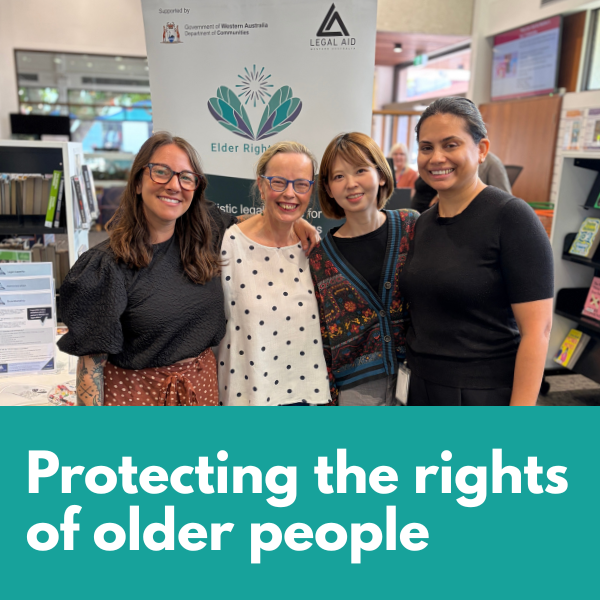
 Elder Rights WA is Legal Aid WA's specialist service for older people. It was established in 2022 to provide legal assistance, advocacy, and support to older people experiencing or at risk of experiencing elder abuse or mistreatment.
Within the aging population, the legal issues affecting older people are becoming increasingly complex, and can impact their rights, safety, autonomy, and their wellbeing.
Our Elder Rights WA team combines specialist legal expertise with social work support, providing a holistic service to address interconnected legal, financial, family, and social issues typically faced by clients.
They interact with clients experiencing elder abuse across a range of forms: psychological, physical, social, sexual, cultural, spiritual, financial abuse, and/or neglect. The abuse may, and often does, come from someone the client trusts. Compounding the situation, clients may also live with disability, mental ill-health, financial stress, or feel grief and significant shame from the abuse.
A number of trends have been identified by our team recently in clients approaching Elder Rights WA for assistance.
Older Women at Risk of Homelessness
One of the most concerning trends is the growing number of older women facing housing insecurity and homelessness.
Many of these women have experienced relationship breakdowns later in life, have limited superannuation or savings, or have spent years in unpaid caring roles, affecting their long-term financial security. The current economic environment, cost of living, rising housing costs, and rental shortages compound the situation.
The Elder Rights WA team have engaged with older people who have been asked to leave family homes and are unable to afford private rentals. Similarly, there are those who had informal living arrangements with family members that have since broken down.
“Inheritance Impatience”
Recently the team have identified a trend of what is becoming known as "Inheritance Impatience". This is a situation where adult children or other family members approach an older person with the aim of accessing their assets during their lifetime.
Inheritance Impatience doesn’t always involve deliberate or intentional abuse, which can make it difficult for the older person to understand that the pressure placed on them to transfer property, provide loans, change wills, appoint attorneys, guarantee debts, or make significant financial gifts, is actually a breach of their rights.
Growing Complexity in State Administrative Tribunal Matters
Our specialist service is also experiencing increasing demand for assistance in guardianship and administration matters before the State Administrative Tribunal.
As people live longer and the prevalence of cognitive impairment and dementia increases, families are more frequently navigating questions about decision-making capacity, financial management, and care arrangements.
Elder Rights WA in the Community
As well as providing reactive legal and social support services when clients approach Elder Rights WA for assistance, a major part of the team’s activities is being present where older people are, providing education, and raising awareness about the rights of older people and how to safeguard them.
Through community legal education sessions, outreach activities, partnerships with other frontline service providers, and interacting with local governments, aged care providers and community organisations, our Elder Rights WA team aims to reduce and eventually eliminate elder abuse and mistreatment.
This journey begins by raising awareness of the abuse and mistreatment of older people, educating the public about advanced planning and legal documents, and speaking not just with older people, but with the community at large. In some cases, the abuse may be unintentional, so education is key.
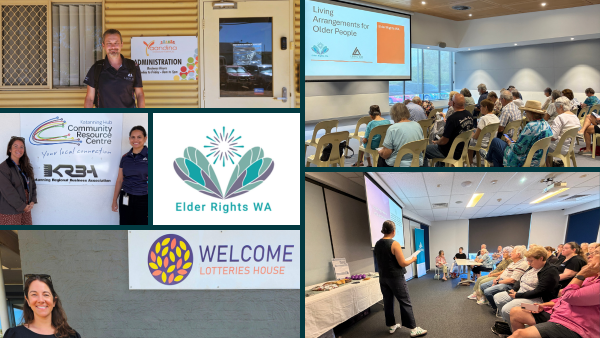 In 2026, our Elder Rights WA team have been making an impact in regional WA
In March, the team travelled to the south of WA and partnered with a number of local organisations to run free community information sessions for older local people.
In Katanning they partnered with the Katanning Community Resource Centre, then travelled down to the coast and ran two sessions in Albany. The first was a community information session run in partnership with the City of Albany, while the second was a networking workshop with Great Southern Community Legal Services. That workshop involved discussions about the legal needs of older people in the Great Southern region, and shared resources and insights in order to provide more comprehensive support and streamlined referral pathways for people in need of legal assistance. This regional tour ended in Manjimup at the Manjimup Community Resource Centre, where a large number of attendees listened to the presentation explaining important legal documents like the Enduring Power of Attorney and Enduring Power of Guardianship, as well as information and tips to help safeguard their rights as they age.
In April, the team headed to the north and delivered information sessions to older people and those caring for them across the Pilbara region.
First stop was a presentation to staff at Karlarra House Aged Care Facility in South Hedland, operated by the WA Country Health Service. Next, the team connected with Yaandina Aged Care Centre in Roebourne. With a strong focus on First Nations Elders, Yaandina is a residential aged care facility in the Pilbara that supports older people to age with dignity in a culturally safe environment, while maintaining connections to family, community, and Country. While in town, the team stopped to visit and build connection with Val and Kathy’s Crafty Kitchen, a community initiative supporting and celebrating Ngarluma Elders. The last stop of the Pilbara tour was Karratha, where the team partnered with the City of Karratha for a community information session.
This month, the team will travel east to the Goldfields region. On World Elder Abuse Awareness Day (June 15) the team will hold a community information session at the Coolgardie Community Resource Centre.
In Kalgoorlie, they will present another community information session, this time in partnership with the City of Kalgoorlie, before a networking session for local service providers in the greater Goldfield region to find out more about Elder Rights WA, hosted by Legal Aid WA’s Goldfields-Esperance office in Kalgoorlie. From there, they will travel to the Shire of Esperance and end the tour at the Hopetoun Community Resource Centre later that week.
These regional road trips are essential to provide equitable access to justice and empower older people living in regional and remote areas. A commitment to meeting older people where they are is an integral part of the Elder Rights WA service.
In the Perth Metropolitan region, Elder Rights WA have been working closely with Local Governments, holding (or planning to hold) sessions in Canning, Swan, Rockingham, Wanneroo, Pinjarra, and the Shire of Serpentine over the first six months of this year.
Recognising the significance of World Elder Abuse Awareness Day, the team will participate in a panel event facilitated by Relationships Australia, hosted by the City of Mandurah. They will share their insights and knowledge on topics including supports available for Culturally and Linguistically Diverse and First Nations backgrounds people, how Elders Rights WA can support someone who is experiencing abuse but does not want to involve courts or lawyers, and complex legal issues that can eventuate from family breakdowns.
Through proactive education and engagement work, Elder Rights WA contributes not only to improving outcomes for individual clients but also to working towards a broader culture shift that values the autonomy, dignity, and rights of older people.
Elder Rights WA is a free service delivered by Legal Aid WA, supported by the Department of Communities.